 |
PDBsum entry 1oyc

|
|
|
|
|
|

|

|

|

|
|

|
|

|
|

|
|

|
|
|
 |

|

|
|
|
|
|
|
|
|
|
|
|
|
|
|
|
|
|
|
|
|
|
|
|
|
|
|
|
|
|
|
|
|
|
Oxidoreductase(flavoprotein)
|
PDB id
|
|
|
|
1oyc
|
|
|
|
|
|
|
|
|
|
|
|
|
|
|

|

|

|
|
|
|
|
|
|
|
 |
Contents |
 |
|
|
|
|
|
|
|
|
|
|
|
|
* Residue conservation analysis
|
|
|
|
|
|
|
|
|
|
|
Enzyme class:
|
|
E.C.1.6.99.1
- Nadph dehydrogenase.
|
|
|
|
|
|
|
Reaction:
|
|
A + NADPH + H+ = AH2 + NADP+
|
|
|
|
|
|
|
+
|
 NADPH
NADPH
|
+
|
H(+)
|
=
|
AH2
|
+
|
 NADP(+)
|
|
|
|
|
|
|
|
|
|
Cofactor:
|
|
FMN or FAD
|
|
|
|
|
|
FMN
Bound ligand (Het Group name =
FMN)
corresponds exactly
|
or
|
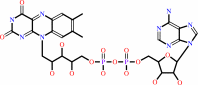 FAD
FAD
|
|
|
|
|
|
|
Molecule diagrams generated from .mol files obtained from the
KEGG ftp site
|
|
|
|
|
|
|
|
|
|
|
|
|
|
 |
|
|
|
|
|
|
| |
|
|
| |
|
DOI no:
|
Structure
2:1089-1105
(1994)
|
|
PubMed id:
|
|
|
|
|
|
| |
|
Old yellow enzyme at 2 A resolution: overall structure, ligand binding, and comparison with related flavoproteins.
|
|
K.M.Fox,
P.A.Karplus.
|
|
|
|
|
| |
ABSTRACT
|
|
|
|
| |
|
|
BACKGROUND: Old yellow enzyme (OYE) was the first flavoenzyme purified, but its
function is still unknown. Nevertheless, the NADPH oxidase activity, the flavin
mononucleotide environment and the ligand-binding properties of OYE have been
extensively studied by biochemical and spectroscopic approaches. Full
interpretation of these data requires structural information. RESULTS: The
crystal structures of oxidized and reduced OYE at 2 A resolution reveal an
alpha/beta-barrel topology clearly related to trimethylamine dehydrogenase.
Complexes of OYE with p-hydroxybenzaldehyde, beta-estradiol, and an NADPH analog
show all three binding at a common site, stacked on the flavin. The putative
NADPH binding mode is novel as it involves primary recognition of the
nicotinamide mononucleotide portion. CONCLUSIONS: This work shows that the
striking spectral changes seen upon phenol binding are due to close physical
association of the flavin and phenolate. It also identifies the structural class
of OYE and suggests that if NADPH is its true substrate, then OYE has adopted
NADPH dependence during evolution.
|
|
|
|
|
|
| |
Selected figure(s)
|
|
|
|
| |
|
|

|
|

|
|
Figure 13.
Figure 13. Comparison of PHB, BED and (c–THN)TPN binding.
Shown are FMN, His191 and Asn194 from the native structure
(yellow) overlayed with the bound conformations of PHB (green),
BED (red) and the ordered portion of (c–THN)TPN (violet).
Arrows indicate the two hydrogen bonds donated to ligand oxygens
which appear to be major determinants of binding. Figure
13. Comparison of PHB, BED and (c–THN)TPN binding. Shown are
FMN, His191 and Asn194 from the native structure (yellow)
overlayed with the bound conformations of PHB (green), BED (red)
and the ordered portion of (c–THN)TPN (violet). Arrows
indicate the two hydrogen bonds donated to ligand oxygens which
appear to be major determinants of binding.
|
|
Figure 15.
Figure 15. Comparison of FMN in the oxidized (yellow) and
reduced (green) states. The refined structures are shown for
FMN, His191 and Asn194. Two preferred water sites seen in the
reduced state are also included. Difference electron density is
shown contoured at +4.0 ρ[rms] (violet) and –4.0 ρ[rms]
(red). The large negative peak reflects the loss of the chloride
ion. Figure 15. Comparison of FMN in the oxidized (yellow)
and reduced (green) states. The refined structures are shown for
FMN, His191 and Asn194. Two preferred water sites seen in the
reduced state are also included. Difference electron density is
shown contoured at +4.0 ρ[rms] (violet) and –4.0 ρ[rms]
(red). The large negative peak reflects the loss of the chloride
ion.
|
|
|
|
|
|
| |
The above figures are
reprinted
by permission from Cell Press:
Structure
(1994,
2,
1089-1105)
copyright 1994.
|
|
| |
Figures were
selected
by an automated process.
|
|
|
|
|
|
|
|
|
|
|
|
|
|
|
|
 |
 |
 |
|
Literature references that cite this PDB file's key reference
|
|
|
| |
PubMed id
|
|
Reference
|
|
|
|
|
|
H.S.Toogood,
A.Fryszkowska,
M.Hulley,
M.Sakuma,
D.Mansell,
G.M.Stephens,
J.M.Gardiner,
and
N.S.Scrutton
(2011).
A site-saturated mutagenesis study of pentaerythritol tetranitrate reductase reveals that residues 181 and 184 influence ligand binding, stereochemistry and reactivity.
|
| |
Chembiochem,
12,
738-749.
|
|
|
PDB codes:
|
|
|
|
|
|
|
|
N.Richter,
H.Gröger,
and
W.Hummel
(2011).
Asymmetric reduction of activated alkenes using an enoate reductase from Gluconobacter oxydans.
|
| |
Appl Microbiol Biotechnol,
89,
79-89.
|
|
|
|
|
|
|
W.Li,
F.Zhou,
B.Liu,
D.Feng,
Y.He,
K.Qi,
H.Wang,
and
J.Wang
(2011).
Comparative characterization, expression pattern and function analysis of the 12-oxo-phytodienoic acid reductase gene family in rice.
|
| |
Plant Cell Rep,
30,
981-995.
|
|
|
|
|
|
|
C.Stueckler,
N.J.Mueller,
C.K.Winkler,
S.M.Glueck,
K.Gruber,
G.Steinkellner,
and
K.Faber
(2010).
Bioreduction of alpha-methylcinnamaldehyde derivatives: chemo-enzymatic asymmetric synthesis of Lilial and Helional.
|
| |
Dalton Trans,
39,
8472-8476.
|
|
|
|
|
|
|
M.E.Hulley,
H.S.Toogood,
A.Fryszkowska,
D.Mansell,
G.M.Stephens,
J.M.Gardiner,
and
N.S.Scrutton
(2010).
Focused directed evolution of pentaerythritol tetranitrate reductase by using automated anaerobic kinetic screening of site-saturated libraries.
|
| |
Chembiochem,
11,
2433-2447.
|
|
|
PDB codes:
|
|
|
|
|
|
|
|
Y.Yanto,
M.Hall,
and
A.S.Bommarius
(2010).
Nitroreductase from Salmonella typhimurium: characterization and catalytic activity.
|
| |
Org Biomol Chem,
8,
1826-1832.
|
|
|
|
|
|
|
A.Fryszkowska,
H.Toogood,
M.Sakuma,
J.M.Gardiner,
G.M.Stephens,
and
N.S.Scrutton
(2009).
Asymmetric Reduction of Activated Alkenes by Pentaerythritol Tetranitrate Reductase: Specificity and Control of Stereochemical Outcome by Reaction Optimisation.
|
| |
Adv Synth Catal,
351,
2976-2990.
|
|
|
|
|
|
|
C.R.Pudney,
S.Hay,
and
N.S.Scrutton
(2009).
Bipartite recognition and conformational sampling mechanisms for hydride transfer from nicotinamide coenzyme to FMN in pentaerythritol tetranitrate reductase.
|
| |
FEBS J,
276,
4780-4789.
|
|
|
|
|
|
|
H.Nivinskas,
J.Sarlauskas,
Z.Anusevicius,
H.S.Toogood,
N.S.Scrutton,
and
N.Cenas
(2008).
Reduction of aliphatic nitroesters and N-nitramines by Enterobacter cloacae PB2 pentaerythritol tetranitrate reductase: quantitative structure-activity relationships.
|
| |
FEBS J,
275,
6192-6203.
|
|
|
|
|
|
|
H.S.Toogood,
A.Fryszkowska,
V.Hare,
K.Fisher,
A.Roujeinikova,
D.Leys,
J.M.Gardiner,
G.M.Stephens,
and
N.S.Scrutton
(2008).
Structure-Based Insight into the Asymmetric Bioreduction of the C=C Double Bond of alpha,beta-Unsaturated Nitroalkenes by Pentaerythritol Tetranitrate Reductase.
|
| |
Adv Synth Catal,
350,
2789-2803.
|
|
|
|
|
|
|
K.C.Ehrlich,
L.L.Scharfenstein,
B.G.Montalbano,
and
P.K.Chang
(2008).
Are the Genes nadA and norB Involved in Formation of Aflatoxin G(1)?
|
| |
Int J Mol Sci,
9,
1717-1729.
|
|
|
|
|
|
|
M.D.Roldán,
E.Pérez-Reinado,
F.Castillo,
and
C.Moreno-Vivián
(2008).
Reduction of polynitroaromatic compounds: the bacterial nitroreductases.
|
| |
FEMS Microbiol Rev,
32,
474-500.
|
|
|
|
|
|
|
A.Müller,
B.Hauer,
and
B.Rosche
(2007).
Asymmetric alkene reduction by yeast old yellow enzymes and by a novel Zymomonas mobilis reductase.
|
| |
Biotechnol Bioeng,
98,
22-29.
|
|
|
|
|
|
|
O.Odat,
S.Matta,
H.Khalil,
S.C.Kampranis,
R.Pfau,
P.N.Tsichlis,
and
A.M.Makris
(2007).
Old yellow enzymes, highly homologous FMN oxidoreductases with modulating roles in oxidative stress and programmed cell death in yeast.
|
| |
J Biol Chem,
282,
36010-36023.
|
|
|
|
|
|
|
D.C.Lamb,
Y.Kim,
L.V.Yermalitskaya,
V.N.Yermalitsky,
G.I.Lepesheva,
S.L.Kelly,
M.R.Waterman,
and
L.M.Podust
(2006).
A second FMN binding site in yeast NADPH-cytochrome P450 reductase suggests a mechanism of electron transfer by diflavin reductases.
|
| |
Structure,
14,
51-61.
|
|
|
PDB codes:
|
|
|
|
|
|
|
|
D.van den Hemel,
A.Brigé,
S.N.Savvides,
and
J.Van Beeumen
(2006).
Ligand-induced conformational changes in the capping subdomain of a bacterial old yellow enzyme homologue and conserved sequence fingerprints provide new insights into substrate binding.
|
| |
J Biol Chem,
281,
28152-28161.
|
|
|
PDB codes:
|
|
|
|
|
|
|
|
B.G.Fox,
T.E.Malone,
K.A.Johnson,
S.E.Madson,
D.Aceti,
C.A.Bingman,
P.G.Blommel,
B.Buchan,
B.Burns,
J.Cao,
C.Cornilescu,
J.Doreleijers,
J.Ellefson,
R.Frederick,
H.Geetha,
D.Hruby,
W.B.Jeon,
T.Kimball,
J.Kunert,
J.L.Markley,
C.Newman,
A.Olson,
F.C.Peterson,
G.N.Phillips,
J.Primm,
B.Ramirez,
N.S.Rosenberg,
M.Runnels,
K.Seder,
J.Shaw,
D.W.Smith,
H.Sreenath,
J.Song,
M.R.Sussman,
S.Thao,
D.Troestler,
E.Tyler,
R.Tyler,
E.Ulrich,
D.Vinarov,
F.Vojtik,
B.F.Volkman,
G.Wesenberg,
R.L.Wrobel,
J.Zhang,
Q.Zhao,
and
Z.Zolnai
(2005).
X-ray structure of Arabidopsis At1g77680, 12-oxophytodienoate reductase isoform 1.
|
| |
Proteins,
61,
206-208.
|
|
|
PDB code:
|
|
|
|
|
|
|
|
H.Khan,
T.Barna,
N.C.Bruce,
A.W.Munro,
D.Leys,
and
N.S.Scrutton
(2005).
Proton transfer in the oxidative half-reaction of pentaerythritol tetranitrate reductase. Structure of the reduced enzyme-progesterone complex and the roles of residues Tyr186, His181, His184.
|
| |
FEBS J,
272,
4660-4671.
|
|
|
PDB codes:
|
|
|
|
|
|
|
|
H.L.Messiha,
A.W.Munro,
N.C.Bruce,
I.Barsukov,
and
N.S.Scrutton
(2005).
Reaction of morphinone reductase with 2-cyclohexen-1-one and 1-nitrocyclohexene: proton donation, ligand binding, and the role of residues Histidine 186 and Asparagine 189.
|
| |
J Biol Chem,
280,
10695-10709.
|
|
|
|
|
|
|
H.L.Messiha,
N.C.Bruce,
B.M.Sattelle,
M.J.Sutcliffe,
A.W.Munro,
and
N.S.Scrutton
(2005).
Role of active site residues and solvent in proton transfer and the modulation of flavin reduction potential in bacterial morphinone reductase.
|
| |
J Biol Chem,
280,
27103-27110.
|
|
|
|
|
|
|
K.Kitzing,
T.B.Fitzpatrick,
C.Wilken,
J.Sawa,
G.P.Bourenkov,
P.Macheroux,
and
T.Clausen
(2005).
The 1.3 A crystal structure of the flavoprotein YqjM reveals a novel class of Old Yellow Enzymes.
|
| |
J Biol Chem,
280,
27904-27913.
|
|
|
PDB codes:
|
|
|
|
|
|
|
|
R.Kutty,
and
G.N.Bennett
(2005).
Biochemical characterization of trinitrotoluene transforming oxygen-insensitive nitroreductases from Clostridium acetobutylicum ATCC 824.
|
| |
Arch Microbiol,
184,
158-167.
|
|
|
|
|
|
|
T.E.Malone,
S.E.Madson,
R.L.Wrobel,
W.B.Jeon,
N.S.Rosenberg,
K.A.Johnson,
C.A.Bingman,
D.W.Smith,
G.N.Phillips,
J.L.Markley,
and
B.G.Fox
(2005).
X-ray structure of Arabidopsis At2g06050, 12-oxophytodienoate reductase isoform 3.
|
| |
Proteins,
58,
243-245.
|
|
|
PDB code:
|
|
|
|
|
|
|
|
A.M.Orville,
L.Manning,
D.S.Blehert,
B.G.Fox,
and
G.H.Chambliss
(2004).
Crystallization and preliminary analysis of xenobiotic reductase B from Pseudomonas fluorescens I-C.
|
| |
Acta Crystallogr D Biol Crystallogr,
60,
1289-1291.
|
|
|
|
|
|
|
A.M.Orville,
L.Manning,
D.S.Blehert,
J.M.Studts,
B.G.Fox,
and
G.H.Chambliss
(2004).
Crystallization and preliminary analysis of xenobiotic reductase A and ligand complexes from Pseudomonas putida II-B.
|
| |
Acta Crystallogr D Biol Crystallogr,
60,
957-961.
|
|
|
|
|
|
|
B.K.Haarer,
and
D.C.Amberg
(2004).
Old yellow enzyme protects the actin cytoskeleton from oxidative stress.
|
| |
Mol Biol Cell,
15,
4522-4531.
|
|
|
|
|
|
|
H.Khan,
T.Barna,
R.J.Harris,
N.C.Bruce,
I.Barsukov,
A.W.Munro,
P.C.Moody,
and
N.S.Scrutton
(2004).
Atomic resolution structures and solution behavior of enzyme-substrate complexes of Enterobacter cloacae PB2 pentaerythritol tetranitrate reductase. Multiple conformational states and implications for the mechanism of nitroaromatic explosive degradation.
|
| |
J Biol Chem,
279,
30563-30572.
|
|
|
PDB codes:
|
|
|
|
|
|
|
|
R.E.Williams,
D.A.Rathbone,
N.S.Scrutton,
and
N.C.Bruce
(2004).
Biotransformation of explosives by the old yellow enzyme family of flavoproteins.
|
| |
Appl Environ Microbiol,
70,
3566-3574.
|
|
|
|
|
|
|
S.J.Marshall,
D.Krause,
D.K.Blencowe,
and
G.F.White
(2004).
Characterization of glycerol trinitrate reductase (NerA) and the catalytic role of active-site residues.
|
| |
J Bacteriol,
186,
1802-1810.
|
|
|
|
|
|
|
S.W.Aufhammer,
E.Warkentin,
H.Berk,
S.Shima,
R.K.Thauer,
and
U.Ermler
(2004).
Coenzyme binding in F420-dependent secondary alcohol dehydrogenase, a member of the bacterial luciferase family.
|
| |
Structure,
12,
361-370.
|
|
|
PDB code:
|
|
|
|
|
|
|
|
J.Basran,
R.J.Harris,
M.J.Sutcliffe,
and
N.S.Scrutton
(2003).
H-tunneling in the multiple H-transfers of the catalytic cycle of morphinone reductase and in the reductive half-reaction of the homologous pentaerythritol tetranitrate reductase.
|
| |
J Biol Chem,
278,
43973-43982.
|
|
|
|
|
|
|
P.A.Hubbard,
X.Liang,
H.Schulz,
and
J.J.Kim
(2003).
The crystal structure and reaction mechanism of Escherichia coli 2,4-dienoyl-CoA reductase.
|
| |
J Biol Chem,
278,
37553-37560.
|
|
|
PDB code:
|
|
|
|
|
|
|
|
T.B.Fitzpatrick,
N.Amrhein,
and
P.Macheroux
(2003).
Characterization of YqjM, an Old Yellow Enzyme homolog from Bacillus subtilis involved in the oxidative stress response.
|
| |
J Biol Chem,
278,
19891-19897.
|
|
|
|
|
|
|
C.A.Haynes,
R.L.Koder,
A.F.Miller,
and
D.W.Rodgers
(2002).
Structures of nitroreductase in three states: effects of inhibitor binding and reduction.
|
| |
J Biol Chem,
277,
11513-11520.
|
|
|
PDB codes:
|
|
|
|
|
|
|
|
H.Khan,
R.J.Harris,
T.Barna,
D.H.Craig,
N.C.Bruce,
A.W.Munro,
P.C.Moody,
and
N.S.Scrutton
(2002).
Kinetic and structural basis of reactivity of pentaerythritol tetranitrate reductase with NADPH, 2-cyclohexenone, nitroesters, and nitroaromatic explosives.
|
| |
J Biol Chem,
277,
21906-21912.
|
|
|
PDB codes:
|
|
|
|
|
|
|
|
S.Chakraborty,
and
V.Massey
(2002).
Reaction of reduced flavins and flavoproteins with diphenyliodonium chloride.
|
| |
J Biol Chem,
277,
41507-41516.
|
|
|
|
|
|
|
T.Barna,
H.L.Messiha,
C.Petosa,
N.C.Bruce,
N.S.Scrutton,
and
P.C.Moody
(2002).
Crystal structure of bacterial morphinone reductase and properties of the C191A mutant enzyme.
|
| |
J Biol Chem,
277,
30976-30983.
|
|
|
PDB code:
|
|
|
|
|
|
|
|
C.Breithaupt,
J.Strassner,
U.Breitinger,
R.Huber,
P.Macheroux,
A.Schaller,
and
T.Clausen
(2001).
X-ray structure of 12-oxophytodienoate reductase 1 provides structural insight into substrate binding and specificity within the family of OYE.
|
| |
Structure,
9,
419-429.
|
|
|
PDB codes:
|
|
|
|
|
|
|
|
C.J.Rizzo
(2001).
Further computational studies on the conformation of 1,5-dihydrolumiflavin.
|
| |
Antioxid Redox Signal,
3,
737-746.
|
|
|
|
|
|
|
M.Ortiz-Maldonado,
D.P.Ballou,
and
V.Massey
(2001).
A rate-limiting conformational change of the flavin in p-hydroxybenzoate hydroxylase is necessary for ligand exchange and catalysis: studies with 8-mercapto- and 8-hydroxy-flavins.
|
| |
Biochemistry,
40,
1091-1101.
|
|
|
|
|
|
|
Y.Meah,
B.J.Brown,
S.Chakraborty,
and
V.Massey
(2001).
Old yellow enzyme: reduction of nitrate esters, glycerin trinitrate, and propylene 1,2-dinitrate.
|
| |
Proc Natl Acad Sci U S A,
98,
8560-8565.
|
|
|
|
|
|
|
J.Buckman,
and
S.M.Miller
(2000).
Transient kinetics and intermediates formed during the electron transfer reaction catalyzed by Candida albicans estrogen binding protein.
|
| |
Biochemistry,
39,
10521-10531.
|
|
|
|
|
|
|
J.Buckman,
and
S.M.Miller
(2000).
Stabilization of a novel enzyme.substrate intermediate in the Y206F mutant of Candida albicans EBP1: evidence for acid catalysis.
|
| |
Biochemistry,
39,
10532-10541.
|
|
|
|
|
|
|
P.Trickey,
J.Basran,
L.Y.Lian,
Z.Chen,
J.D.Barton,
M.J.Sutcliffe,
N.S.Scrutton,
and
F.S.Mathews
(2000).
Structural and biochemical characterization of recombinant wild type and a C30A mutant of trimethylamine dehydrogenase from methylophilus methylotrophus (sp. W(3)A(1)).
|
| |
Biochemistry,
39,
7678-7688.
|
|
|
PDB codes:
|
|
|
|
|
|
|
|
R.H.van den Heuvel,
M.W.Fraaije,
A.Mattevi,
and
W.J.van Berkel
(2000).
Asp-170 is crucial for the redox properties of vanillyl-alcohol oxidase.
|
| |
J Biol Chem,
275,
14799-14808.
|
|
|
PDB code:
|
|
|
|
|
|
|
|
Y.Meah,
and
V.Massey
(2000).
Old yellow enzyme: stepwise reduction of nitro-olefins and catalysis of aci-nitro tautomerization.
|
| |
Proc Natl Acad Sci U S A,
97,
10733-10738.
|
|
|
|
|
|
|
B.H.Rohde,
R.Schmid,
and
M.S.Ullrich
(1999).
Thermoregulated expression and characterization of an NAD(P)H-dependent 2-cyclohexen-1-one reductase in the plant pathogenic bacterium Pseudomonas syringae pv. glycinea.
|
| |
J Bacteriol,
181,
814-822.
|
|
|
|
|
|
|
B.W.Lennon,
C.H.Williams,
and
M.L.Ludwig
(1999).
Crystal structure of reduced thioredoxin reductase from Escherichia coli: structural flexibility in the isoalloxazine ring of the flavin adenine dinucleotide cofactor.
|
| |
Protein Sci,
8,
2366-2379.
|
|
|
PDB code:
|
|
|
|
|
|
|
|
D.S.Blehert,
B.G.Fox,
and
G.H.Chambliss
(1999).
Cloning and sequence analysis of two Pseudomonas flavoprotein xenobiotic reductases.
|
| |
J Bacteriol,
181,
6254-6263.
|
|
|
|
|
|
|
D.Xu,
R.M.Kohli,
and
V.Massey
(1999).
The role of threonine 37 in flavin reactivity of the old yellow enzyme.
|
| |
Proc Natl Acad Sci U S A,
96,
3556-3561.
|
|
|
|
|
|
|
J.Strassner,
A.Fürholz,
P.Macheroux,
N.Amrhein,
and
A.Schaller
(1999).
A homolog of old yellow enzyme in tomato. Spectral properties and substrate specificity of the recombinant protein.
|
| |
J Biol Chem,
274,
35067-35073.
|
|
|
|
|
|
|
N.Nagano,
E.G.Hutchinson,
and
J.M.Thornton
(1999).
Barrel structures in proteins: automatic identification and classification including a sequence analysis of TIM barrels.
|
| |
Protein Sci,
8,
2072-2084.
|
|
|
|
|
|
|
B.J.Brown,
Z.Deng,
P.A.Karplus,
and
V.Massey
(1998).
On the active site of Old Yellow Enzyme. Role of histidine 191 and asparagine 194.
|
| |
J Biol Chem,
273,
32753-32762.
|
|
|
PDB codes:
|
|
|
|
|
|
|
|
D.H.Craig,
P.C.Moody,
N.C.Bruce,
and
N.S.Scrutton
(1998).
Reductive and oxidative half-reactions of morphinone reductase from Pseudomonas putida M10: a kinetic and thermodynamic analysis.
|
| |
Biochemistry,
37,
7598-7607.
|
|
|
|
|
|
|
J.Buckman,
and
S.M.Miller
(1998).
Binding and reactivity of Candida albicans estrogen binding protein with steroid and other substrates.
|
| |
Biochemistry,
37,
14326-14336.
|
|
|
|
|
|
|
R.M.Kohli,
and
V.Massey
(1998).
The oxidative half-reaction of Old Yellow Enzyme. The role of tyrosine 196.
|
| |
J Biol Chem,
273,
32763-32770.
|
|
|
|
|
|
|
Y.V.Murthy,
and
V.Massey
(1998).
Synthesis and properties of 8-CN-flavin nucleotide analogs and studies with flavoproteins.
|
| |
J Biol Chem,
273,
8975-8982.
|
|
|
|
|
|
|
A.Mattevi,
M.W.Fraaije,
A.Mozzarelli,
L.Olivi,
A.Coda,
and
W.J.van Berkel
(1997).
Crystal structures and inhibitor binding in the octameric flavoenzyme vanillyl-alcohol oxidase: the shape of the active-site cavity controls substrate specificity.
|
| |
Structure,
5,
907-920.
|
|
|
PDB codes:
|
|
|
|
|
|
|
|
D.S.Blehert,
K.L.Knoke,
B.G.Fox,
and
G.H.Chambliss
(1997).
Regioselectivity of nitroglycerin denitration by flavoprotein nitroester reductases purified from two Pseudomonas species.
|
| |
J Bacteriol,
179,
6912-6920.
|
|
|
|
|
|
|
F.Schaller,
and
E.W.Weiler
(1997).
Molecular cloning and characterization of 12-oxophytodienoate reductase, an enzyme of the octadecanoid signaling pathway from Arabidopsis thaliana. Structural and functional relationship to yeast old yellow enzyme.
|
| |
J Biol Chem,
272,
28066-28072.
|
|
|
|
|
|
|
I.Schlichting,
and
J.Berendzen
(1997).
Out of the blue: the photocycle of the photoactive yellow protein.
|
| |
Structure,
5,
735-739.
|
|
|
|
|
|
|
J.Brasch
(1997).
[Hormones, fungi and skin]
|
| |
Mycoses,
40,
11-16.
|
|
|
|
|
|
|
J.R.Snape,
N.A.Walkley,
A.P.Morby,
S.Nicklin,
and
G.F.White
(1997).
Purification, properties, and sequence of glycerol trinitrate reductase from Agrobacterium radiobacter.
|
| |
J Bacteriol,
179,
7796-7802.
|
|
|
|
|
|
|
M.Tegoni,
M.Gervais,
and
A.Desbois
(1997).
Resonance Raman study on the oxidized and anionic semiquinone forms of flavocytochrome b2 and L-lactate monooxygenase. Influence of the structure and environment of the isoalloxazine ring on the flavin function.
|
| |
Biochemistry,
36,
8932-8946.
|
|
|
|
|
|
|
P.Rowland,
F.S.Nielsen,
K.F.Jensen,
and
S.Larsen
(1997).
The crystal structure of the flavin containing enzyme dihydroorotate dehydrogenase A from Lactococcus lactis.
|
| |
Structure,
5,
239-252.
|
|
|
PDB code:
|
|
|
|
|
|
|
|
A.J.Fisher,
T.B.Thompson,
J.B.Thoden,
T.O.Baldwin,
and
I.Rayment
(1996).
The 1.5-A resolution crystal structure of bacterial luciferase in low salt conditions.
|
| |
J Biol Chem,
271,
21956-21968.
|
|
|
PDB code:
|
|
|
|
|
|
|
|
C.E.French,
S.Nicklin,
and
N.C.Bruce
(1996).
Sequence and properties of pentaerythritol tetranitrate reductase from Enterobacter cloacae PB2.
|
| |
J Bacteriol,
178,
6623-6627.
|
|
|
|
|
|
|
E.J.Crane,
D.Parsonage,
and
A.Claiborne
(1996).
The active-site histidine-10 of enterococcal NADH peroxidase is not essential for catalytic activity.
|
| |
Biochemistry,
35,
2380-2387.
|
|
|
|
|
|
|
J.I.Yeh,
A.Claiborne,
and
W.G.Hol
(1996).
Structure of the native cysteine-sulfenic acid redox center of enterococcal NADH peroxidase refined at 2.8 A resolution.
|
| |
Biochemistry,
35,
9951-9957.
|
|
|
PDB code:
|
|
|
|
|
|
|
|
Murthy YVSN,
and
V.Massey
(1996).
19F NMR studies with 2'-F-2'-deoxyarabinoflavoproteins.
|
| |
J Biol Chem,
271,
19915-19921.
|
|
|
|
|
|
|
S.Janecek
(1996).
Invariant glycines and prolines flanking in loops the strand beta 2 of various (alpha/beta)8-barrel enzymes: a hidden homology?
|
| |
Protein Sci,
5,
1136-1143.
|
|
|
|
|
|
|
T.O.Baldwin,
J.A.Christopher,
F.M.Raushel,
J.F.Sinclair,
M.M.Ziegler,
A.J.Fisher,
and
I.Rayment
(1995).
Structure of bacterial luciferase.
|
| |
Curr Opin Struct Biol,
5,
798-809.
|
|
|
|
|
|
|
T.Sandalova,
and
Y.Lindqvist
(1995).
Three-dimensional model of the alpha-subunit of bacterial luciferase.
|
| |
Proteins,
23,
241-255.
|
|
|
|
|
|
|
Y.V.Murthy,
and
V.Massey
(1995).
Chemical modification of the N-10 ribityl side chain of flavins. Effects on properties of flavoprotein disulfide oxidoreductases.
|
| |
J Biol Chem,
270,
28586-28594.
|
|
|
|
|
|
The most recent references are shown first.
Citation data come partly from CiteXplore and partly
from an automated harvesting procedure. Note that this is likely to be
only a partial list as not all journals are covered by
either method. However, we are continually building up the citation data
so more and more references will be included with time.
Where a reference describes a PDB structure, the PDB
codes are
shown on the right.
|
|


 Links
Links


