 |
PDBsum entry 1mqb

|
|
|
|
|
 |
Contents |
 |
|
|
|
|
|
|
|
|
|
|
|
|
* Residue conservation analysis
|
|
|
|
|
|
PDB id:
|
|
|
|
| Name: |
|
Transferase
|
|
|
Title:
|
|
Crystal structure of ephrin a2 (epha2) receptor protein kinase
|
|
Structure:
|
|
Ephrin type-a receptor 2. Chain: a, b. Fragment: kinase domain. Synonym: epha2 receptor tyrosine kinase, tyrosine-protein kinase receptor eck, epithelial cell kinase. Engineered: yes
|
|
Source:
|
|
Homo sapiens. Human. Organism_taxid: 9606. Gene: epha2. Expressed in: spodoptera frugiperda. Expression_system_taxid: 7108. Expression_system_cell_line: hi5.
|
|
Resolution:
|
|
|
2.30Å
|
R-factor:
|
0.236
|
R-free:
|
0.288
|
|
|
Authors:
|
|
J.Nowakowski,C.N.Cronin,D.E.Mcree,M.W.Knuth,C.Nelson,N.Pavletich, J.Rogers,B.C.Sang,D.N.Scheibe,R.V.Swanson,D.A.Thompson
|
Key ref:

|
|
J.Nowakowski
et al.
(2002).
Structures of the cancer-related Aurora-A, FAK, and EphA2 protein kinases from nanovolume crystallography.
Structure,
10,
1659-1667.
PubMed id:
DOI:

|
|
|
Date:
|
|
|
16-Sep-02
|
Release date:
|
16-Sep-03
|
|
|
|
|
|
|
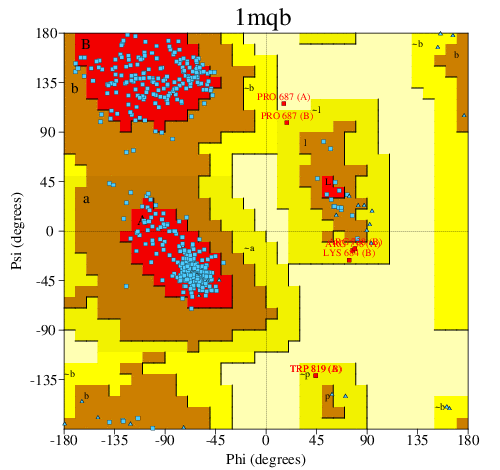
PROCHECK
|
|
|
|
|
|
Headers
|
|
|
|
References
|
|
|
|
|
|

|
|
P29317
(EPHA2_HUMAN) -
Ephrin type-A receptor 2 from Homo sapiens
|
|
|
|
Seq:
Struc:
|
|
|
|
976 a.a.
263 a.a.
|
|

|

|

|
|
|
|
|
|
|
|
|
|
|
Key: |
 |
PfamA domain |
|
|
 |
Secondary structure |
|
 |
CATH domain |
|
|
|
|
|
|
|
|
|
|
|
|
|
Enzyme class:
|
|
E.C.2.7.10.1
- receptor protein-tyrosine kinase.
|
|
|
|
|
|
|
Reaction:
|
|
L-tyrosyl-[protein] + ATP = O-phospho-L-tyrosyl-[protein] + ADP + H+
|
|
|
|
|
|
L-tyrosyl-[protein]
|
+
|
 ATP
ATP
|
=
|
O-phospho-L-tyrosyl-[protein]
Bound ligand (Het Group name = )
matches with 81.25% similarity
|
+
|
 ADP
ADP
|
+
|
H(+)
|
|
|
|
|
|
|
|
|
|
|
|
|
Molecule diagrams generated from .mol files obtained from the
KEGG ftp site
|
|
|
|
|
|
|
|
|
|
|
|
|
|
 |
|
|
|
|
|
|
| |
|
|
| |
|
DOI no:
|
Structure
10:1659-1667
(2002)
|
|
PubMed id:
|
|
|
|
|
|
| |
|
Structures of the cancer-related Aurora-A, FAK, and EphA2 protein kinases from nanovolume crystallography.
|
|
J.Nowakowski,
C.N.Cronin,
D.E.McRee,
M.W.Knuth,
C.G.Nelson,
N.P.Pavletich,
J.Rogers,
B.C.Sang,
D.N.Scheibe,
R.V.Swanson,
D.A.Thompson.
|
|
|
|
|
| |
ABSTRACT
|
|
|
|
| |
|
|
Protein kinases are important drug targets in human cancers, inflammation, and
metabolic diseases. This report presents the structures of kinase domains for
three cancer-associated protein kinases: ephrin receptor A2 (EphA2), focal
adhesion kinase (FAK), and Aurora-A. The expression profiles of EphA2, FAK, and
Aurora-A in carcinomas suggest that inhibitors of these kinases may have
inherent potential as therapeutic agents. The structures were determined from
crystals grown in nanovolume droplets, which produced high-resolution
diffraction data at 1.7, 1.9, and 2.3 A for FAK, Aurora-A, and EphA2,
respectively. The FAK and Aurora-A structures are the first determined within
two unique subfamilies of human kinases, and all three structures provide new
insights into kinase regulation and the design of selective inhibitors.
|
|
|
|
|
|
| |
Selected figure(s)
|
|
|
|
| |
|
|

|
|
Figure 5.
Figure 5. Stereo Diagrams of the ATP Binding Sites(A)
Aurora-A ATP binding site. Carbon atoms, gray; oxygen atoms,
red; nitrogen atoms, blue; phosphorus atoms, green. Water
molecules and Mg2+ ions are represented by red and blue crosses,
respectively.(B) FAK ATP binding site(C) EphA2 ATP binding site.
The representative 2F[o] - F[c] electron density around the ATP
has been computed at 1.9, 1.6, and 2.3 Å for Aurora-A, FAK, and
EphA2, respectively. The density is contoured at 1 s (blue) and
4 s (red). The side chains of the residues that distinguish the
structures of the ATP binding sites are shown with the dotted
van der Waals surface. Hydrogen bonds between the protein and
ATP are shown as dashed lines. The figure was prepared with Xfit
[56].
|
|
|
|
|
|
| |
The above figure is
reprinted
by permission from Cell Press:
Structure
(2002,
10,
1659-1667)
copyright 2002.
|
|
| |
Figure was
selected
by an automated process.
|
|
|
|
|
|
|
|
|
|
|
|
|
|
|
|
 |
 |
 |
|
Literature references that cite this PDB file's key reference
|
|
|
| |
PubMed id
|
|
Reference
|
|
|
|
|
|
X.Xu,
X.Wang,
Z.Xiao,
Y.Li,
and
Y.Wang
(2011).
Two TPX2-Dependent Switches Control the Activity of Aurora A.
|
| |
PLoS One,
6,
e16757.
|
|
|
|
|
|
|
C.C.Lee,
Y.Jia,
N.Li,
X.Sun,
K.Ng,
E.Ambing,
M.Y.Gao,
S.Hua,
C.Chen,
S.Kim,
P.Y.Michellys,
S.A.Lesley,
J.L.Harris,
and
G.Spraggon
(2010).
Crystal structure of the ALK (anaplastic lymphoma kinase) catalytic domain.
|
| |
Biochem J,
430,
425-437.
|
|
|
PDB codes:
|
|
|
|
|
|
|
|
F.Hans,
D.A.Skoufias,
S.Dimitrov,
and
R.L.Margolis
(2009).
Molecular distinctions between Aurora A and B: a single residue change transforms Aurora A into correctly localized and functional Aurora B.
|
| |
Mol Biol Cell,
20,
3491-3502.
|
|
|
|
|
|
|
G.Jun,
H.Guo,
B.E.Klein,
R.Klein,
J.J.Wang,
P.Mitchell,
H.Miao,
K.E.Lee,
T.Joshi,
M.Buck,
P.Chugha,
D.Bardenstein,
A.P.Klein,
J.E.Bailey-Wilson,
X.Gong,
T.D.Spector,
T.Andrew,
C.J.Hammond,
R.C.Elston,
S.K.Iyengar,
and
B.Wang
(2009).
EPHA2 is associated with age-related cortical cataract in mice and humans.
|
| |
PLoS Genet,
5,
e1000584.
|
|
|
|
|
|
|
S.Han,
A.Mistry,
J.S.Chang,
D.Cunningham,
M.Griffor,
P.C.Bonnette,
H.Wang,
B.A.Chrunyk,
G.E.Aspnes,
D.P.Walker,
A.D.Brosius,
and
L.Buckbinder
(2009).
Structural Characterization of Proline-rich Tyrosine Kinase 2 (PYK2) Reveals a Unique (DFG-out) Conformation and Enables Inhibitor Design.
|
| |
J Biol Chem,
284,
13193-13201.
|
|
|
PDB codes:
|
|
|
|
|
|
|
|
A.Poulsen,
A.William,
A.Lee,
S.Blanchard,
E.Teo,
W.Deng,
N.Tu,
E.Tan,
E.Sun,
K.L.Goh,
W.C.Ong,
C.P.Ng,
K.C.Goh,
and
Z.Bonday
(2008).
Structure-based design of Aurora A & B inhibitors.
|
| |
J Comput Aided Mol Des,
22,
897-906.
|
|
|
|
|
|
|
B.Zhao,
A.Smallwood,
J.Yang,
K.Koretke,
K.Nurse,
A.Calamari,
R.B.Kirkpatrick,
and
Z.Lai
(2008).
Modulation of kinase-inhibitor interactions by auxiliary protein binding: crystallography studies on Aurora A interactions with VX-680 and with TPX2.
|
| |
Protein Sci,
17,
1791-1797.
|
|
|
PDB code:
|
|
|
|
|
|
|
|
D.Lietha,
and
M.J.Eck
(2008).
Crystal structures of the FAK kinase in complex with TAE226 and related bis-anilino pyrimidine inhibitors reveal a helical DFG conformation.
|
| |
PLoS ONE,
3,
e3800.
|
|
|
PDB codes:
|
|
|
|
|
|
|
|
P.Singh,
B.Wang,
T.Maeda,
K.Palczewski,
and
J.J.Tesmer
(2008).
Structures of rhodopsin kinase in different ligand states reveal key elements involved in G protein-coupled receptor kinase activation.
|
| |
J Biol Chem,
283,
14053-14062.
|
|
|
PDB codes:
|
|
|
|
|
|
|
|
T.L.Davis,
J.R.Walker,
P.Loppnau,
C.Butler-Cole,
A.Allali-Hassani,
and
S.Dhe-Paganon
(2008).
Autoregulation by the juxtamembrane region of the human ephrin receptor tyrosine kinase A3 (EphA3).
|
| |
Structure,
16,
873-884.
|
|
|
PDB codes:
|
|
|
|
|
|
|
|
T.M.Bandeiras,
R.C.Hillig,
P.M.Matias,
U.Eberspaecher,
J.Fanghänel,
M.Thomaz,
S.Miranda,
K.Crusius,
V.Pütter,
P.Amstutz,
M.Gulotti-Georgieva,
H.K.Binz,
C.Holz,
A.A.Schmitz,
C.Lang,
P.Donner,
U.Egner,
M.A.Carrondo,
and
B.Müller-Tiemann
(2008).
Structure of wild-type Plk-1 kinase domain in complex with a selective DARPin.
|
| |
Acta Crystallogr D Biol Crystallogr,
64,
339-353.
|
|
|
PDB code:
|
|
|
|
|
|
|
|
Y.Mori,
T.Hirokawa,
K.Aoki,
H.Satomi,
S.Takeda,
M.Aburada,
and
K.Miyamoto
(2008).
Structure activity relationships of quinoxalin-2-one derivatives as platelet-derived growth factor-beta receptor (PDGFbeta R) inhibitors, derived from molecular modeling.
|
| |
Chem Pharm Bull (Tokyo),
56,
682-687.
|
|
|
|
|
|
|
C.N.Cronin,
K.B.Lim,
and
J.Rogers
(2007).
Production of selenomethionyl-derivatized proteins in baculovirus-infected insect cells.
|
| |
Protein Sci,
16,
2023-2029.
|
|
|
|
|
|
|
D.Lietha,
X.Cai,
D.F.Ceccarelli,
Y.Li,
M.D.Schaller,
and
M.J.Eck
(2007).
Structural basis for the autoinhibition of focal adhesion kinase.
|
| |
Cell,
129,
1177-1187.
|
|
|
PDB codes:
|
|
|
|
|
|
|
|
J.M.Kneller,
T.Ehlen,
J.P.Matisic,
D.Miller,
D.Van Niekerk,
W.L.Lam,
M.Marra,
R.Richards-Kortum,
M.Follen,
C.Macaulay,
and
S.J.Jones
(2007).
Using LongSAGE to Detect Biomarkers of Cervical Cancer Potentially Amenable to Optical Contrast Agent Labelling.
|
| |
Biomark Insights,
2,
447-461.
|
|
|
|
|
|
|
M.Ikuta,
M.Kornienko,
N.Byrne,
J.C.Reid,
S.Mizuarai,
H.Kotani,
and
S.K.Munshi
(2007).
Crystal structures of the N-terminal kinase domain of human RSK1 bound to three different ligands: Implications for the design of RSK1 specific inhibitors.
|
| |
Protein Sci,
16,
2626-2635.
|
|
|
PDB codes:
|
|
|
|
|
|
|
|
A.P.Zabell,
A.D.Schroff,
B.E.Bain,
R.L.Van Etten,
O.Wiest,
and
C.V.Stauffacher
(2006).
Crystal structure of the human B-form low molecular weight phosphotyrosyl phosphatase at 1.6-A resolution.
|
| |
J Biol Chem,
281,
6520-6527.
|
|
|
PDB code:
|
|
|
|
|
|
|
|
C.Y.Lee,
R.O.Andersen,
C.Cabernard,
L.Manning,
K.D.Tran,
M.J.Lanskey,
A.Bashirullah,
and
C.Q.Doe
(2006).
Drosophila Aurora-A kinase inhibits neuroblast self-renewal by regulating aPKC/Numb cortical polarity and spindle orientation.
|
| |
Genes Dev,
20,
3464-3474.
|
|
|
|
|
|
|
D.F.Ceccarelli,
H.K.Song,
F.Poy,
M.D.Schaller,
and
M.J.Eck
(2006).
Crystal structure of the FERM domain of focal adhesion kinase.
|
| |
J Biol Chem,
281,
252-259.
|
|
|
PDB codes:
|
|
|
|
|
|
|
|
J.M.Corsi,
E.Rouer,
J.A.Girault,
and
H.Enslen
(2006).
Organization and post-transcriptional processing of focal adhesion kinase gene.
|
| |
BMC Genomics,
7,
198.
|
|
|
|
|
|
|
K.Strebhardt,
and
A.Ullrich
(2006).
Targeting polo-like kinase 1 for cancer therapy.
|
| |
Nat Rev Cancer,
6,
321-330.
|
|
|
|
|
|
|
N.Matthews,
C.Visintin,
B.Hartzoulakis,
A.Jarvis,
and
D.L.Selwood
(2006).
Aurora A and B kinases as targets for cancer: will they be selective for tumors?
|
| |
Expert Rev Anticancer Ther,
6,
109-120.
|
|
|
|
|
|
|
S.Ohashi,
G.Sakashita,
R.Ban,
M.Nagasawa,
H.Matsuzaki,
Y.Murata,
H.Taniguchi,
H.Shima,
K.Furukawa,
and
T.Urano
(2006).
Phospho-regulation of human protein kinase Aurora-A: analysis using anti-phospho-Thr288 monoclonal antibodies.
|
| |
Oncogene,
25,
7691-7702.
|
|
|
|
|
|
|
S.Wiesner,
L.E.Wybenga-Groot,
N.Warner,
H.Lin,
T.Pawson,
J.D.Forman-Kay,
and
F.Sicheri
(2006).
A change in conformational dynamics underlies the activation of Eph receptor tyrosine kinases.
|
| |
EMBO J,
25,
4686-4696.
|
|
|
PDB codes:
|
|
|
|
|
|
|
|
C.J.Squire,
J.M.Dickson,
I.Ivanovic,
and
E.N.Baker
(2005).
Structure and inhibition of the human cell cycle checkpoint kinase, Wee1A kinase: an atypical tyrosine kinase with a key role in CDK1 regulation.
|
| |
Structure,
13,
541-550.
|
|
|
PDB code:
|
|
|
|
|
|
|
|
S.K.Mitra,
D.A.Hanson,
and
D.D.Schlaepfer
(2005).
Focal adhesion kinase: in command and control of cell motility.
|
| |
Nat Rev Mol Cell Biol,
6,
56-68.
|
|
|
|
|
|
|
D.D.Schlaepfer,
and
S.K.Mitra
(2004).
Multiple connections link FAK to cell motility and invasion.
|
| |
Curr Opin Genet Dev,
14,
92.
|
|
|
|
|
|
|
G.Snell,
C.Cork,
R.Nordmeyer,
E.Cornell,
G.Meigs,
D.Yegian,
J.Jaklevic,
J.Jin,
R.C.Stevens,
and
T.Earnest
(2004).
Automated sample mounting and alignment system for biological crystallography at a synchrotron source.
|
| |
Structure,
12,
537-545.
|
|
|
|
|
|
|
X.Li,
G.Sakashita,
H.Matsuzaki,
K.Sugimoto,
K.Kimura,
F.Hanaoka,
H.Taniguchi,
K.Furukawa,
and
T.Urano
(2004).
Direct association with inner centromere protein (INCENP) activates the novel chromosomal passenger protein, Aurora-C.
|
| |
J Biol Chem,
279,
47201-47211.
|
|
|
|
|
|
|
M.Carmena,
and
W.C.Earnshaw
(2003).
The cellular geography of aurora kinases.
|
| |
Nat Rev Mol Cell Biol,
4,
842-854.
|
|
|
|
|
|
|
R.Bayliss,
T.Sardon,
I.Vernos,
and
E.Conti
(2003).
Structural basis of Aurora-A activation by TPX2 at the mitotic spindle.
|
| |
Mol Cell,
12,
851-862.
|
|
|
PDB codes:
|
|
|
|
|
|
|
The most recent references are shown first.
Citation data come partly from CiteXplore and partly
from an automated harvesting procedure. Note that this is likely to be
only a partial list as not all journals are covered by
either method. However, we are continually building up the citation data
so more and more references will be included with time.
Where a reference describes a PDB structure, the PDB
codes are
shown on the right.
|
|


 Links
Links


