 |
PDBsum entry 2qo2

|
|
|
|
|
 |
Contents |
 |
|
|
|
|
|
|
|
|
|
|
|
|
* Residue conservation analysis
|
|
|
|
|
|
PDB id:
|
|
|
|
| Name: |
|
Transferase
|
|
|
Title:
|
|
Human epha3 kinase and juxtamembrane region, dephosphorylated, apo structure
|
|
Structure:
|
|
Ephrin receptor. Chain: a. Fragment: juxtamembrane segment and kinase domain: residues 577-947. Engineered: yes
|
|
Source:
|
|
Homo sapiens. Human. Organism_taxid: 9606. Tissue: placenta. Gene: epha3. Expressed in: escherichia coli bl21(de3). Expression_system_taxid: 469008.
|
|
Resolution:
|
|
|
1.60Å
|
R-factor:
|
0.177
|
R-free:
|
0.203
|
|
|
Authors:
|
|
T.Davis,J.R.Walker,E.M.Newman,F.Mackenzie,C.Butler-Cole,J.Weigelt, M.Sundstrom,C.H.Arrowsmith,A.M.Edwards,A.Bochkarev,S.Dhe-Paganon, Structural Genomics Consortium (Sgc)
|
Key ref:

|
|
T.L.Davis
et al.
(2008).
Autoregulation by the juxtamembrane region of the human ephrin receptor tyrosine kinase A3 (EphA3).
Structure,
16,
873-884.
PubMed id:
DOI:

|
|
|
Date:
|
|
|
19-Jul-07
|
Release date:
|
21-Aug-07
|
|
|
|
|
|
|
PROCHECK
|

|
|
|
|
|
Headers
|
|
|
|
References
|
|
|
|
|
|

|
|
P29320
(EPHA3_HUMAN) -
Ephrin type-A receptor 3 from Homo sapiens
|
|
|
|
Seq:
Struc:
|
|
|
|
983 a.a.
282 a.a.*
|
|

|

|

|
|
|
|
|
|
|
|
|
|
|
Key: |
 |
PfamA domain |
|
|
 |
Secondary structure |
|
 |
CATH domain |
|
|
*
PDB and UniProt seqs differ
at 1 residue position (black
cross)
|
|
|
|
|
|
|
|
|
|
|
|
|
Enzyme class:
|
|
E.C.2.7.10.1
- receptor protein-tyrosine kinase.
|
|
|
|
|
|
|
Reaction:
|
|
L-tyrosyl-[protein] + ATP = O-phospho-L-tyrosyl-[protein] + ADP + H+
|
|
|
|
|
|
L-tyrosyl-[protein]
|
+
|
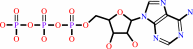 ATP
ATP
|
=
|
O-phospho-L-tyrosyl-[protein]
|
+
|
 ADP
ADP
|
+
|
H(+)
|
|
|
|
|
|
|
|
|
|
|
|
|
Molecule diagrams generated from .mol files obtained from the
KEGG ftp site
|
|
|
|
|
|
|
|
|
|
|
|
|
|
 |
|
|
|
|
|
|
| |
|
|
| |
|
DOI no:
|
Structure
16:873-884
(2008)
|
|
PubMed id:
|
|
|
|
|
|
| |
|
Autoregulation by the juxtamembrane region of the human ephrin receptor tyrosine kinase A3 (EphA3).
|
|
T.L.Davis,
J.R.Walker,
P.Loppnau,
C.Butler-Cole,
A.Allali-Hassani,
S.Dhe-Paganon.
|
|
|
|
|
| |
ABSTRACT
|
|
|
|
| |
|
|
Ephrin receptors (Eph) affect cell shape and movement, unlike other receptor
tyrosine kinases that directly affect proliferative pathways. The kinase domain
of EphA3 is activated by ephrin binding and receptor oligomerization. This
activation is associated with two tyrosines in the juxtamembrane region; these
tyrosines are sites of autophosphorylation and interact with the active site of
the kinase to modulate activity. This allosteric event has important
implications both in terms of understanding signal transduction pathways
mediated by Eph kinases as well as discovering specific therapeutic ligands for
receptor kinases. In order to provide further details of the molecular mechanism
through which the unphosphorylated juxtamembrane region blocks catalysis, we
studied wild-type and site-specific mutants in detail. High-resolution
structures of multiple states of EphA3 kinase with and without the juxtamembrane
segment allowed us to map the coupled pathway of residues that connect the
juxtamembrane segment, the activation loop, and the catalytic residues of the
kinase domain. This highly conserved set of residues likely delineates a
molecular recognition pathway for most of the Eph RTKs, helping to characterize
the dynamic nature of these physiologically important enzymes.
|
|
|
|
|
|
| |
Selected figure(s)
|
|
|
|
| |
|
|

|
|

|
|
Figure 2.
Figure 2. Overall Structure of EphA3 Kinase
All
molecular graphics figures were generated using PyMOL unless
noted.
(A) Cartoon representation of the EphA3 JMKIN base
ANP structure. The structure is shown in forest green and in
cartoon representation. Secondary structure elements and regions
discussed in the test are labeled. Regions of disorder are
indicated with dashed lines. This structure was chosen because
it represents the highest degree of order modeled for all the
EphA3 structures.
(B) Ribbon representation of JMKIN base
ANP overlaid with EphB2 in pink (1JPA). Alignment over all atoms
yields an rmsd of less than 1Å for all structures; key
regions of structural difference occur in the N-terminal lobe,
centered on the JMS and the AL, along with slight differences in
the β1-G loop-β2 region.
|
|
Figure 4.
Figure 4. The Linker Between the Kinase and SAM Domains Binds
into a Complementary Pocket on the C-terminal Lobe of the Kinase
Domain
An electrostatic surface was generated using APBS
(Baker et al., 2001) using a gradient from −10 to 10 keT.
Shown in cartoon and stick representation is the model for KIN
ANP in firebrick red; this model contains the most ordered
linker region comprising residues 885–906. Highlighted is the
complementary surface made up by Tyr841, Leu901, and Leu903.
|
|
|
|
|
|
| |
The above figures are
reprinted
by permission from Cell Press:
Structure
(2008,
16,
873-884)
copyright 2008.
|
|
| |
Figures were
selected
by an automated process.
|
|
|
|
|
|
|
|
|
|
|
|
|
|
|
|
 |
 |
 |
|
Literature references that cite this PDB file's key reference
|
|
|
| |
PubMed id
|
|
Reference
|
|
|
|
|
|
G.De Lorenzo,
A.Brutus,
D.V.Savatin,
F.Sicilia,
and
F.Cervone
(2011).
Engineering plant resistance by constructing chimeric receptors that recognize damage-associated molecular patterns (DAMPs).
|
| |
FEBS Lett,
585,
1521-1528.
|
|
|
|
|
|
|
G.Kisselman,
W.Qiu,
V.Romanov,
C.M.Thompson,
R.Lam,
K.P.Battaile,
E.F.Pai,
and
N.Y.Chirgadze
(2011).
X-CHIP: an integrated platform for high-throughput protein crystallization and on-the-chip X-ray diffraction data collection.
|
| |
Acta Crystallogr D Biol Crystallogr,
67,
533-539.
|
|
|
|
|
|
|
N.Singla,
H.Erdjument-Bromage,
J.P.Himanen,
T.W.Muir,
and
D.B.Nikolov
(2011).
A semisynthetic Eph receptor tyrosine kinase provides insight into ligand-induced kinase activation.
|
| |
Chem Biol,
18,
361-371.
|
|
|
|
|
|
|
G.Shi,
G.Yue,
and
R.Zhou
(2010).
EphA3 functions are regulated by collaborating phosphotyrosine residues.
|
| |
Cell Res,
20,
1263-1275.
|
|
|
|
|
|
|
H.E.Grecco,
P.Roda-Navarro,
A.Girod,
J.Hou,
T.Frahm,
D.C.Truxius,
R.Pepperkok,
A.Squire,
and
P.I.Bastiaens
(2010).
In situ analysis of tyrosine phosphorylation networks by FLIM on cell arrays.
|
| |
Nat Methods,
7,
467-472.
|
|
|
|
|
|
|
M.Rabiller,
M.Getlik,
S.Klüter,
A.Richters,
S.Tückmantel,
J.R.Simard,
and
D.Rauh
(2010).
Proteus in the world of proteins: conformational changes in protein kinases.
|
| |
Arch Pharm (Weinheim),
343,
193-206.
|
|
|
|
|
|
|
E.Stuttfeld,
and
K.Ballmer-Hofer
(2009).
Structure and function of VEGF receptors.
|
| |
IUBMB Life,
61,
915-922.
|
|
|
|
|
|
|
P.W.Janes,
S.H.Wimmer-Kleikamp,
A.S.Frangakis,
K.Treble,
B.Griesshaber,
O.Sabet,
M.Grabenbauer,
A.Y.Ting,
P.Saftig,
P.I.Bastiaens,
and
M.Lackmann
(2009).
Cytoplasmic relaxation of active Eph controls ephrin shedding by ADAM10.
|
| |
PLoS Biol,
7,
e1000215.
|
|
|
|
|
|
|
T.L.Davis,
J.R.Walker,
A.Allali-Hassani,
S.A.Parker,
B.E.Turk,
and
S.Dhe-Paganon
(2009).
Structural recognition of an optimized substrate for the ephrin family of receptor tyrosine kinases.
|
| |
FEBS J,
276,
4395-4404.
|
|
|
PDB codes:
|
|
|
|
|
|
|
|
X.Huang,
P.Finerty,
J.R.Walker,
C.Butler-Cole,
M.Vedadi,
M.Schapira,
S.A.Parker,
B.E.Turk,
D.A.Thompson,
and
S.Dhe-Paganon
(2009).
Structural insights into the inhibited states of the Mer receptor tyrosine kinase.
|
| |
J Struct Biol,
165,
88-96.
|
|
|
PDB codes:
|
|
|
|
|
|
|
|
Y.Choi,
F.Syeda,
J.R.Walker,
P.J.Finerty,
D.Cuerrier,
A.Wojciechowski,
Q.Liu,
S.Dhe-Paganon,
and
N.S.Gray
(2009).
Discovery and structural analysis of Eph receptor tyrosine kinase inhibitors.
|
| |
Bioorg Med Chem Lett,
19,
4467-4470.
|
|
|
|
|
|
The most recent references are shown first.
Citation data come partly from CiteXplore and partly
from an automated harvesting procedure. Note that this is likely to be
only a partial list as not all journals are covered by
either method. However, we are continually building up the citation data
so more and more references will be included with time.
Where a reference describes a PDB structure, the PDB
codes are
shown on the right.
|
|


 Links
Links



