 |
PDBsum entry 1k3d

|
|
|
|
|
 |
Contents |
 |
|
|
|
|
|
|
|
|
|
|
|
|
|
|
* Residue conservation analysis
|
|
|
|
|
|
|
|
|
|
|
Enzyme class:
|
|
E.C.4.1.1.49
- phosphoenolpyruvate carboxykinase (ATP).
|
|
|
|
|
|
|
Reaction:
|
|
oxaloacetate + ATP = phosphoenolpyruvate + ADP + CO2
|
|
|
|
|
|
 oxaloacetate
|
+
|
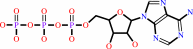 ATP
ATP
|
=
|
phosphoenolpyruvate
Bound ligand (Het Group name = )
corresponds exactly
|
+
|
 ADP
ADP
|
+
|
 CO2
CO2
|
|
|
|
|
|
|
|
|
|
|
|
|
Molecule diagrams generated from .mol files obtained from the
KEGG ftp site
|
|
|
|
|
|
|
|
|
|
|
|
|
|
 |
|
|
|
|
|
|
| |
|
|
| |
|
DOI no:
|
J Mol Biol
314:83-92
(2001)
|
|
PubMed id:
|
|
|
|
|
|
| |
|
The phosphoryl-transfer mechanism of Escherichia coli phosphoenolpyruvate carboxykinase from the use of AlF(3).
|
|
A.M.Sudom,
L.Prasad,
H.Goldie,
L.T.Delbaere.
|
|
|
|
|
| |
ABSTRACT
|
|
|
|
| |
|
|
The mechanism of reversible transfer of the gamma-phosphate group of ATP by
Escherichia coli phosphoenolpyruvate carboxykinase (PCK) on to its substrate is
of great interest. It is known that metallofluorides are accurate analogs of the
transition state in the context of kinase mechanisms. Therefore, two complexes
of PCK, one with AlF(3), Mg(2+) and ADP (complex I), the other with AlF(3),
Mg(2+), ADP and pyruvate (complex II) were crystallized. The X-ray crystal
structures of these two complexes were determined at 2.0 A resolution. The Al
atom has trigonal bipyramidal geometry that mimics the transition state of
phosphoryl transfer. The Al atom is at a distance of 2.8 A and 2.9 A from an
oxygen atom of the beta-phosphoryl group of ADP in complex I and II,
respectively. A water molecule in complex I and an oxygen atom of the pyruvate
in complex II are located along the axis of the trigonal bipyramid on the side
opposite to the beta-phosphoryl oxygen with respect to the equatorial plane,
suggesting that the complexes are close mimics of the transition state. Along
with the presence of positively charged species around the AlF(3) moiety, these
results indicate that phosphoryl transfer occurs via a direct displacement
mechanism with associative qualities.
|
|
|
|
|
|
| |
Selected figure(s)
|
|
|
|
| |
|
|

|
|

|
|
Figure 1.
Figure 1. The associative (SN2-like) versus dissociative
(SN1-like) mechanisms of phosphoryl transfer. As can be seen in
the associative state, one bond is formed between the incoming
nucleophile and attacked phosphorus atom concurrently with the
existing bond between Pg and the b, g-bridging oxygen. The
dissociative state first involves bond breaking between Pg and
the b, g-bridging oxygen, then bond formation occurs. The two
states also differ in geometry and charge distribution, as the
associative case involves a pentagonal bipyramidal structure (
-3) and the dissociative case involves a planar, trigonal
phosphorane ( -1).
|
|
Figure 4.
Figure 4. Detailed diagram illustrating AlF[3] binding in
the active site region of the ADP-Mg2+-AlF[3] E. coli PCK
quaternary complex. Note that the fluorine atoms interact
primarily with basic residues or Mg2+. The aluminum atom is
close to an oxygen atom of the b-phosphoryl group of ATP. Mg2+
is the light blue sphere, the aluminum atom is colored pink, the
fluorine atoms are colored green. (a) PCK-ADP-AlF[3]-Mg2+
complex (complex I). (b) PCK-ADP-AlF[3]-Mg2+-pyruvate complex
(complex II).
|
|
|
|
|
|
| |
The above figures are
reprinted
by permission from Elsevier:
J Mol Biol
(2001,
314,
83-92)
copyright 2001.
|
|
| |
Figures were
selected
by the author.
|
|
|
|
|
|
|
|
|
|
|
|
|
|
|
|
 |
 |
 |
|
Literature references that cite this PDB file's key reference
|
|
|
| |
PubMed id
|
|
Reference
|
|
|
|
|
|
N.Asanuma,
K.Kanada,
Y.Arai,
K.Yoshizawa,
T.Ichikawa,
and
T.Hino
(2010).
Molecular characterization and significance of phosphoenolpyruvate carboxykinase in a ruminal bacterium, Streptococcus bovis.
|
| |
J Gen Appl Microbiol,
56,
121-127.
|
|
|
|
|
|
|
G.M.Carlson,
and
T.Holyoak
(2009).
Structural insights into the mechanism of phosphoenolpyruvate carboxykinase catalysis.
|
| |
J Biol Chem,
284,
27037-27041.
|
|
|
|
|
|
|
N.Asanuma,
K.Yoshizawa,
K.Kanada,
and
T.Hino
(2009).
Molecular and biochemical characterization of phosphoenolpyruvate carboxykinase in the ruminal bacterium Ruminococcus albus.
|
| |
Curr Microbiol,
58,
416-420.
|
|
|
|
|
|
|
L.Dharmarajan,
C.L.Case,
P.Dunten,
and
B.Mukhopadhyay
(2008).
Tyr235 of human cytosolic phosphoenolpyruvate carboxykinase influences catalysis through an anion-quadrupole interaction with phosphoenolpyruvate carboxylate.
|
| |
FEBS J,
275,
5810-5819.
|
|
|
|
|
|
|
S.Aich,
and
L.T.Delbaere
(2007).
Phylogenetic Study of the Evolution of PEP-Carboxykinase.
|
| |
Evol Bioinform Online,
3,
333-340.
|
|
|
|
|
|
|
A.Sudom,
R.Walters,
L.Pastushok,
D.Goldie,
L.Prasad,
L.T.Delbaere,
and
H.Goldie
(2003).
Mechanisms of activation of phosphoenolpyruvate carboxykinase from Escherichia coli by Ca2+ and of desensitization by trypsin.
|
| |
J Bacteriol,
185,
4233-4242.
|
|
|
PDB code:
|
|
|
|
|
|
|
|
S.Nessler,
S.Fieulaine,
S.Poncet,
A.Galinier,
J.Deutscher,
and
J.Janin
(2003).
HPr kinase/phosphorylase, the sensor enzyme of catabolite repression in Gram-positive bacteria: structural aspects of the enzyme and the complex with its protein substrate.
|
| |
J Bacteriol,
185,
4003-4010.
|
|
|
|
|
|
|
M.V.Encinas,
F.D.González-Nilo,
H.Goldie,
and
E.Cardemil
(2002).
Ligand interactions and protein conformational changes of phosphopyridoxyl-labeled Escherichia coli phosphoenolpyruvate carboxykinase determined by fluorescence spectroscopy.
|
| |
Eur J Biochem,
269,
4960-4968.
|
|
|
|
|
|
|
Madhusudan,
P.Akamine,
N.H.Xuong,
and
S.S.Taylor
(2002).
Crystal structure of a transition state mimic of the catalytic subunit of cAMP-dependent protein kinase.
|
| |
Nat Struct Biol,
9,
273-277.
|
|
|
PDB code:
|
|
|
|
|
|
|
|
S.Fieulaine,
S.Morera,
S.Poncet,
I.Mijakovic,
A.Galinier,
J.Janin,
J.Deutscher,
and
S.Nessler
(2002).
X-ray structure of a bifunctional protein kinase in complex with its protein substrate HPr.
|
| |
Proc Natl Acad Sci U S A,
99,
13437-13441.
|
|
|
PDB codes:
|
|
|
|
|
|
|
The most recent references are shown first.
Citation data come partly from CiteXplore and partly
from an automated harvesting procedure. Note that this is likely to be
only a partial list as not all journals are covered by
either method. However, we are continually building up the citation data
so more and more references will be included with time.
Where a reference describes a PDB structure, the PDB
code is
shown on the right.
|
|


 Links
Links


