|
|
|
|
|
 |
Contents |
 |
|
|
|
|
|
|
|
|
|
|
|
|
|
|
* Residue conservation analysis
|
|
|
|
|
|
|
|
|
|
Enzyme class 1:
|
|
Chains A, B:
E.C.2.5.1.58
- protein farnesyltransferase.
|
|
|
|
|
|
|
Reaction:
|
|
L-cysteinyl-[protein] + (2E,6E)-farnesyl diphosphate = S-(2E,6E)- farnesyl-L-cysteinyl-[protein] + diphosphate
|
|
|
|
|
|
L-cysteinyl-[protein]
Bound ligand (Het Group name = )
matches with 50.00% similarity
|
+
|
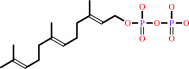 (2E,6E)-farnesyl diphosphate
|
=
|
S-(2E,6E)- farnesyl-L-cysteinyl-[protein]
|
+
|
 diphosphate
|
|
|
|
|
|
|
|
|
|
Cofactor:
|
|
Mg(2+); Zn(2+)
|
|
|
|
|
|
Enzyme class 2:
|
|
Chain A:
E.C.2.5.1.59
- protein geranylgeranyltransferase type I.
|
|
|
|
|
|
|
Reaction:
|
|
geranylgeranyl diphosphate + L-cysteinyl-[protein] = S-geranylgeranyl-L- cysteinyl-[protein] + diphosphate
|
|
|
|
|
|
geranylgeranyl diphosphate
Bound ligand (Het Group name = )
matches with 43.24% similarity
|
+
|
L-cysteinyl-[protein]
|
=
|
S-geranylgeranyl-L- cysteinyl-[protein]
|
+
|
diphosphate
|
|
|
|
|
|
|
|
|
|
Cofactor:
|
|
Zn(2+)
|
|
|
|
|
|
|
|
|
Note, where more than one E.C. class is given (as above), each may
correspond to a different protein domain or, in the case of polyprotein
precursors, to a different mature protein.
|
|
|
|
Molecule diagrams generated from .mol files obtained from the
KEGG ftp site
|
|
|
|
|
|
|
|
|
|
|
|
|
|
 |
|
|
|
|
|
|
| |
|
|
| |
|
DOI no:
|
Proc Natl Acad Sci U S A
98:12948-12953
(2001)
|
|
PubMed id:
|
|
|
|
|
|
| |
|
The crystal structure of human protein farnesyltransferase reveals the basis for inhibition by CaaX tetrapeptides and their mimetics.
|
|
S.B.Long,
P.J.Hancock,
A.M.Kral,
H.W.Hellinga,
L.S.Beese.
|
|
|
|
|
| |
ABSTRACT
|
|
|
|
| |
|
|
Protein farnesyltransferase (FTase) catalyzes the attachment of a farnesyl lipid
group to the cysteine residue located in the C-terminal tetrapeptide of many
essential signal transduction proteins, including members of the Ras
superfamily. Farnesylation is essential both for normal functioning of these
proteins, and for the transforming activity of oncogenic mutants. Consequently
FTase is an important target for anti-cancer therapeutics. Several FTase
inhibitors are currently undergoing clinical trials for cancer treatment. Here,
we present the crystal structure of human FTase, as well as ternary complexes
with the TKCVFM hexapeptide substrate, CVFM non-substrate tetrapeptide, and
L-739,750 peptidomimetic with either farnesyl diphosphate (FPP), or a
nonreactive analogue. These structures reveal the structural mechanism of FTase
inhibition. Some CaaX tetrapeptide inhibitors are not farnesylated, and are more
effective inhibitors than farnesylated CaaX tetrapeptides. CVFM and L-739,750
are not farnesylated, because these inhibitors bind in a conformation that is
distinct from the TKCVFM hexapeptide substrate. This non-substrate binding mode
is stabilized by an ion pair between the peptide N terminus and the
alpha-phosphate of the FPP substrate. Conformational mapping calculations reveal
the basis for the sequence specificity in the third position of the CaaX motif
that determines whether a tetrapeptide is a substrate or non-substrate. The
presence of beta-branched amino acids in this position prevents formation of the
non-substrate conformation; all other aliphatic amino acids in this position are
predicted to form the non-substrate conformation, provided their N terminus is
available to bind to the FPP alpha-phosphate. These results may facilitate
further development of FTase inhibitors.
|
|
|
|
|
|
| |
Selected figure(s)
|
|
|
|
| |
|
|

|
|

|
|
Figure 1.
Fig. 1. Chemical structures.
|
|
Figure 2.
Fig. 2. Structure of human FTase in complex with the
CIFM-derived L-739,750 peptidomimetic and FPP substrate. (A)
Overall structure. (B) 6  F[O]-F[C]
omit electron density for L-739,750. The FPP substrate and zinc
ion are included for reference. (C) Residues forming van der
Waals interactions with L-739,750, shown in stereo. The N
terminus of the peptidomimetic forms an ion pair with an F[O]-F[C]
omit electron density for L-739,750. The FPP substrate and zinc
ion are included for reference. (C) Residues forming van der
Waals interactions with L-739,750, shown in stereo. The N
terminus of the peptidomimetic forms an ion pair with an  -phosphate
oxygen of the FPP substrate. -phosphate
oxygen of the FPP substrate.
|
|
|
|
| |
Figures were
selected
by an automated process.
|
|
|
|
|
|
|
|
|
|
|
|
|
|
|
|
 |
 |
 |
|
Literature references that cite this PDB file's key reference
|
|
|
| |
PubMed id
|
|
Reference
|
|
|
|
|
|
Y.Qiao,
J.Gao,
Y.Qiu,
L.Wu,
F.Guo,
K.K.Lo,
and
D.Li
(2011).
Design, synthesis, and characterization of piperazinedione-based dual protein inhibitors for both farnesyltransferase and geranylgeranyltransferase-I.
|
| |
Eur J Med Chem,
46,
2264-2273.
|
|
|
|
|
|
|
A.H.Khan,
A.Prakash,
D.Kumar,
A.K.Rawat,
R.Srivastava,
and
S.Srivastava
(2010).
Virtual screening and pharmacophore studies for ftase inhibitors using Indian plant anticancer compounds database.
|
| |
Bioinformation,
5,
62-66.
|
|
|
|
|
|
|
J.L.Hougland,
K.A.Hicks,
H.L.Hartman,
R.A.Kelly,
T.J.Watt,
and
C.A.Fierke
(2010).
Identification of novel peptide substrates for protein farnesyltransferase reveals two substrate classes with distinct sequence selectivities.
|
| |
J Mol Biol,
395,
176-190.
|
|
|
|
|
|
|
M.L.Hovlid,
R.L.Edelstein,
O.Henry,
J.Ochocki,
A.DeGraw,
S.Lenevich,
T.Talbot,
V.G.Young,
A.W.Hruza,
F.Lopez-Gallego,
N.P.Labello,
C.L.Strickland,
C.Schmidt-Dannert,
and
M.D.Distefano
(2010).
Synthesis, properties, and applications of diazotrifluropropanoyl-containing photoactive analogs of farnesyl diphosphate containing modified linkages for enhanced stability.
|
| |
Chem Biol Drug Des,
75,
51-67.
|
|
|
PDB code:
|
|
|
|
|
|
|
|
S.Fletcher,
E.P.Keaney,
C.G.Cummings,
M.A.Blaskovich,
M.A.Hast,
M.P.Glenn,
S.Y.Chang,
C.J.Bucher,
R.J.Floyd,
W.P.Katt,
M.H.Gelb,
W.C.Van Voorhis,
L.S.Beese,
S.M.Sebti,
and
A.D.Hamilton
(2010).
Structure-based design and synthesis of potent, ethylenediamine-based, mammalian farnesyltransferase inhibitors as anticancer agents.
|
| |
J Med Chem,
53,
6867-6888.
|
|
|
|
|
|
|
J.L.Hougland,
C.L.Lamphear,
S.A.Scott,
R.A.Gibbs,
and
C.A.Fierke
(2009).
Context-dependent substrate recognition by protein farnesyltransferase.
|
| |
Biochemistry,
48,
1691-1701.
|
|
|
|
|
|
|
M.A.Hast,
S.Fletcher,
C.G.Cummings,
E.E.Pusateri,
M.A.Blaskovich,
K.Rivas,
M.H.Gelb,
W.C.Van Voorhis,
S.M.Sebti,
A.D.Hamilton,
and
L.S.Beese
(2009).
Structural basis for binding and selectivity of antimalarial and anticancer ethylenediamine inhibitors to protein farnesyltransferase.
|
| |
Chem Biol,
16,
181-192.
|
|
|
PDB codes:
|
|
|
|
|
|
|
|
O.Henry,
F.Lopez-Gallego,
S.A.Agger,
C.Schmidt-Dannert,
S.Sen,
D.Shintani,
K.Cornish,
and
M.D.Distefano
(2009).
A versatile photoactivatable probe designed to label the diphosphate binding site of farnesyl diphosphate utilizing enzymes.
|
| |
Bioorg Med Chem,
17,
4797-4805.
|
|
|
|
|
|
|
S.F.Sousa,
P.A.Fernandes,
and
M.J.Ramos
(2009).
The search for the mechanism of the reaction catalyzed by farnesyltransferase.
|
| |
Chemistry,
15,
4243-4247.
|
|
|
|
|
|
|
M.A.Hast,
and
L.S.Beese
(2008).
Structure of protein geranylgeranyltransferase-I from the human pathogen Candida albicans complexed with a lipid substrate.
|
| |
J Biol Chem,
283,
31933-31940.
|
|
|
PDB code:
|
|
|
|
|
|
|
|
S.Fletcher,
C.G.Cummings,
K.Rivas,
W.P.Katt,
C.Hornéy,
F.S.Buckner,
D.Chakrabarti,
S.M.Sebti,
M.H.Gelb,
W.C.Van Voorhis,
and
A.D.Hamilton
(2008).
Potent, Plasmodium-selective farnesyltransferase inhibitors that arrest the growth of malaria parasites: structure-activity relationships of ethylenediamine-analogue scaffolds and homology model validation.
|
| |
J Med Chem,
51,
5176-5197.
|
|
|
|
|
|
|
T.Subramanian,
S.Liu,
J.M.Troutman,
D.A.Andres,
and
H.P.Spielmann
(2008).
Protein farnesyltransferase-catalyzed isoprenoid transfer to peptide depends on lipid size and shape, not hydrophobicity.
|
| |
Chembiochem,
9,
2872-2882.
|
|
|
|
|
|
|
G.Cui,
and
K.M.Merz
(2007).
Computational studies of the farnesyltransferase ternary complex part II: the conformational activation of farnesyldiphosphate.
|
| |
Biochemistry,
46,
12375-12381.
|
|
|
|
|
|
|
G.R.Labadie,
R.Viswanathan,
and
C.D.Poulter
(2007).
Farnesyl diphosphate analogues with omega-bioorthogonal azide and alkyne functional groups for protein farnesyl transferase-catalyzed ligation reactions.
|
| |
J Org Chem,
72,
9291-9297.
|
|
|
|
|
|
|
J.Penner-Hahn
(2007).
Zinc-promoted alkyl transfer: a new role for zinc.
|
| |
Curr Opin Chem Biol,
11,
166-171.
|
|
|
|
|
|
|
R.M.de Figueiredo,
L.Coudray,
and
J.Dubois
(2007).
Synthesis and biological evaluation of potential bisubstrate inhibitors of protein farnesyltransferase. Design and synthesis of functionalized imidazoles.
|
| |
Org Biomol Chem,
5,
3299-3309.
|
|
|
|
|
|
|
S.F.Sousa,
P.A.Fernandes,
and
M.J.Ramos
(2007).
Theoretical studies on farnesyltransferase: the distances paradox explained.
|
| |
Proteins,
66,
205-218.
|
|
|
|
|
|
|
G.Pentheroudakis,
and
N.Pavlidis
(2006).
Perspectives for targeted therapies in cancer of unknown primary site.
|
| |
Cancer Treat Rev,
32,
637-644.
|
|
|
|
|
|
|
J.Ohkanda,
C.L.Strickland,
M.A.Blaskovich,
D.Carrico,
J.W.Lockman,
A.Vogt,
C.J.Bucher,
J.Sun,
Y.Qian,
D.Knowles,
E.E.Pusateri,
S.M.Sebti,
and
A.D.Hamilton
(2006).
Structure-based design of imidazole-containing peptidomimetic inhibitors of protein farnesyltransferase.
|
| |
Org Biomol Chem,
4,
482-492.
|
|
|
|
|
|
|
G.Cui,
B.Wang,
and
K.M.Merz
(2005).
Computational studies of the farnesyltransferase ternary complex part I: substrate binding.
|
| |
Biochemistry,
44,
16513-16523.
|
|
|
|
|
|
|
S.F.Sousa,
P.A.Fernandes,
and
M.J.Ramos
(2005).
Farnesyltransferase--new insights into the zinc-coordination sphere paradigm: evidence for a carboxylate-shift mechanism.
|
| |
Biophys J,
88,
483-494.
|
|
|
|
|
|
|
S.F.Sousa,
P.A.Fernandes,
and
M.J.Ramos
(2005).
Unraveling the mechanism of the farnesyltransferase enzyme.
|
| |
J Biol Inorg Chem,
10,
3.
|
|
|
|
|
|
|
J.S.Taylor,
T.S.Reid,
K.L.Terry,
P.J.Casey,
and
L.S.Beese
(2003).
Structure of mammalian protein geranylgeranyltransferase type-I.
|
| |
EMBO J,
22,
5963-5974.
|
|
|
PDB codes:
|
|
|
|
|
|
|
|
D.T.Le,
and
K.M.Shannon
(2002).
Ras processing as a therapeutic target in hematologic malignancies.
|
| |
Curr Opin Hematol,
9,
308-315.
|
|
|
|
|
|
|
S.B.Long,
P.J.Casey,
and
L.S.Beese
(2002).
Reaction path of protein farnesyltransferase at atomic resolution.
|
| |
Nature,
419,
645-650.
|
|
|
PDB codes:
|
|
|
|
|
|
|
The most recent references are shown first.
Citation data come partly from CiteXplore and partly
from an automated harvesting procedure. Note that this is likely to be
only a partial list as not all journals are covered by
either method. However, we are continually building up the citation data
so more and more references will be included with time.
Where a reference describes a PDB structure, the PDB
code is
shown on the right.
|
 |


 Links
Links