 |
PDBsum entry 1j2f

|
|
|
|
|
|

|

|

|

|
|

|
|

|
|

|
|

|
|

|
|

|
|
|
 |

|

|
|
|
|
|
|
|
|
|
|
|
|
|
|
|
|
|
|
|
|
|
|
|
|
|
|
|
|
|
|
|
|
|
|
|
DNA binding protein
|
PDB id
|
|
|
|
1j2f
|
|
|
|
|
|
|
|
|
|
|
|
|
|
|

|

|

|
|
|
|
|
|
|
|
 |
Contents |
 |
|
|
|
|
|
|
|
|
|
|
* Residue conservation analysis
|
|
|
|
|
|
PDB id:
|
|
|
|
| Name: |
|
DNA binding protein
|
|
|
Title:
|
|
X-ray crystal structure of irf-3 and its functional implications
|
|
Structure:
|
|
Interferon regulatory factor 3. Chain: a, b. Fragment: residues 170-427. Synonym: irf-3. Engineered: yes
|
|
Source:
|
|
Homo sapiens. Human. Organism_taxid: 9606. Expressed in: escherichia coli. Expression_system_taxid: 562.
|
|
Resolution:
|
|
|
2.30Å
|
R-factor:
|
0.217
|
R-free:
|
0.242
|
|
|
Authors:
|
|
K.Takahasi,N.Noda,M.Horiuchi,M.Mori,Y.Okabe,Y.Fukuhara,H.Terasawa, T.Fujita,F.Inagaki
|
Key ref:

|
|
K.Takahasi
et al.
(2003).
X-ray crystal structure of IRF-3 and its functional implications.
Nat Struct Biol,
10,
922-927.
PubMed id:
DOI:

|
|
|
Date:
|
|
|
04-Jan-03
|
Release date:
|
25-Nov-03
|
|
|
|
|
|
|
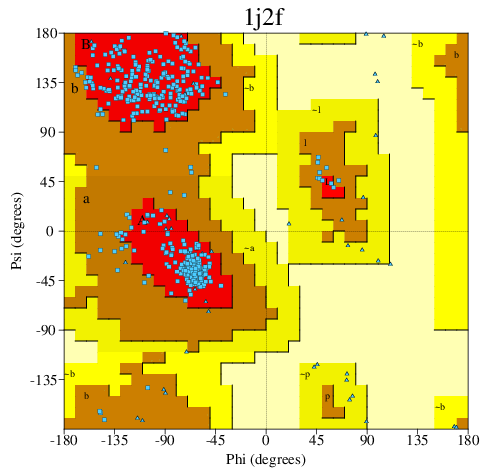
PROCHECK
|
|
|
|
|
|
Headers
|
|
|
|
References
|
|
|
|
|
|

|
|
Q14653
(IRF3_HUMAN) -
Interferon regulatory factor 3 from Homo sapiens
|
|
|
|
Seq:
Struc:
|
|
|
|
427 a.a.
226 a.a.
|
|

|

|

|
|
|
|
|
|
|
|
|
|
|
Key: |
 |
PfamA domain |
|
|
 |
Secondary structure |
|
 |
CATH domain |
|
|
|
|
|
|
|
|
|
|
|
|
|
|
|
|
|
 |
|
|
|
|
|
|
| |
|
DOI no:
|
Nat Struct Biol
10:922-927
(2003)
|
|
PubMed id:
|
|
|
|
|
|
| |
|
X-ray crystal structure of IRF-3 and its functional implications.
|
|
K.Takahasi,
N.N.Suzuki,
M.Horiuchi,
M.Mori,
W.Suhara,
Y.Okabe,
Y.Fukuhara,
H.Terasawa,
S.Akira,
T.Fujita,
F.Inagaki.
|
|
|
|
|
| |
ABSTRACT
|
|
|
|
| |
|
|
Transcription factor IRF-3 is post-translationally activated by Toll-like
receptor (TLR) signaling and has critical roles in the regulation of innate
immunity. Here we present the X-ray crystal structure of the C-terminal
regulatory domain of IRF-3(175-427) (IRF-3 175C) at a resolution of 2.3 A. IRF-3
175C is structurally similar to the Mad homology domain 2 of the Smad family.
Structural and functional analyses reveal phosphorylation-induced IRF-3
dimerization, which generates an extensive acidic pocket responsible for binding
with p300/CBP. Although TLR and Smad signaling are evolutionarily independent,
our results suggest that IRF-3 originates from Smad and acquires its function
downstream of TLR.
|
|
|
|
|
|
| |
Selected figure(s)
|
|
|
|
| |
|
|

|
|

|
|
Figure 2.
Figure 2. Overall structure of IRF-3 and its structural
similarity to Smad2. (a) A stereo view of the C  trace
of the IRF-3 175C homodimer in the asymmetric unit. Subunits A
and B are blue and red, respectively. Dotted circles represent
the LHR-pocket. This figure was prepared with MolScript33. (b,c)
Ribbon diagram representations of the IRF-3 175C monomer. SRR is
cyan, and a disordered loop is indicated by a dotted line. b and
c are related by a 90° rotation along the horizontal axis. (d)
Comparison of the structures of IRF-3 175C (left) and Smad2
(right). The structurally similar region between IRF-3 175C and
Smad2 is in cyan and others are in yellow. All figures except
Figures 2a, 3b and 4 were prepared with MolScript and
Raster3D^34. trace
of the IRF-3 175C homodimer in the asymmetric unit. Subunits A
and B are blue and red, respectively. Dotted circles represent
the LHR-pocket. This figure was prepared with MolScript33. (b,c)
Ribbon diagram representations of the IRF-3 175C monomer. SRR is
cyan, and a disordered loop is indicated by a dotted line. b and
c are related by a 90° rotation along the horizontal axis. (d)
Comparison of the structures of IRF-3 175C (left) and Smad2
(right). The structurally similar region between IRF-3 175C and
Smad2 is in cyan and others are in yellow. All figures except
Figures 2a, 3b and 4 were prepared with MolScript and
Raster3D^34.
|
|
Figure 5.
Figure 5. Acidic surface of IRF-3. (a) The electrostatic
surface potential representation of the IRF-3 homodimer. The
surface corresponds to the opposite surface shown in Figure 2a.
Figure 5a was prepared with GRASP36 and Raster3D^34. (b) Dimer
formation of the E/A mutant. Expression vectors for p50-tagged
wild type and the E/A mutant of IRF-3 were transiently expressed
in L929 cells. After mock treatment (-) or infection with NDV
for 12 h (+), the extracts were prepared and subjected to native
PAGE using anti-p50-tag as a probe. (c) Critical role of
glutamate residues in the association of p50-tagged IRF-3 with
p300/CBP. The extracts in Figure 5c were immunoprecipitated with
anti-NES, and resolved by SDS-PAGE followed by immunoblotting
with anti-p300/CBP (top) or anti-p50-tag (bottom).
|
|
|
|
|
|
| |
The above figures are
reprinted
by permission from Macmillan Publishers Ltd:
Nat Struct Biol
(2003,
10,
922-927)
copyright 2003.
|
|
| |
Figures were
selected
by an automated process.
|
|
|
|
|
|
|
|
|
|
|
|
|
|
|
|
 |
 |
 |
|
Literature references that cite this PDB file's key reference
|
|
|
| |
PubMed id
|
|
Reference
|
|
|
|
|
|
C.Li,
L.Ma,
and
X.Chen
(2010).
Interferon regulatory factor 3-CL, an isoform of IRF3, antagonizes activity of IRF3.
|
| |
Cell Mol Immunol,
8,
67-74.
|
|
|
|
|
|
|
F.Inagaki,
and
F.Inagaki
(2010).
[On the occasion of retirement from Graduate School of Pharmaceutical Sciences, Hokkaido University].
|
| |
Yakugaku Zasshi,
130,
1251-1262.
|
|
|
|
|
|
|
P.S.Biswas,
G.Bhagat,
and
A.B.Pernis
(2010).
IRF4 and its regulators: evolving insights into the pathogenesis of inflammatory arthritis?
|
| |
Immunol Rev,
233,
79-96.
|
|
|
|
|
|
|
P.S.Biswas,
S.Gupta,
E.Chang,
L.Song,
R.A.Stirzaker,
J.K.Liao,
G.Bhagat,
and
A.B.Pernis
(2010).
Phosphorylation of IRF4 by ROCK2 regulates IL-17 and IL-21 production and the development of autoimmunity in mice.
|
| |
J Clin Invest,
120,
3280-3295.
|
|
|
|
|
|
|
J.A.Fleming,
G.Song,
Y.Choi,
T.E.Spencer,
and
F.W.Bazer
(2009).
Interferon regulatory factor 6 (IRF6) is expressed in the ovine uterus and functions as a transcriptional activator.
|
| |
Mol Cell Endocrinol,
299,
252-260.
|
|
|
|
|
|
|
M.Nociari,
O.Ocheretina,
M.Murphy,
and
E.Falck-Pedersen
(2009).
Adenovirus induction of IRF3 occurs through a binary trigger targeting Jun N-terminal kinase and TBK1 kinase cascades and type I interferon autocrine signaling.
|
| |
J Virol,
83,
4081-4091.
|
|
|
|
|
|
|
P.Génin,
R.Lin,
J.Hiscott,
and
A.Civas
(2009).
Differential regulation of human interferon A gene expression by interferon regulatory factors 3 and 7.
|
| |
Mol Cell Biol,
29,
3435-3450.
|
|
|
|
|
|
|
H.Wang,
C.A.Garcia,
K.Rehani,
C.Cekic,
P.Alard,
D.F.Kinane,
T.Mitchell,
and
M.Martin
(2008).
IFN-beta production by TLR4-stimulated innate immune cells is negatively regulated by GSK3-beta.
|
| |
J Immunol,
181,
6797-6802.
|
|
|
|
|
|
|
J.F.Clément,
A.Bibeau-Poirier,
S.P.Gravel,
N.Grandvaux,
E.Bonneil,
P.Thibault,
S.Meloche,
and
M.J.Servant
(2008).
Phosphorylation of IRF-3 on Ser 339 generates a hyperactive form of IRF-3 through regulation of dimerization and CBP association.
|
| |
J Virol,
82,
3984-3996.
|
|
|
|
|
|
|
K.Ogawa,
M.Funaba,
and
M.Tsujimoto
(2008).
Suppression of NF-kappaB and IRF-1-induced transcription of the murine IL-12 p40 by transforming growth factor-beta Smad pathway in macrophages.
|
| |
Mol Cell Biochem,
308,
9.
|
|
|
|
|
|
|
T.Tamura,
H.Yanai,
D.Savitsky,
and
T.Taniguchi
(2008).
The IRF family transcription factors in immunity and oncogenesis.
|
| |
Annu Rev Immunol,
26,
535-584.
|
|
|
|
|
|
|
W.Chen,
H.Srinath,
S.S.Lam,
C.A.Schiffer,
W.E.Royer,
and
K.Lin
(2008).
Contribution of Ser386 and Ser396 to activation of interferon regulatory factor 3.
|
| |
J Mol Biol,
379,
251-260.
|
|
|
|
|
|
|
W.Chen,
S.S.Lam,
H.Srinath,
Z.Jiang,
J.J.Correia,
C.A.Schiffer,
K.A.Fitzgerald,
K.Lin,
and
W.E.Royer
(2008).
Insights into interferon regulatory factor activation from the crystal structure of dimeric IRF5.
|
| |
Nat Struct Mol Biol,
15,
1213-1220.
|
|
|
PDB code:
|
|
|
|
|
|
|
|
A.I.Dragan,
V.V.Hargreaves,
E.N.Makeyeva,
and
P.L.Privalov
(2007).
Mechanisms of activation of interferon regulator factor 3: the role of C-terminal domain phosphorylation in IRF-3 dimerization and DNA binding.
|
| |
Nucleic Acids Res,
35,
3525-3534.
|
|
|
|
|
|
|
A.Paun,
and
P.M.Pitha
(2007).
The IRF family, revisited.
|
| |
Biochimie,
89,
744-753.
|
|
|
|
|
|
|
C.R.Escalante,
E.Nistal-Villán,
L.Shen,
A.García-Sastre,
and
A.K.Aggarwal
(2007).
Structure of IRF-3 bound to the PRDIII-I regulatory element of the human interferon-beta enhancer.
|
| |
Mol Cell,
26,
703-716.
|
|
|
PDB code:
|
|
|
|
|
|
|
|
D.Panne,
S.M.McWhirter,
T.Maniatis,
and
S.C.Harrison
(2007).
Interferon regulatory factor 3 is regulated by a dual phosphorylation-dependent switch.
|
| |
J Biol Chem,
282,
22816-22822.
|
|
|
|
|
|
|
F.Ikeda,
C.M.Hecker,
A.Rozenknop,
R.D.Nordmeier,
V.Rogov,
K.Hofmann,
S.Akira,
V.Dötsch,
and
I.Dikic
(2007).
Involvement of the ubiquitin-like domain of TBK1/IKK-i kinases in regulation of IFN-inducible genes.
|
| |
EMBO J,
26,
3451-3462.
|
|
|
|
|
|
|
J.Hiscott
(2007).
Triggering the innate antiviral response through IRF-3 activation.
|
| |
J Biol Chem,
282,
15325-15329.
|
|
|
|
|
|
|
K.Ozato,
P.Tailor,
and
T.Kubota
(2007).
The interferon regulatory factor family in host defense: mechanism of action.
|
| |
J Biol Chem,
282,
20065-20069.
|
|
|
|
|
|
|
X.Tang,
J.S.Gao,
Y.J.Guan,
K.E.McLane,
Z.L.Yuan,
B.Ramratnam,
and
Y.E.Chin
(2007).
Acetylation-dependent signal transduction for type I interferon receptor.
|
| |
Cell,
131,
93.
|
|
|
|
|
|
|
J.Hiscott,
T.L.Nguyen,
M.Arguello,
P.Nakhaei,
and
S.Paz
(2006).
Manipulation of the nuclear factor-kappaB pathway and the innate immune response by viruses.
|
| |
Oncogene,
25,
6844-6867.
|
|
|
|
|
|
|
K.Honda,
A.Takaoka,
and
T.Taniguchi
(2006).
Type I interferon [corrected] gene induction by the interferon regulatory factor family of transcription factors.
|
| |
Immunity,
25,
349-360.
|
|
|
|
|
|
|
A.Caillaud,
A.G.Hovanessian,
D.E.Levy,
and
I.J.Marié
(2005).
Regulatory serine residues mediate phosphorylation-dependent and phosphorylation-independent activation of interferon regulatory factor 7.
|
| |
J Biol Chem,
280,
17671-17677.
|
|
|
|
|
|
|
B.Y.Qin,
C.Liu,
H.Srinath,
S.S.Lam,
J.J.Correia,
R.Derynck,
and
K.Lin
(2005).
Crystal structure of IRF-3 in complex with CBP.
|
| |
Structure,
13,
1269-1277.
|
|
|
|
|
|
|
J.Hiscott,
and
R.Lin
(2005).
IRF-3 releases its inhibitions.
|
| |
Structure,
13,
1235-1236.
|
|
|
PDB code:
|
|
|
|
|
|
|
|
K.Brzózka,
S.Finke,
and
K.K.Conzelmann
(2005).
Identification of the rabies virus alpha/beta interferon antagonist: phosphoprotein P interferes with phosphorylation of interferon regulatory factor 3.
|
| |
J Virol,
79,
7673-7681.
|
|
|
|
|
|
|
M.Lohoff,
and
T.W.Mak
(2005).
Roles of interferon-regulatory factors in T-helper-cell differentiation.
|
| |
Nat Rev Immunol,
5,
125-135.
|
|
|
|
|
|
|
M.Nakanishi,
Y.Goto,
and
Y.Kitade
(2005).
2-5A induces a conformational change in the ankyrin-repeat domain of RNase L.
|
| |
Proteins,
60,
131-138.
|
|
|
|
|
|
|
Y.Obata,
K.Yamamoto,
M.Miyazaki,
K.Shimotohno,
S.Kohno,
and
T.Matsuyama
(2005).
Role of cyclophilin B in activation of interferon regulatory factor-3.
|
| |
J Biol Chem,
280,
18355-18360.
|
|
|
|
|
|
|
B.R.tenOever,
S.Sharma,
W.Zou,
Q.Sun,
N.Grandvaux,
I.Julkunen,
H.Hemmi,
M.Yamamoto,
S.Akira,
W.C.Yeh,
R.Lin,
and
J.Hiscott
(2004).
Activation of TBK1 and IKKvarepsilon kinases by vesicular stomatitis virus infection and the role of viral ribonucleoprotein in the development of interferon antiviral immunity.
|
| |
J Virol,
78,
10636-10649.
|
|
|
|
|
|
|
D.Panne,
T.Maniatis,
and
S.C.Harrison
(2004).
Crystal structure of ATF-2/c-Jun and IRF-3 bound to the interferon-beta enhancer.
|
| |
EMBO J,
23,
4384-4393.
|
|
|
PDB code:
|
|
|
|
|
|
|
|
J.Hiscott
(2004).
Another detour on the Toll road to the interferon antiviral response.
|
| |
Nat Struct Mol Biol,
11,
1028-1030.
|
|
|
|
|
|
|
M.Mori,
M.Yoneyama,
T.Ito,
K.Takahashi,
F.Inagaki,
and
T.Fujita
(2004).
Identification of Ser-386 of interferon regulatory factor 3 as critical target for inducible phosphorylation that determines activation.
|
| |
J Biol Chem,
279,
9698-9702.
|
|
|
|
|
|
|
B.Y.Qin,
C.Liu,
S.S.Lam,
H.Srinath,
R.Delston,
J.J.Correia,
R.Derynck,
and
K.Lin
(2003).
Crystal structure of IRF-3 reveals mechanism of autoinhibition and virus-induced phosphoactivation.
|
| |
Nat Struct Biol,
10,
913-921.
|
|
|
PDB code:
|
|
|
|
|
|
|
The most recent references are shown first.
Citation data come partly from CiteXplore and partly
from an automated harvesting procedure. Note that this is likely to be
only a partial list as not all journals are covered by
either method. However, we are continually building up the citation data
so more and more references will be included with time.
Where a reference describes a PDB structure, the PDB
code is
shown on the right.
|
|


 Links
Links


