 |
PDBsum entry 1imt

|
|
|
|
|
 |
Contents |
 |
|
|
|
|
|
|
|
|
* Residue conservation analysis
|
|
|
|
|
|
PDB id:
|
|
|
|
| Name: |
|
Toxin
|
|
|
Title:
|
|
Mamba intestinal toxin 1, nmr, 39 structures
|
|
Structure:
|
|
Intestinal toxin 1. Chain: a. Synonym: mit1
|
|
Source:
|
|
Dendroaspis polylepis polylepis. Black mamba. Organism_taxid: 8620. Strain: polylepis. Secretion: venom
|
|
NMR struc:
|
|
39 models
|
|
|
Authors:
|
|
J.Boisbouvier,J.-P.Albrand,M.Blackledge,M.Jaquinod,H.Schweitz, M.Lazdunski,D.Marion
|
Key ref:

|
|
J.Boisbouvier
et al.
(1998).
A structural homologue of colipase in black mamba venom revealed by NMR floating disulphide bridge analysis.
J Mol Biol,
283,
205-219.
PubMed id:
DOI:

|
|
|
Date:
|
|
|
14-Apr-98
|
Release date:
|
20-Apr-99
|
|
|
|
|
|
|
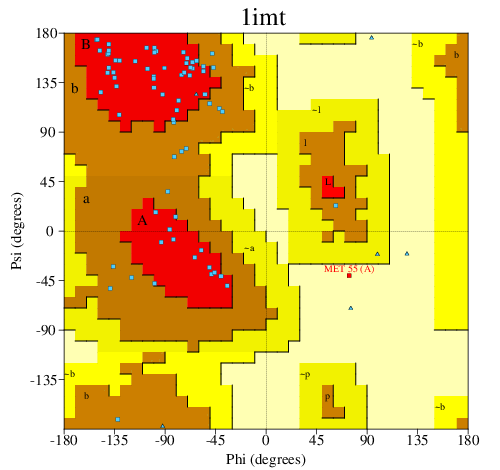
PROCHECK
|
|
|
|
|
|
Headers
|
|
|
|
References
|
|
|
|
|
|

|
|
P25687
(MIT1_DENPO) -
Toxin MIT1 from Dendroaspis polylepis polylepis
|
|
|
|
Seq:
Struc:
|
|
|
|
81 a.a.
80 a.a.
|
|

|

|
|
|
|
|
|
|
|
|
|
|
|
Key: |
 |
PfamA domain |
|
|
 |
Secondary structure |
|
 |
CATH domain |
|
|
|
|
|
|
|
|
|
|
|
|
|
|
|
|
|
 |
|
|
|
|
|
|
| |
|
DOI no:
|
J Mol Biol
283:205-219
(1998)
|
|
PubMed id:
|
|
|
|
|
|
| |
|
A structural homologue of colipase in black mamba venom revealed by NMR floating disulphide bridge analysis.
|
|
J.Boisbouvier,
J.P.Albrand,
M.Blackledge,
M.Jaquinod,
H.Schweitz,
M.Lazdunski,
D.Marion.
|
|
|
|
|
| |
ABSTRACT
|
|
|
|
| |
|
|
The solution structure of mamba intestinal toxin 1 (MIT1), isolated from
Dendroaspis polylepis polylepis venom, has been determined. This molecule is a
cysteine-rich polypeptide exhibiting no recognised family membership. Resistance
to MIT1 to classical specific endoproteases produced contradictory NMR and
biochemical information concerning disulphide-bridge topology. We have used
distance restraints allowing ambiguous partners between S atoms in combination
with NMR-derived structural information, to correctly determine the
disulphide-bridge topology. The resultant solution structure of MIT1, determined
to a resolution of 0.5 A, reveals an unexpectedly similar global fold with
respect to colipase, a protein involved in fatty acid digestion. Colipase
exhibits an analogous resistance to endoprotease activity, indicating for the
first time the possible topological origins of this biochemical property. The
biochemical and structural homology permitted us to propose a mechanically
related digestive function for MIT1 and provides novel information concerning
snake venom protein evolution.
|
|
|
|
|
|
| |
Selected figure(s)
|
|
|
|
| |
|
|

|
|

|
|
Figure 5.
Figure 5. Solution structure of MIT1. (a) Backbone and
disulphide-bridge heavy atoms from residues 5 to 80 of the 39
NMR conformers (calculations rMD, Table 1). N, C and C^a atoms
from residues 6 to 79 of each structure were superimposed on the
average structure atoms. Central core residue backbone atoms (5
to 10, 16 to 21, 29 to 43, 57 to 69 and 75 to 80) are displayed
in blue, extremity residue backbone atoms of each finger (11 to
15, 22 to 28, 44 to 56 and 70 to 74) are displayed in red, and
disulphide-bridges in yellow. (b) Stereo view of the conformer
closest to the mean structure of the 39 conformers shown in (a).
The following colours were used for the side-chains: blue, Arg
and Lys; red, Glu and Asp; yellow, Ala, Cys, Ile, Leu, Met, Phe,
Pro, Trp and Val; grey, Asn, Gln, Ser, Thr and His. Buried
side-chains of the inner ionic bridge; Asp10 and Arg54 are
displayed with a thicker stick and are labelled. The His46 O
atom is labelled.
|
|
Figure 9.
Figure 9. Electrostatic potentials map of colipase and
MIT1. (a) and (b) The exposed surface of colipase, (c) and (d)
were coloured with the electrostatic potential [Gilson et al
1987] by linear interpolation between red (f(r)< -3 kT,
negative), white (f(r = 0 kT, neutral) and blue (f(r)>3 kT,
positive). (a) and (c) Surfaces were displayed with the same
orientation as Figure 5. (b) and (d) Representations were turned
by 180° with respect to the vertical axis.
|
|
|
|
|
|
| |
The above figures are
reprinted
by permission from Elsevier:
J Mol Biol
(1998,
283,
205-219)
copyright 1998.
|
|
| |
Figures were
selected
by an automated process.
|
|
|
|
|
|
|
|
|
|
|
|
|
|
|
|
 |
 |
 |
|
Literature references that cite this PDB file's key reference
|
|
|
| |
PubMed id
|
|
Reference
|
|
|
|
|
|
A.Watthanasurorot,
K.Söderhäll,
P.Jiravanichpaisal,
and
I.Söderhäll
(2011).
An ancient cytokine, astakine, mediates circadian regulation of invertebrate hematopoiesis.
|
| |
Cell Mol Life Sci,
68,
315-323.
|
|
|
|
|
|
|
R.A.Morales,
N.L.Daly,
I.Vetter,
M.Mobli,
I.A.Napier,
D.J.Craik,
R.J.Lewis,
M.J.Christie,
G.F.King,
P.F.Alewood,
and
T.Durek
(2010).
Chemical synthesis and structure of the prokineticin Bv8.
|
| |
Chembiochem,
11,
1882-1888.
|
|
|
PDB code:
|
|
|
|
|
|
|
|
B.G.Fry,
K.Roelants,
D.E.Champagne,
H.Scheib,
J.D.Tyndall,
G.F.King,
T.J.Nevalainen,
J.A.Norman,
R.J.Lewis,
R.S.Norton,
C.Renjifo,
and
R.C.de la Vega
(2009).
The toxicogenomic multiverse: convergent recruitment of proteins into animal venoms.
|
| |
Annu Rev Genomics Hum Genet,
10,
483-511.
|
|
|
|
|
|
|
F.Shojaei,
M.Singh,
J.D.Thompson,
and
N.Ferrara
(2008).
Role of Bv8 in neutrophil-dependent angiogenesis in a transgenic model of cancer progression.
|
| |
Proc Natl Acad Sci U S A,
105,
2640-2645.
|
|
|
|
|
|
|
L.Chen,
K.Wang,
Y.Shao,
J.Huang,
X.Li,
J.Shan,
D.Wu,
and
J.J.Zheng
(2008).
Structural insight into the mechanisms of wnt signaling antagonism by dkk.
|
| |
J Biol Chem,
283,
23364-23370.
|
|
|
PDB code:
|
|
|
|
|
|
|
|
D.Maldonado-Pérez,
J.Evans,
F.Denison,
R.P.Millar,
and
H.N.Jabbour
(2007).
Potential roles of the prokineticins in reproduction.
|
| |
Trends Endocrinol Metab,
18,
66-72.
|
|
|
|
|
|
|
L.Negri,
R.Lattanzi,
E.Giannini,
and
P.Melchiorri
(2007).
Bv8/Prokineticin proteins and their receptors.
|
| |
Life Sci,
81,
1103-1116.
|
|
|
|
|
|
|
C.Niehrs
(2006).
Function and biological roles of the Dickkopf family of Wnt modulators.
|
| |
Oncogene,
25,
7469-7481.
|
|
|
|
|
|
|
Q.Y.Zhou
(2006).
The prokineticins: a novel pair of regulatory peptides.
|
| |
Mol Interv,
6,
330-338.
|
|
|
|
|
|
|
L.Negri,
R.Lattanzi,
E.Giannini,
M.A.Colucci,
G.Mignogna,
D.Barra,
F.Grohovaz,
F.Codazzi,
A.Kaiser,
G.Kreil,
and
P.Melchiorri
(2005).
Biological activities of Bv8 analogues.
|
| |
Br J Pharmacol,
146,
625-632.
|
|
|
|
|
|
|
J.LeCouter,
C.Zlot,
M.Tejada,
F.Peale,
and
N.Ferrara
(2004).
Bv8 and endocrine gland-derived vascular endothelial growth factor stimulate hematopoiesis and hematopoietic cell mobilization.
|
| |
Proc Natl Acad Sci U S A,
101,
16813-16818.
|
|
|
|
|
|
|
A.Kaser,
M.Winklmayr,
G.Lepperdinger,
and
G.Kreil
(2003).
The AVIT protein family. Secreted cysteine-rich vertebrate proteins with diverse functions.
|
| |
EMBO Rep,
4,
469-473.
|
|
|
|
|
|
|
J.LeCouter,
R.Lin,
M.Tejada,
G.Frantz,
F.Peale,
K.J.Hillan,
and
N.Ferrara
(2003).
The endocrine-gland-derived VEGF homologue Bv8 promotes angiogenesis in the testis: Localization of Bv8 receptors to endothelial cells.
|
| |
Proc Natl Acad Sci U S A,
100,
2685-2690.
|
|
|
|
|
|
|
J.LeCouter,
and
N.Ferrara
(2002).
EG-VEGF and the concept of tissue-specific angiogenic growth factors.
|
| |
Semin Cell Dev Biol,
13,
3-8.
|
|
|
|
|
|
|
R.Lin,
J.LeCouter,
J.Kowalski,
and
N.Ferrara
(2002).
Characterization of endocrine gland-derived vascular endothelial growth factor signaling in adrenal cortex capillary endothelial cells.
|
| |
J Biol Chem,
277,
8724-8729.
|
|
|
|
|
|
|
H.van Tilbeurgh,
S.Bezzine,
C.Cambillau,
R.Verger,
and
F.Carrière
(1999).
Colipase: structure and interaction with pancreatic lipase.
|
| |
Biochim Biophys Acta,
1441,
173-184.
|
|
|
|
|
|
The most recent references are shown first.
Citation data come partly from CiteXplore and partly
from an automated harvesting procedure. Note that this is likely to be
only a partial list as not all journals are covered by
either method. However, we are continually building up the citation data
so more and more references will be included with time.
Where a reference describes a PDB structure, the PDB
code is
shown on the right.
|
|


 Links
Links


