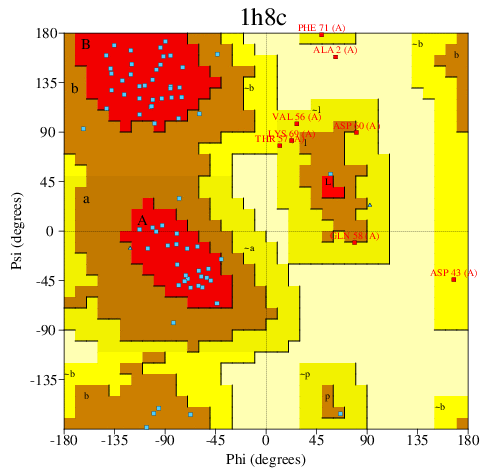
|
PDBsum entry 1h8c

|
|
|
|
|
 |
Contents |
 |
|
|
|
|
|
|
|
|
* Residue conservation analysis
|
|
|
|
|
|
|
|
|
|
|
|
|
|
|
 |
|
|
|
|
|
|
| |
|
DOI no:
|
J Mol Biol
307:17-24
(2001)
|
|
PubMed id:
|
|
|
|
|
|
| |
|
The UBX domain: a widespread ubiquitin-like module.
|
|
A.Buchberger,
M.J.Howard,
M.Proctor,
M.Bycroft.
|
|
|
|
|
| |
ABSTRACT
|
|
|
|
| |
|
|
The UBX domain is an 80 amino acid residue module that is present typically at
the carboxyl terminus of a variety of eukaryotic proteins. In an effort to
elucidate the function of UBX domains, we solved the three-dimensional structure
of the UBX domain of human Fas-associated factor-1 (FAF1) by NMR spectroscopy.
The structure has a beta-Grasp fold characterised by a
beta-beta-alpha-beta-beta-alpha-beta secondary-structure organisation. The five
beta strands are arranged into a mixed sheet in the order 21534. The longer
first helix packs across the first three strands of the sheet, and a second
shorter 3(10) helix is located in an extended loop connecting strands 4 and 5.
In the absence of significant sequence similarity, the UBX domain can be
superimposed with ubiquitin with an r.m.s.d. of 1.9 A, suggesting that the two
structures share the same superfold, and an evolutionary relationship. However,
the absence of a carboxyl-terminal extension containing a double glycine motif
and of suitably positioned lysine side-chains makes it highly unlikely that UBX
domains are either conjugated to other proteins or part of mixed UBX-ubiquitin
chains. Database searches revealed that most UBX domain-containing proteins
belong to one of four evolutionarily conserved families represented by the human
FAF1, p47, Y33K, and Rep8 proteins. A role of the UBX domain in
ubiquitin-related processes is suggested.
|
|
|
|
|
|
| |
Selected figure(s)
|
|
|
|
| |
|
|

|
|

|
|
Figure 1.
Figure 1. Three-dimensional structure of the UBX domain of
human FAF1. (a) Stereo view of an overlay of the 20 best NMR
structures. (b) Ribbon representation in the same orientation as
in (a), highlighting the structural elements. (c) Conserved
putative interaction site. The side-chains of the exposed and
conserved residues R11, F51, P52, and R53 are depicted as
ball-and-stick models. (b) and (c) were prepared using MOLSCRIPT
[Kraulis 1991]. The DNA sequence encoding the carboxyl-terminal
100 residues of human FAF1 was cloned into the pRSET-derived
pHisGro vector (M. P. & A. R. Fersht, unpublished results)
allowing for expression of the FAF1 UBX domain as a
hexahistidine-tagged fusion protein with the apical domain of
GroEL. Expression of isotopically labelled protein in E. coli
C41 (DE3) cells, purification, and proteolytic removal of the
fusion moiety were performed as described [Buchberger et al
2000]. NMR samples were 5 mM protein in 20 mM phosphate buffer
(pH 5.8). NMR spectra were recorded at 37°C on a Bruker AMX
500 spectrometer equipped with a pulsed field gradient, triple
resonance probe. Resonance assignments were obtained using
standard double and triple resonance experiments [Bax and
Grzesiek 1993]. Briefly, backbone assignments were obtained
using 3D 1H,15N-edited TOCSY, HBHACONH, CBCACONH and HNCACB
experiments. Side-chain assignments were obtained from HCCONH
and CCONH experiments recorded on a Bruker DRX 600 spectrometer.
Additional side-chain assignments were obtained using 2D 1H,1H
DQF-COSY, 2D 1H,1H TOCSY and 3D HCCH-TOCSY experiments.
Stereospecific assignments for the methyl groups of valine and
leucine residues were obtained as described [Neri et al 1989]
using a 10 % fractionally 13C-labelled sample. The assignments
have been deposited in the BioMagResBank under accession number
4952. Torsional restraints for 43 f and 43 q angles were
obtained from an analysis of C', N, C^a, Ha, and C^b chemical
shifts with TALOS [Cornilescu et al 1999a] and from experimental
3J[HNHa] coupling constants measured using an HNHA experiment
[Kuboniwa et al 1994]. x1 side-chain restraints for 30 residues
were determined from J[ab] coupling constants measured by a HNHB
experiment and from NOE data. Distance restraints were obtained
from the analysis of 2D 1H,1H NOESY, 3D 1H,15N-edited NOESY and
3D 1H,13C-edited NOESY experiments all recorded with 100 ms
mixing time. Peak volumes were converted into inter-proton
distance restraints based on known distances. The distance
restraints were then classified as strong, medium or weak,
corresponding to upper distance bounds of 2.7 Å, 3.3
Å, and 5.0 Å, respectively. An additional 0.5
Å was added to upper distance bounds for atoms involving
methyl protons. A lower distance bound of 1.8 Å was used
for all NOE-derived distance restraints. Structures were
calculated using 207 intra-residue, 186 sequential, 92
medium-range and 322 long-range NOE restraints after elimination
of redundant distance restraints using the program AQUA
[Laskowski et al 1996]. In addition, 33 hydrogen bond restraints
were used in the calculations. These were based on the
observation of J connectivity between amide protons and hydrogen
bond-accepting carbonyl carbon atoms [Cornilescu et al 1999b],
the identification of potential hydrogen bond donors from a
1H,15N HSQC spectrum recorded immediately after dissolving a
protein sample in 100 % 2H[2]O, and the characteristic NOE
patterns that are observed for residues in regular secondary
structure [Wuthrich 1986]. Structures were calculated using
simulated annealing from random starting structures using the
program X-PLOR 3.8 [Brunger 1992]. The coordinates have been
deposited in the PDB, entry 1H8C.
|
|
Figure 3.
Figure 3. Structural alignment of the UBX domain with
ubiquitin. (a) Stereoview of the superimposed backbone traces of
the FAF1 UBX domain (yellow) and human ubiquitin (magenta; PDB
entry 1aar). The superimposition was done using Insight (MSI).
The orientation is the same as in Figure 1(a). (b) Sequence
alignment based on the structure comparison. Elements of
secondary structure are indicated above and below the sequences
of the FAF1 UBX domain and human ubiquitin, respectively.
|
|
|
|
|
|
| |
The above figures are
reprinted
by permission from Elsevier:
J Mol Biol
(2001,
307,
17-24)
copyright 2001.
|
|
| |
Figures were
selected
by an automated process.
|
|
|
|
|
|
|
|
|
|
|
|
|
|
|
|
 |
 |
 |
|
Literature references that cite this PDB file's key reference
|
|
|
| |
PubMed id
|
|
Reference
|
|
|
|
|
|
W.Kang,
and
J.K.Yang
(2011).
Crystal structure of human FAF1 UBX domain reveals a novel FcisP touch-turn motif in p97/VCP-binding region.
|
| |
Biochem Biophys Res Commun,
407,
531-534.
|
|
|
PDB code:
|
|
|
|
|
|
|
|
D.S.Haines
(2010).
p97-containing complexes in proliferation control and cancer: emerging culprits or guilt by association?
|
| |
Genes Cancer,
1,
753-763.
|
|
|
|
|
|
|
Y.Sasagawa,
K.Yamanaka,
Y.Saito-Sasagawa,
and
T.Ogura
(2010).
Caenorhabditis elegans UBX cofactors for CDC-48/p97 control spermatogenesis.
|
| |
Genes Cells,
15,
1201-1215.
|
|
|
|
|
|
|
C.W.Menges,
D.A.Altomare,
and
J.R.Testa
(2009).
FAS-associated factor 1 (FAF1): diverse functions and implications for oncogenesis.
|
| |
Cell Cycle,
8,
2528-2534.
|
|
|
|
|
|
|
K.Rezvani,
Y.Teng,
Y.Pan,
J.A.Dani,
J.Lindstrom,
E.A.García Gras,
J.M.McIntosh,
and
M.De Biasi
(2009).
UBXD4, a UBX-containing protein, regulates the cell surface number and stability of alpha3-containing nicotinic acetylcholine receptors.
|
| |
J Neurosci,
29,
6883-6896.
|
|
|
|
|
|
|
L.Madsen,
M.Seeger,
C.A.Semple,
and
R.Hartmann-Petersen
(2009).
New ATPase regulators--p97 goes to the PUB.
|
| |
Int J Biochem Cell Biol,
41,
2380-2388.
|
|
|
|
|
|
|
S.M.Alberts,
C.Sonntag,
A.Schäfer,
and
D.H.Wolf
(2009).
Ubx4 modulates cdc48 activity and influences degradation of misfolded proteins of the endoplasmic reticulum.
|
| |
J Biol Chem,
284,
16082-16089.
|
|
|
|
|
|
|
L.Madsen,
K.M.Andersen,
S.Prag,
T.Moos,
C.A.Semple,
M.Seeger,
and
R.Hartmann-Petersen
(2008).
Ubxd1 is a novel co-factor of the human p97 ATPase.
|
| |
Int J Biochem Cell Biol,
40,
2927-2942.
|
|
|
|
|
|
|
L.Sanchez-Pulido,
D.Devos,
Z.R.Sung,
and
M.Calonje
(2008).
RAWUL: a new ubiquitin-like domain in PRC1 ring finger proteins that unveils putative plant and worm PRC1 orthologs.
|
| |
BMC Genomics,
9,
308.
|
|
|
|
|
|
|
V.Goder,
P.Carvalho,
and
T.A.Rapoport
(2008).
The ER-associated degradation component Der1p and its homolog Dfm1p are contained in complexes with distinct cofactors of the ATPase Cdc48p.
|
| |
FEBS Lett,
582,
1575-1580.
|
|
|
|
|
|
|
G.Zhao,
X.Zhou,
L.Wang,
G.Li,
H.Schindelin,
and
W.J.Lennarz
(2007).
Studies on peptide:N-glycanase-p97 interaction suggest that p97 phosphorylation modulates endoplasmic reticulum-associated degradation.
|
| |
Proc Natl Acad Sci U S A,
104,
8785-8790.
|
|
|
PDB codes:
|
|
|
|
|
|
|
|
S.Jentsch,
and
S.Rumpf
(2007).
Cdc48 (p97): a "molecular gearbox" in the ubiquitin pathway?
|
| |
Trends Biochem Sci,
32,
6.
|
|
|
|
|
|
|
S.Park,
D.M.Rancour,
and
S.Y.Bednarek
(2007).
Protein domain-domain interactions and requirements for the negative regulation of Arabidopsis CDC48/p97 by the plant ubiquitin regulatory X (UBX) domain-containing protein, PUX1.
|
| |
J Biol Chem,
282,
5217-5224.
|
|
|
|
|
|
|
S.Raasi,
and
D.H.Wolf
(2007).
Ubiquitin receptors and ERAD: a network of pathways to the proteasome.
|
| |
Semin Cell Dev Biol,
18,
780-791.
|
|
|
|
|
|
|
A.L.Folpe,
and
A.T.Deyrup
(2006).
Alveolar soft-part sarcoma: a review and update.
|
| |
J Clin Pathol,
59,
1127-1132.
|
|
|
|
|
|
|
J.D.Wilson,
Y.Liu,
C.M.Bentivoglio,
and
C.Barlowe
(2006).
Sel1p/Ubx2p participates in a distinct Cdc48p-dependent endoplasmic reticulum-associated degradation pathway.
|
| |
Traffic,
7,
1213-1223.
|
|
|
|
|
|
|
M.D.Allen,
A.Buchberger,
and
M.Bycroft
(2006).
The PUB domain functions as a p97 binding module in human peptide N-glycanase.
|
| |
J Biol Chem,
281,
25502-25508.
|
|
|
PDB codes:
|
|
|
|
|
|
|
|
S.Rumpf,
and
S.Jentsch
(2006).
Functional division of substrate processing cofactors of the ubiquitin-selective Cdc48 chaperone.
|
| |
Mol Cell,
21,
261-269.
|
|
|
|
|
|
|
C.Schuberth,
and
A.Buchberger
(2005).
Membrane-bound Ubx2 recruits Cdc48 to ubiquitin ligases and their substrates to ensure efficient ER-associated protein degradation.
|
| |
Nat Cell Biol,
7,
999.
|
|
|
|
|
|
|
E.J.Song,
S.H.Yim,
E.Kim,
N.S.Kim,
and
K.J.Lee
(2005).
Human Fas-associated factor 1, interacting with ubiquitinated proteins and valosin-containing protein, is involved in the ubiquitin-proteasome pathway.
|
| |
Mol Cell Biol,
25,
2511-2524.
|
|
|
|
|
|
|
N.J.Marianayagam,
and
S.E.Jackson
(2005).
Native-state dynamics of the ubiquitin family: implications for function and evolution.
|
| |
J R Soc Interface,
2,
47-54.
|
|
|
|
|
|
|
R.Farràs,
G.Bossis,
E.Andermarcher,
I.Jariel-Encontre,
and
M.Piechaczyk
(2005).
Mechanisms of delivery of ubiquitylated proteins to the proteasome: new target for anti-cancer therapy?
|
| |
Crit Rev Oncol Hematol,
54,
31-51.
|
|
|
|
|
|
|
R.L.Welchman,
C.Gordon,
and
R.J.Mayer
(2005).
Ubiquitin and ubiquitin-like proteins as multifunctional signals.
|
| |
Nat Rev Mol Cell Biol,
6,
599-609.
|
|
|
|
|
|
|
S.Elsasser,
and
D.Finley
(2005).
Delivery of ubiquitinated substrates to protein-unfolding machines.
|
| |
Nat Cell Biol,
7,
742-749.
|
|
|
|
|
|
|
B.L.Lytle,
F.C.Peterson,
S.H.Qiu,
M.Luo,
Q.Zhao,
J.L.Markley,
and
B.F.Volkman
(2004).
Solution structure of a ubiquitin-like domain from tubulin-binding cofactor B.
|
| |
J Biol Chem,
279,
46787-46793.
|
|
|
PDB code:
|
|
|
|
|
|
|
|
C.Schuberth,
H.Richly,
S.Rumpf,
and
A.Buchberger
(2004).
Shp1 and Ubx2 are adaptors of Cdc48 involved in ubiquitin-dependent protein degradation.
|
| |
EMBO Rep,
5,
818-824.
|
|
|
|
|
|
|
D.M.Rancour,
S.Park,
S.D.Knight,
and
S.Y.Bednarek
(2004).
Plant UBX domain-containing protein 1, PUX1, regulates the oligomeric structure and activity of arabidopsis CDC48.
|
| |
J Biol Chem,
279,
54264-54274.
|
|
|
|
|
|
|
I.Dreveny,
H.Kondo,
K.Uchiyama,
A.Shaw,
X.Zhang,
and
P.S.Freemont
(2004).
Structural basis of the interaction between the AAA ATPase p97/VCP and its adaptor protein p47.
|
| |
EMBO J,
23,
1030-1039.
|
|
|
PDB code:
|
|
|
|
|
|
|
|
M.Albrecht,
M.Golatta,
U.Wüllner,
and
T.Lengauer
(2004).
Structural and functional analysis of ataxin-2 and ataxin-3.
|
| |
Eur J Biochem,
271,
3155-3170.
|
|
|
|
|
|
|
M.Y.Park,
H.D.Jang,
S.Y.Lee,
K.J.Lee,
and
E.Kim
(2004).
Fas-associated factor-1 inhibits nuclear factor-kappaB (NF-kappaB) activity by interfering with nuclear translocation of the RelA (p65) subunit of NF-kappaB.
|
| |
J Biol Chem,
279,
2544-2549.
|
|
|
|
|
|
|
R.Hartmann-Petersen,
and
C.Gordon
(2004).
Integral UBL domain proteins: a family of proteasome interacting proteins.
|
| |
Semin Cell Dev Biol,
15,
247-259.
|
|
|
|
|
|
|
R.Hartmann-Petersen,
M.Wallace,
K.Hofmann,
G.Koch,
A.H.Johnsen,
K.B.Hendil,
and
C.Gordon
(2004).
The Ubx2 and Ubx3 cofactors direct Cdc48 activity to proteolytic and nonproteolytic ubiquitin-dependent processes.
|
| |
Curr Biol,
14,
824-828.
|
|
|
|
|
|
|
R.M.Bruderer,
C.Brasseur,
and
H.H.Meyer
(2004).
The AAA ATPase p97/VCP interacts with its alternative co-factors, Ufd1-Npl4 and p47, through a common bipartite binding mechanism.
|
| |
J Biol Chem,
279,
49609-49616.
|
|
|
|
|
|
|
X.Yuan,
P.Simpson,
C.McKeown,
H.Kondo,
K.Uchiyama,
R.Wallis,
I.Dreveny,
C.Keetch,
X.Zhang,
C.Robinson,
P.Freemont,
and
S.Matthews
(2004).
Structure, dynamics and interactions of p47, a major adaptor of the AAA ATPase, p97.
|
| |
EMBO J,
23,
1463-1473.
|
|
|
PDB codes:
|
|
|
|
|
|
|
|
D.Bartkeviciute,
and
K.Sasnauskas
(2003).
Studies of yeast Kluyveromyces lactis mutations conferring super-secretion of recombinant proteins.
|
| |
Yeast,
20,
1.
|
|
|
|
|
|
|
J.S.Bogan,
N.Hendon,
A.E.McKee,
T.S.Tsao,
and
H.F.Lodish
(2003).
Functional cloning of TUG as a regulator of GLUT4 glucose transporter trafficking.
|
| |
Nature,
425,
727-733.
|
|
|
|
|
|
|
M.Grynberg,
L.Jaroszewski,
and
A.Godzik
(2003).
Domain analysis of the tubulin cofactor system: a model for tubulin folding and dimerization.
|
| |
BMC Bioinformatics,
4,
46.
|
|
|
|
|
|
|
M.H.Kim,
T.Cierpicki,
U.Derewenda,
D.Krowarsch,
Y.Feng,
Y.Devedjiev,
Z.Dauter,
C.A.Walsh,
J.Otlewski,
J.H.Bushweller,
and
Z.S.Derewenda
(2003).
The DCX-domain tandems of doublecortin and doublecortin-like kinase.
|
| |
Nat Struct Biol,
10,
324-333.
|
|
|
PDB codes:
|
|
|
|
|
|
|
|
R.Hartmann-Petersen,
C.A.Semple,
C.P.Ponting,
K.B.Hendil,
and
C.Gordon
(2003).
UBA domain containing proteins in fission yeast.
|
| |
Int J Biochem Cell Biol,
35,
629-636.
|
|
|
|
|
|
|
R.Hartmann-Petersen,
M.Seeger,
and
C.Gordon
(2003).
Transferring substrates to the 26S proteasome.
|
| |
Trends Biochem Sci,
28,
26-31.
|
|
|
|
|
|
|
H.Katoh,
A.Harada,
K.Mori,
and
M.Negishi
(2002).
Socius is a novel Rnd GTPase-interacting protein involved in disassembly of actin stress fibers.
|
| |
Mol Cell Biol,
22,
2952-2964.
|
|
|
|
|
|
|
T.Doerks,
R.R.Copley,
J.Schultz,
C.P.Ponting,
and
P.Bork
(2002).
Systematic identification of novel protein domain families associated with nuclear functions.
|
| |
Genome Res,
12,
47-56.
|
|
|
|
|
|
|
H.Park,
T.Suzuki,
and
W.J.Lennarz
(2001).
Identification of proteins that interact with mammalian peptide:N-glycanase and implicate this hydrolase in the proteasome-dependent pathway for protein degradation.
|
| |
Proc Natl Acad Sci U S A,
98,
11163-11168.
|
|
|
|
|
|
The most recent references are shown first.
Citation data come partly from CiteXplore and partly
from an automated harvesting procedure. Note that this is likely to be
only a partial list as not all journals are covered by
either method. However, we are continually building up the citation data
so more and more references will be included with time.
Where a reference describes a PDB structure, the PDB
code is
shown on the right.
|
|


 Links
Links