 |
PDBsum entry 1vaz

|
|
|
|
|
|

|

|

|

|
|

|
|

|
|
|
 |

|

|
|
|
|
|
|
|
|
|
|
|
|
|
|
|
|
|
|
|
|
|
|
|
|
|
|
|
|
|
|
|
Lipid binding protein
|
PDB id
|
|
|
|
1vaz
|
|
|
|
|
|
|
|
|
|
|
|
|
|
|

|

|

|
|
|
|
|
|
|
|
 |
Contents |
 |
|
|
|
|
|
|
|
|
* Residue conservation analysis
|
|
|
|
|
|
PDB id:
|
|
|
|
| Name: |
|
Lipid binding protein
|
|
|
Title:
|
|
Solution structures of the p47 sep domain
|
|
Structure:
|
|
Nsfl1 cofactor p47. Chain: a. Fragment: p47 sep domain (residues 1-76). Synonym: p97 cofactor p47, xy body-associated protein xy40. Engineered: yes
|
|
Source:
|
|
Rattus norvegicus. Norway rat. Organism_taxid: 10116. Tissue: liver. Expressed in: escherichia coli. Expression_system_taxid: 562.
|
|
NMR struc:
|
|
10 models
|
|
|
Authors:
|
|
X.Yuan,P.Simpson,C.Mckeown,H.Kondo,K.Uchiyama,R.Wallis,I.Dreveny, C.Keetch,X.Zhang,C.Robinson,P.Freemont,S.Matthews
|
Key ref:

|
|
X.Yuan
et al.
(2004).
Structure, dynamics and interactions of p47, a major adaptor of the AAA ATPase, p97.
EMBO J,
23,
1463-1473.
PubMed id:
DOI:

|
|
|
Date:
|
|
|
20-Feb-04
|
Release date:
|
06-Apr-04
|
|
|
|
|
|
|
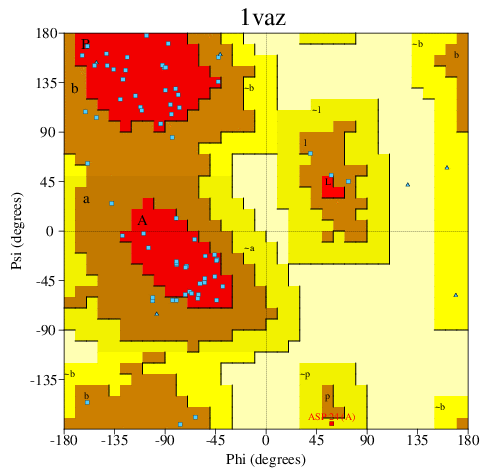
PROCHECK
|
|
|
|
|
|
Headers
|
|
|
|
References
|
|
|
|
|
|

|
|
O35987
(NSF1C_RAT) -
NSFL1 cofactor p47 from Rattus norvegicus
|
|
|
|
Seq:
Struc:
|
|
|
|
370 a.a.
76 a.a.
|
|

|

|

|
|
|
|
|
|
|
|
|
|
|
Key: |
 |
PfamA domain |
|
|
 |
Secondary structure |
|
 |
CATH domain |
|
|
|
|
|
|
|
|
|
|
|
|
|
|
|
|
|
 |
|
|
|
|
|
|
| |
|
DOI no:
|
EMBO J
23:1463-1473
(2004)
|
|
PubMed id:
|
|
|
|
|
|
| |
|
Structure, dynamics and interactions of p47, a major adaptor of the AAA ATPase, p97.
|
|
X.Yuan,
P.Simpson,
C.McKeown,
H.Kondo,
K.Uchiyama,
R.Wallis,
I.Dreveny,
C.Keetch,
X.Zhang,
C.Robinson,
P.Freemont,
S.Matthews.
|
|
|
|
|
| |
ABSTRACT
|
|
|
|
| |
|
|
p47 is a major adaptor molecule of the cytosolic AAA ATPase p97. The principal
role of the p97-p47 complex is in regulation of membrane fusion events.
Mono-ubiquitin recognition by p47 has also been shown to be crucial in the
p97-p47-mediated Golgi membrane fusion events. Here, we describe the
high-resolution solution structures of the N-terminal UBA domain and the central
domain (SEP) from p47. The p47 UBA domain has the characteristic three-helix
bundle fold and forms a highly stable complex with ubiquitin. We report the
interaction surfaces of the two proteins and present a structure for the p47
UBA-ubiquitin complex. The p47 SEP domain adopts a novel fold with a
betabetabetaalphaalphabeta secondary structure arrangement, where beta4 pairs in
a parallel fashion to beta1. Based on biophysical studies, we demonstrate a
clear propensity for the self-association of p47. Furthermore, p97 N binding
abolishes p47 self-association, revealing the potential interaction surfaces for
recognition of other domains within p97 or the substrate.
|
|
|
|
|
|
| |
Selected figure(s)
|
|
|
|
| |
|
|

|
|

|
|
Figure 1.
Figure 1 Schematic representation of the domain structure of
full-length rat p47 and fragments used in this study.
|
|
Figure 4.
Figure 4 Comparison of p47 UBA -ubiquitin, CUE -ubiquitin and
di-ubiquitin structures. (A) C[  ]traces
representing the superimposition of the 10 refined p47 UBA
-ubiquitin complex structures using the HADDOCK approach. p47
UBA is shown in gold and ubiquitin in green. (B) Ribbon
representation of the p47 UBA -ubiquitin complex. (C) Ribbon
representation of the structure of the yeast CUE2-1 domain
-ubiquitin complex in the same orientation as in (B). The CUE
domain is shown in purple (Kang et al, 2003; Shih et al, 2003).
(D) Ribbon representation of the structure of Lys48-linked
di-ubiquitin in the same orientation as in (B) (Cook et al,
1992, 1994; Cummings et al, 1995; Beal et al, 1998; Phillips et
al, 2001; Varadan et al, 2002). ]traces
representing the superimposition of the 10 refined p47 UBA
-ubiquitin complex structures using the HADDOCK approach. p47
UBA is shown in gold and ubiquitin in green. (B) Ribbon
representation of the p47 UBA -ubiquitin complex. (C) Ribbon
representation of the structure of the yeast CUE2-1 domain
-ubiquitin complex in the same orientation as in (B). The CUE
domain is shown in purple (Kang et al, 2003; Shih et al, 2003).
(D) Ribbon representation of the structure of Lys48-linked
di-ubiquitin in the same orientation as in (B) (Cook et al,
1992, 1994; Cummings et al, 1995; Beal et al, 1998; Phillips et
al, 2001; Varadan et al, 2002).
|
|
|
|
|
|
| |
The above figures are
reprinted
from an Open Access publication published by Macmillan Publishers Ltd:
EMBO J
(2004,
23,
1463-1473)
copyright 2004.
|
|
| |
Figures were
selected
by an automated process.
|
|
|
|
|
|
|
|
|
|
|
|
|
|
|
|
 |
 |
 |
|
Literature references that cite this PDB file's key reference
|
|
|
| |
PubMed id
|
|
Reference
|
|
|
|
|
|
A.S.Fatimababy,
Y.L.Lin,
R.Usharani,
R.Radjacommare,
H.T.Wang,
H.L.Tsai,
Y.Lee,
and
H.Fu
(2010).
Cross-species divergence of the major recognition pathways of ubiquitylated substrates for ubiquitin/26S proteasome-mediated proteolysis.
|
| |
FEBS J,
277,
796-816.
|
|
|
|
|
|
|
H.Fu,
Y.L.Lin,
and
A.S.Fatimababy
(2010).
Proteasomal recognition of ubiquitylated substrates.
|
| |
Trends Plant Sci,
15,
375-386.
|
|
|
|
|
|
|
Y.Sasagawa,
K.Yamanaka,
Y.Saito-Sasagawa,
and
T.Ogura
(2010).
Caenorhabditis elegans UBX cofactors for CDC-48/p97 control spermatogenesis.
|
| |
Genes Cells,
15,
1201-1215.
|
|
|
|
|
|
|
J.M.Baugh,
E.G.Viktorova,
and
E.V.Pilipenko
(2009).
Proteasomes can degrade a significant proportion of cellular proteins independent of ubiquitination.
|
| |
J Mol Biol,
386,
814-827.
|
|
|
|
|
|
|
J.Song,
J.K.Park,
J.J.Lee,
Y.S.Choi,
K.S.Ryu,
J.H.Kim,
E.Kim,
K.J.Lee,
Y.H.Jeon,
and
E.E.Kim
(2009).
Structure and interaction of ubiquitin-associated domain of human Fas-associated factor 1.
|
| |
Protein Sci,
18,
2265-2276.
|
|
|
|
|
|
|
J.Long,
T.R.Gallagher,
J.R.Cavey,
P.W.Sheppard,
S.H.Ralston,
R.Layfield,
and
M.S.Searle
(2008).
Ubiquitin recognition by the ubiquitin-associated domain of p62 involves a novel conformational switch.
|
| |
J Biol Chem,
283,
5427-5440.
|
|
|
PDB codes:
|
|
|
|
|
|
|
|
G.Kozlov,
P.Peschard,
B.Zimmerman,
T.Lin,
T.Moldoveanu,
N.Mansur-Azzam,
K.Gehring,
and
M.Park
(2007).
Structural basis for UBA-mediated dimerization of c-Cbl ubiquitin ligase.
|
| |
J Biol Chem,
282,
27547-27555.
|
|
|
PDB code:
|
|
|
|
|
|
|
|
M.Sharon,
and
C.V.Robinson
(2007).
The role of mass spectrometry in structure elucidation of dynamic protein complexes.
|
| |
Annu Rev Biochem,
76,
167-193.
|
|
|
|
|
|
|
P.Peschard,
G.Kozlov,
T.Lin,
I.A.Mirza,
A.M.Berghuis,
S.Lipkowitz,
M.Park,
and
K.Gehring
(2007).
Structural basis for ubiquitin-mediated dimerization and activation of the ubiquitin protein ligase Cbl-b.
|
| |
Mol Cell,
27,
474-485.
|
|
|
PDB codes:
|
|
|
|
|
|
|
|
V.E.Pye,
F.Beuron,
C.A.Keetch,
C.McKeown,
C.V.Robinson,
H.H.Meyer,
X.Zhang,
and
P.S.Freemont
(2007).
Structural insights into the p97-Ufd1-Npl4 complex.
|
| |
Proc Natl Acad Sci U S A,
104,
467-472.
|
|
|
|
|
|
|
A.Boeddrich,
S.Gaumer,
A.Haacke,
N.Tzvetkov,
M.Albrecht,
B.O.Evert,
E.C.Müller,
R.Lurz,
P.Breuer,
N.Schugardt,
S.Plassmann,
K.Xu,
J.M.Warrick,
J.Suopanki,
U.Wüllner,
R.Frank,
U.F.Hartl,
N.M.Bonini,
and
E.E.Wanker
(2006).
An arginine/lysine-rich motif is crucial for VCP/p97-mediated modulation of ataxin-3 fibrillogenesis.
|
| |
EMBO J,
25,
1547-1558.
|
|
|
|
|
|
|
B.K.Sato,
and
R.Y.Hampton
(2006).
Yeast Derlin Dfm1 interacts with Cdc48 and functions in ER homeostasis.
|
| |
Yeast,
23,
1053-1064.
|
|
|
|
|
|
|
F.Beuron,
I.Dreveny,
X.Yuan,
V.E.Pye,
C.McKeown,
L.C.Briggs,
M.J.Cliff,
Y.Kaneko,
R.Wallis,
R.L.Isaacson,
J.E.Ladbury,
S.J.Matthews,
H.Kondo,
X.Zhang,
and
P.S.Freemont
(2006).
Conformational changes in the AAA ATPase p97-p47 adaptor complex.
|
| |
EMBO J,
25,
1967-1976.
|
|
|
|
|
|
|
M.C.Tettamanzi,
C.Yu,
J.S.Bogan,
and
M.E.Hodsdon
(2006).
Solution structure and backbone dynamics of an N-terminal ubiquitin-like domain in the GLUT4-regulating protein, TUG.
|
| |
Protein Sci,
15,
498-508.
|
|
|
PDB code:
|
|
|
|
|
|
|
|
Y.G.Chang,
A.X.Song,
Y.G.Gao,
Y.H.Shi,
X.J.Lin,
X.T.Cao,
D.H.Lin,
and
H.Y.Hu
(2006).
Solution structure of the ubiquitin-associated domain of human BMSC-UbP and its complex with ubiquitin.
|
| |
Protein Sci,
15,
1248-1259.
|
|
|
PDB codes:
|
|
|
|
|
|
|
|
A.D.van Dijk,
R.Boelens,
and
A.M.Bonvin
(2005).
Data-driven docking for the study of biomolecular complexes.
|
| |
FEBS J,
272,
293-312.
|
|
|
|
|
|
|
A.Ohno,
J.Jee,
K.Fujiwara,
T.Tenno,
N.Goda,
H.Tochio,
H.Kobayashi,
H.Hiroaki,
and
M.Shirakawa
(2005).
Structure of the UBA domain of Dsk2p in complex with ubiquitin molecular determinants for ubiquitin recognition.
|
| |
Structure,
13,
521-532.
|
|
|
PDB code:
|
|
|
|
|
|
|
|
L.Hicke,
H.L.Schubert,
and
C.P.Hill
(2005).
Ubiquitin-binding domains.
|
| |
Nat Rev Mol Cell Biol,
6,
610-621.
|
|
|
|
|
|
|
S.Raasi,
R.Varadan,
D.Fushman,
and
C.M.Pickart
(2005).
Diverse polyubiquitin interaction properties of ubiquitin-associated domains.
|
| |
Nat Struct Mol Biol,
12,
708-714.
|
|
|
|
|
|
|
M.Albrecht,
M.Golatta,
U.Wüllner,
and
T.Lengauer
(2004).
Structural and functional analysis of ataxin-2 and ataxin-3.
|
| |
Eur J Biochem,
271,
3155-3170.
|
|
|
|
|
|
|
R.M.Bruderer,
C.Brasseur,
and
H.H.Meyer
(2004).
The AAA ATPase p97/VCP interacts with its alternative co-factors, Ufd1-Npl4 and p47, through a common bipartite binding mechanism.
|
| |
J Biol Chem,
279,
49609-49616.
|
|
|
|
|
|
The most recent references are shown first.
Citation data come partly from CiteXplore and partly
from an automated harvesting procedure. Note that this is likely to be
only a partial list as not all journals are covered by
either method. However, we are continually building up the citation data
so more and more references will be included with time.
Where a reference describes a PDB structure, the PDB
codes are
shown on the right.
|
|


 Links
Links


