
|
|
|
|
|
 |
Contents |
 |
|
|
|
|
|
|
|
|
|
|
* Residue conservation analysis
|
|
|
|
|
|
|
|
|
|
Enzyme class 2:
|
|
Chains A, B:
E.C.?
|
|
|
|
|
|
|
Enzyme class 3:
|
|
Chains C, D:
E.C.2.7.13.3
- histidine kinase.
|
|
|
|
|
|
|
Reaction:
|
|
ATP + protein L-histidine = ADP + protein N-phospho-L-histidine
|
|
|
|
|
|
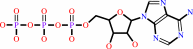 ATP
ATP
|
+
|
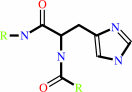 protein L-histidine
|
=
|
 ADP
ADP
|
+
|
protein N-phospho-L-histidine
|
|
|
|
|
|
|
|
|
|
|
|
|
Note, where more than one E.C. class is given (as above), each may
correspond to a different protein domain or, in the case of polyprotein
precursors, to a different mature protein.
|
|
|
|
Molecule diagrams generated from .mol files obtained from the
KEGG ftp site
|
|
|
|
|
|
|
|
|
|
|
|
|
|
 |
|
|
|
|
|
|
| |
|
|
| |
|
DOI no:
|
Proc Natl Acad Sci U S A
95:7333-7338
(1998)
|
|
PubMed id:
|
|
|
|
|
|
| |
|
Two binding modes reveal flexibility in kinase/response regulator interactions in the bacterial chemotaxis pathway.
|
|
M.M.McEvoy,
A.C.Hausrath,
G.B.Randolph,
S.J.Remington,
F.W.Dahlquist.
|
|
|
|
|
| |
ABSTRACT
|
|
|
|
| |
|
|
The crystal structure at 2.0-A resolution of the complex of the Escherichia coli
chemotaxis response regulator CheY and the phosphoacceptor-binding domain (P2)
of the kinase CheA is presented. The binding interface involves the fourth and
fifth helices and fifth beta-strand of CheY and both helices of P2.
Surprisingly, the two heterodimers in the asymmetric unit have two different
binding modes involving the same interface, suggesting some flexibility in the
binding regions. Significant conformational changes have occurred in CheY
compared with previously determined unbound structures. The active site of CheY
is exposed by the binding of the kinase domain, possibly to enhance
phosphotransfer from CheA to CheY. The conformational changes upon complex
formation as well as the observation that there are two different binding modes
suggest that the plasticity of CheY is an essential feature of response
regulator function.
|
|
|
|
|
|
| |
Selected figure(s)
|
|
|
|
| |
|
|

|
|

|
|
Figure 3.
Fig. 3. Active site region of CheY. The overlay of CheY
free (dark) and P2-bound (light) was based on a superposition of
the entire  -carbon
backbone. -carbon
backbone.
|
|
Figure 4.
Fig. 4. Sequence alignment of CheY and the response
regulator domain of CheB. The interface forming residues in CheY
of either heterodimer have a bar over the residue. Those
residues that form side-chain hydrogen bonds in either
heterodimer are indicated by  above the
residue. above the
residue.
|
|
|
|
| |
Figures were
selected
by an automated process.
|
|
|
|
|
|
|
|
|
|
|
|
|
|
|
|
 |
 |
 |
|
Literature references that cite this PDB file's key reference
|
|
|
| |
PubMed id
|
|
Reference
|
|
|
|
|
|
A.K.Eaton,
and
R.C.Stewart
(2009).
The two active sites of Thermotoga maritima CheA dimers bind ATP with dramatically different affinities.
|
| |
Biochemistry,
48,
6412-6422.
|
|
|
|
|
|
|
J.R.Frederick,
E.A.Rogers,
and
R.T.Marconi
(2008).
Analysis of a growth-phase-regulated two-component regulatory system in the periodontal pathogen Treponema denticola.
|
| |
J Bacteriol,
190,
6162-6169.
|
|
|
|
|
|
|
M.G.Lerner,
K.L.Meagher,
and
H.A.Carlson
(2008).
Automated clustering of probe molecules from solvent mapping of protein surfaces: new algorithms applied to hot-spot mapping and structure-based drug design.
|
| |
J Comput Aided Mol Des,
22,
727-736.
|
|
|
|
|
|
|
K.Wuichet,
R.P.Alexander,
and
I.B.Zhulin
(2007).
Comparative genomic and protein sequence analyses of a complex system controlling bacterial chemotaxis.
|
| |
Methods Enzymol,
422,
1.
|
|
|
|
|
|
|
M.H.Knaggs,
F.R.Salsbury,
M.H.Edgell,
and
J.S.Fetrow
(2007).
Insights into correlated motions and long-range interactions in CheY derived from molecular dynamics simulations.
|
| |
Biophys J,
92,
2062-2079.
|
|
|
|
|
|
|
A.S.Miller,
S.C.Kohout,
K.A.Gilman,
and
J.J.Falke
(2006).
CheA Kinase of bacterial chemotaxis: chemical mapping of four essential docking sites.
|
| |
Biochemistry,
45,
8699-8711.
|
|
|
|
|
|
|
C.M.Dyer,
and
F.W.Dahlquist
(2006).
Switched or not?: the structure of unphosphorylated CheY bound to the N terminus of FliM.
|
| |
J Bacteriol,
188,
7354-7363.
|
|
|
PDB code:
|
|
|
|
|
|
|
|
K.Muchová,
R.J.Lewis,
D.Perecko,
J.A.Brannigan,
J.C.Ladds,
A.Leech,
A.J.Wilkinson,
and
I.Barák
(2004).
Dimer-induced signal propagation in Spo0A.
|
| |
Mol Microbiol,
53,
829-842.
|
|
|
|
|
|
|
S.Y.Park,
B.D.Beel,
M.I.Simon,
A.M.Bilwes,
and
B.R.Crane
(2004).
In different organisms, the mode of interaction between two signaling proteins is not necessarily conserved.
|
| |
Proc Natl Acad Sci U S A,
101,
11646-11651.
|
|
|
PDB code:
|
|
|
|
|
|
|
|
G.Alexandre,
and
I.B.Zhulin
(2003).
Different evolutionary constraints on chemotaxis proteins CheW and CheY revealed by heterologous expression studies and protein sequence analysis.
|
| |
J Bacteriol,
185,
544-552.
|
|
|
|
|
|
|
G.S.Anand,
and
A.M.Stock
(2002).
Kinetic basis for the stimulatory effect of phosphorylation on the methylesterase activity of CheB.
|
| |
Biochemistry,
41,
6752-6760.
|
|
|
|
|
|
|
S.Da Re,
T.Tolstykh,
P.M.Wolanin,
and
J.B.Stock
(2002).
Genetic analysis of response regulator activation in bacterial chemotaxis suggests an intermolecular mechanism.
|
| |
Protein Sci,
11,
2644-2654.
|
|
|
|
|
|
|
A.H.West,
and
A.M.Stock
(2001).
Histidine kinases and response regulator proteins in two-component signaling systems.
|
| |
Trends Biochem Sci,
26,
369-376.
|
|
|
|
|
|
|
D.Jain,
K.J.Kaur,
and
D.M.Salunke
(2001).
Plasticity in protein-peptide recognition: crystal structures of two different peptides bound to concanavalin A.
|
| |
Biophys J,
80,
2912-2921.
|
|
|
PDB codes:
|
|
|
|
|
|
|
|
J.S.Wright,
and
R.J.Kadner
(2001).
The phosphoryl transfer domain of UhpB interacts with the response regulator UhpA.
|
| |
J Bacteriol,
183,
3149-3159.
|
|
|
|
|
|
|
M.Schuster,
R.E.Silversmith,
and
R.B.Bourret
(2001).
Conformational coupling in the chemotaxis response regulator CheY.
|
| |
Proc Natl Acad Sci U S A,
98,
6003-6008.
|
|
|
|
|
|
|
P.Gouet,
N.Chinardet,
M.Welch,
V.Guillet,
S.Cabantous,
C.Birck,
L.Mourey,
and
J.P.Samama
(2001).
Further insights into the mechanism of function of the response regulator CheY from crystallographic studies of the CheY--CheA(124--257) complex.
|
| |
Acta Crystallogr D Biol Crystallogr,
57,
44-51.
|
|
|
PDB codes:
|
|
|
|
|
|
|
|
T.Hübschmann,
H.J.Jorissen,
T.Börner,
W.Gärtner,
and
N.Tandeau de Marsac
(2001).
Phosphorylation of proteins in the light-dependent signalling pathway of a filamentous cyanobacterium.
|
| |
Eur J Biochem,
268,
3383-3389.
|
|
|
|
|
|
|
A.Bren,
and
M.Eisenbach
(2000).
How signals are heard during bacterial chemotaxis: protein-protein interactions in sensory signal propagation.
|
| |
J Bacteriol,
182,
6865-6873.
|
|
|
|
|
|
|
A.M.Stock,
V.L.Robinson,
and
P.N.Goudreau
(2000).
Two-component signal transduction.
|
| |
Annu Rev Biochem,
69,
183-215.
|
|
|
|
|
|
|
D.J.Rigden,
L.V.Mello,
and
D.J.Bertioli
(2000).
Structural modeling of a plant disease resistance gene product domain.
|
| |
Proteins,
41,
133-143.
|
|
|
|
|
|
|
D.S.Shah,
S.L.Porter,
D.C.Harris,
G.H.Wadhams,
P.A.Hamblin,
and
J.P.Armitage
(2000).
Identification of a fourth cheY gene in Rhodobacter sphaeroides and interspecies interaction within the bacterial chemotaxis signal transduction pathway.
|
| |
Mol Microbiol,
35,
101-112.
|
|
|
|
|
|
|
J.S.Wright,
I.N.Olekhnovich,
G.Touchie,
and
R.J.Kadner
(2000).
The histidine kinase domain of UhpB inhibits UhpA action at the Escherichia coli uhpT promoter.
|
| |
J Bacteriol,
182,
6279-6286.
|
|
|
|
|
|
|
J.Stock,
and
M.Levit
(2000).
Signal transduction: hair brains in bacterial chemotaxis.
|
| |
Curr Biol,
10,
R11-R14.
|
|
|
|
|
|
|
R.C.Stewart,
K.Jahreis,
and
J.S.Parkinson
(2000).
Rapid phosphotransfer to CheY from a CheA protein lacking the CheY-binding domain.
|
| |
Biochemistry,
39,
13157-13165.
|
|
|
|
|
|
|
A.L.Perraud,
V.Weiss,
and
R.Gross
(1999).
Signalling pathways in two-component phosphorelay systems.
|
| |
Trends Microbiol,
7,
115-120.
|
|
|
|
|
|
|
A.M.Bilwes,
L.A.Alex,
B.R.Crane,
and
M.I.Simon
(1999).
Structure of CheA, a signal-transducing histidine kinase.
|
| |
Cell,
96,
131-141.
|
|
|
PDB code:
|
|
|
|
|
|
|
|
C.Fabret,
V.A.Feher,
and
J.A.Hoch
(1999).
Two-component signal transduction in Bacillus subtilis: how one organism sees its world.
|
| |
J Bacteriol,
181,
1975-1983.
|
|
|
|
|
|
|
M.Kato,
T.Shimizu,
T.Mizuno,
and
T.Hakoshima
(1999).
Structure of the histidine-containing phosphotransfer (HPt) domain of the anaerobic sensor protein ArcB complexed with the chemotaxis response regulator CheY.
|
| |
Acta Crystallogr D Biol Crystallogr,
55,
1257-1263.
|
|
|
PDB code:
|
|
|
|
|
|
|
|
R.Dutta,
L.Qin,
and
M.Inouye
(1999).
Histidine kinases: diversity of domain organization.
|
| |
Mol Microbiol,
34,
633-640.
|
|
|
|
|
|
The most recent references are shown first.
Citation data come partly from CiteXplore and partly
from an automated harvesting procedure. Note that this is likely to be
only a partial list as not all journals are covered by
either method. However, we are continually building up the citation data
so more and more references will be included with time.
Where a reference describes a PDB structure, the PDB
code is
shown on the right.
|
 |


 Links
Links


