 |
PDBsum entry 1czc

|
|
|
|
|
 |
Contents |
 |
|
|
|
|
|
|
|
|
|
|
|
|
* Residue conservation analysis
|
|
|
|
|
|
|
|
|
|
|
Enzyme class:
|
|
E.C.2.6.1.1
- aspartate transaminase.
|
|
|
|
|
|
|
Reaction:
|
|
L-aspartate + 2-oxoglutarate = oxaloacetate + L-glutamate
|
|
|
|
|
|
L-aspartate
Bound ligand (Het Group name = )
matches with 90.00% similarity
|
+
|
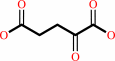 2-oxoglutarate
|
=
|
 oxaloacetate
|
+
|
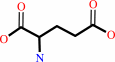 L-glutamate
|
|
|
|
|
|
|
|
|
|
Cofactor:
|
|
Pyridoxal 5'-phosphate
|
|
|
|
|
|
Pyridoxal 5'-phosphate
Bound ligand (Het Group name =
PLP)
matches with 93.75% similarity
|
|
|
|
|
|
|
Molecule diagrams generated from .mol files obtained from the
KEGG ftp site
|
|
|
|
|
|
|
|
|
|
|
|
|
|
 |
|
|
|
|
|
|
| |
|
|
| |
|
|
J Biochem (tokyo)
127:337-343
(2000)
|
|
PubMed id:
|
|
|
|
|
|
| |
|
Cocrystallization of a mutant aspartate aminotransferase with a C5-dicarboxylic substrate analog: structural comparison with the enzyme-C4-dicarboxylic analog complex.
|
|
S.Oue,
A.Okamoto,
T.Yano,
H.Kagamiyama.
|
|
|
|
|
| |
ABSTRACT
|
|
|
|
| |
|
|
A mutant Escherichia coil aspartate aminotransferase with 17 amino acid
substitutions (ATB17), previously created by directed evolution, shows increased
activity for beta-branched amino acids and decreased activity for the native
substrates, aspartate and glutamate. A new mutant (ATBSN) was generated by
changing two of the 17 mutated residues back to the original ones. ATBSN
recovered the activities for aspartate and glutamate to the level of the
wild-type enzyme while maintaining the enhanced activity of ATB17 for the other
amino acid substrates. The absorption spectrum of the bound coenzyme, pyridoxal
5'-phosphate, also returned to the original state. ATBSN shows significantly
increased affinity for substrate analogs including succinate and glutarate,
analogs of aspartate and glutamate, respectively. Hence, we could cocrystallize
ATBSN with succinate or glutarate, and the structures show how the enzyme can
bind two kinds of dicarboxylic substrates with different chain lengths. The
present results may also provide an insight into the long-standing controversies
regarding the mode of binding of glutamate to the wild-type enzyme.
|
|
|
|
|
|
|
|
|
|
|
|
|
|
|
|
|
|
 |
 |
 |
|
Literature references that cite this PDB file's key reference
|
|
|
| |
PubMed id
|
|
Reference
|
|
|
|
|
|
A.C.Eliot,
and
J.F.Kirsch
(2004).
Pyridoxal phosphate enzymes: mechanistic, structural, and evolutionary considerations.
|
| |
Annu Rev Biochem,
73,
383-415.
|
|
|
|
|
|
The most recent references are shown first.
Citation data come partly from CiteXplore and partly
from an automated harvesting procedure. Note that this is likely to be
only a partial list as not all journals are covered by
either method. However, we are continually building up the citation data
so more and more references will be included with time.
|
|


 Links
Links


