|
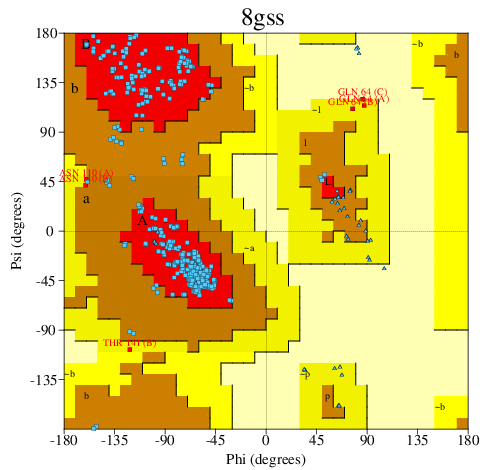
PDBsum entry 8gss

|
|
|
|
|
 |
Contents |
 |
|
|
|
|
|
|
|
|
|
|
|
|
* Residue conservation analysis
|
|
|
|
|
References listed in PDB file
|
|
|
Key reference
|
|
|
Title
|
|
The structures of human glutathione transferase p1-1 in complex with glutathione and various inhibitors at high resolution.
|
|
|
Authors
|
|
A.J.Oakley,
M.Lo bello,
A.Battistoni,
G.Ricci,
J.Rossjohn,
H.O.Villar,
M.W.Parker.
|
|
|
Ref.
|
|
J Mol Biol, 1997,
274,
84.
[DOI no: ]
|
|
|
PubMed id
|
|
|
|
|
|
Abstract
|
|
|
The human pi-class glutathione S-transferase (hGST P1-1) is a target for
structure-based inhibitor design with the aim of developing drugs that could be
used as adjuvants in chemotherapeutic treatment. Here we present seven crystal
structures of the enzyme in complex with substrate (glutathione) and two
inhibitors (S-hexyl glutathione and gamma-glutamyl-
(S-benzyl)cysteinyl-D-phenylglycine). The binding of the modified glutathione
inhibitor, gamma-glutamyl-(S-benzyl)cysteinyl-D-phenylglycine, has been
characterized with the phenyl group stacking against the benzyl moiety of the
inhibitor and making interactions with the active-site residues Phe8 and Trp38.
The structure provides an explanation as to why this compound inhibits the
pi-class GST much better than the other GST classes. The structure of the enzyme
in complex with glutathione has been determined to high resolution (1.9 to 2.2
A) in three different crystal forms and at two different temperatures (100 and
288 K). In one crystal form, the direct hydrogen-bonding interaction between the
hydroxyl group of Tyr7, a residue involved in catalysis, and the thiol group of
the substrate, glutathione, is broken and replaced by a water molecule that
mediates the interaction. The hydrogen-bonding partner of the hydroxyl group of
Tyr108, another residue implicated in the catalysis, is space-group dependent. A
high-resolution (2.0 A) structure of the enzyme in complex with S-hexyl
glutathione in a new crystal form is presented. The enzyme-inhibitor complexes
show that the binding of ligand into the electrophilic binding site does not
lead to any conformational changes of the protein.
|
|
|
|

|
|

|
|
Figure 3.
Figure 3. Schematic drawing of residues that interact with
the substrates and inhibitors. (a) GSH (C2 form, 100 K) and (b)
TER-117 (C2 form, 288 K). The key to the Figures is shown in
part (a). These Figures were produced using the program LIGPLOT
[Wallace et al 1995].
|
|
Figure 7.
Figure 7. Superposition of the active sites of the
alpha-class hGST A1-1 [Sinning et al 1993], human mu-class GST
M2-2 [Raghunathan et al 1994] and human hGST P1-1 crystal
structures showing the fit of the inhibitor TER-117. The
structures are colored yellow, green and mauve, respectively.
The characteristic Mu-loop of the rat enzyme and the C-terminal
helix α9 of the alpha-class enzyme are shown. Residues likely
to collide with the phenyl ring of the inhibitor are
highlighted. This Figure was generated with the program package
INSIGHT II (Molecular Simulations Inc., San Diego, CA, USA.).
|
|
|
|
|
|
The above figures are
reprinted
by permission from Elsevier:
J Mol Biol
(1997,
274,
84-0)
copyright 1997.
|
|
|
Secondary reference #1
|
|
|
Title
|
|
Three-Dimensional structure of class pi glutathione s-Transferase from human placenta in complex with s-Hexylglutathione at 2.8 a resolution.
|
|
|
Authors
|
|
P.Reinemer,
H.W.Dirr,
R.Ladenstein,
R.Huber,
M.Lo bello,
G.Federici,
M.W.Parker.
|
|
|
Ref.
|
|
J Mol Biol, 1992,
227,
214-226.
[DOI no: ]
|
|
|
PubMed id
|
|
|
|
|
|
|
|
|
|

|
|

|
|
Figure 8.
Figure 8. Conolly dot surface of the op region of human class x glutathione S-transferase showing both active sites
occupied by S-hexyllutathione. View is along the local dyad. Also shown is the cavity formed between the 2 subunits.
|
|
Figure 9.
Figure 9. Model o inhibitor S-hexylglutathione and its next neighbors at the active site of human
-transferase.
|
|
|
|
|
|
The above figures are
reproduced from the cited reference
with permission from Elsevier
|
|
|
|
|
|
|