|
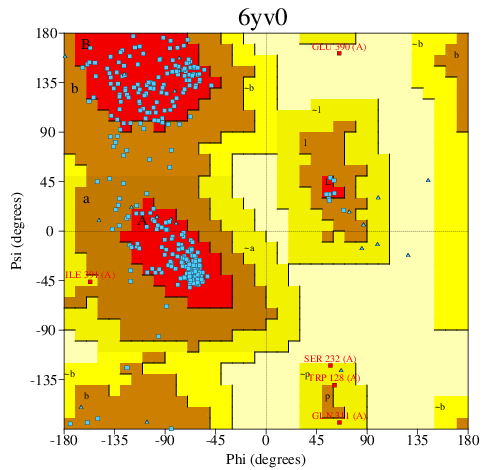
PDBsum entry 6yv0
|
|
|
|
References listed in PDB file
|
 |
|
Key reference
|
|
|
Title
|
|
Screening of a custom-Designed acid fragment library identifies 1-Phenylpyrroles and 1-Phenylpyrrolidines as inhibitors of notum carboxylesterase activity.
|
|
|
Authors
|
|
W.Mahy,
M.Patel,
D.Steadman,
H.L.Woodward,
B.N.Atkinson,
F.Svensson,
N.J.Willis,
A.Flint,
D.Papatheodorou,
Y.Zhao,
L.Vecchia,
R.R.Ruza,
J.Hillier,
S.Frew,
A.Monaghan,
A.Costa,
M.Bictash,
M.W.Walter,
E.Y.Jones,
P.V.Fish.
|
|
|
Ref.
|
|
J Med Chem, 2020,
63,
9464-9483.
[DOI no: ]
|
|
|
PubMed id
|
|
|
|
|
|
|
|
|
Abstract
|
|
|
The Wnt family of proteins are secreted signaling proteins that play key roles
in regulating cellular functions. Recently, carboxylesterase Notum was shown to
act as a negative regulator of Wnt signaling by mediating the removal of an
essential palmitoleate. Here we disclose two new chemical scaffolds that inhibit
Notum enzymatic activity. Our approach was to create a fragment library of 250
acids for screening against Notum in a biochemical assay followed by structure
determination by X-ray crystallography. Twenty fragments were identified as hits
for Notum inhibition, and 14 of these fragments were shown to bind in the
palmitoleate pocket of Notum. Optimization of 1-phenylpyrrole 20, guided
by structure-based drug design, identified 20z as the most potent
compound from this series. Similarly, the optimization of 1-phenylpyrrolidine
8 gave acid 26. This work demonstrates that inhibition of Notum
activity can be achieved by small, drug-like molecules possessing favorable
in vitro ADME profiles.
|
|
|
|
|
|
|