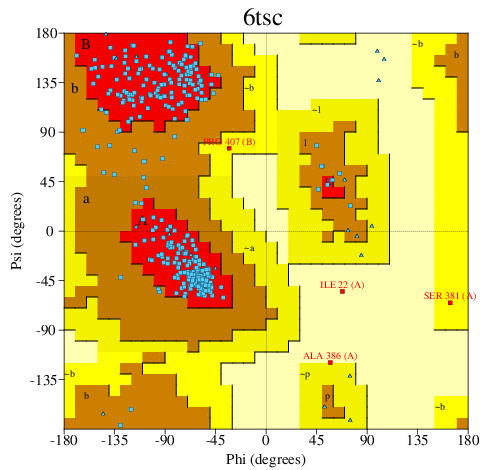
|
PDBsum entry 6tsc
|
|
|
|
References listed in PDB file
|
 |
|
Key reference
|
|
|
Title
|
|
Substrate plasticity of a fungal peptide α-n-Methyltransferase.
|
|
|
Authors
|
|
H.Song,
J.R.Fahrig-Kamarauskaitè,
E.Matabaro,
H.Kaspar,
S.L.Shirran,
C.Zach,
A.Pace,
B.A.Stefanov,
J.H.Naismith,
M.Künzler.
|
|
|
Ref.
|
|
ACS Chem Biol, 2020,
15,
1901-1912.
[DOI no: ]
|
|
|
PubMed id
|
|
|
|
|
|
Abstract
|
|
|
The methylation of amide nitrogen atoms can improve the stability, oral
availability, and cell permeability of peptide therapeutics. Chemical
N-methylation of peptides is challenging. Omphalotin A is a ribosomally
synthesized, macrocylic dodecapeptide with nine backbone N-methylations.
The fungal natural product is derived from the precursor protein, OphMA,
harboring both the core peptide and a SAM-dependent peptide
α-N-methyltransferase domain. OphMA forms a homodimer and its
α-N-methyltransferase domain installs the methyl groups in trans
on the hydrophobic core dodecapeptide and some additional C-terminal residues of
the protomers. These post-translational backbone N-methylations occur in
a processive manner from the N- to the C-terminus of the peptide substrate. We
demonstrate that OphMA can methylate polar, aromatic, and charged residues when
these are introduced into the core peptide. Some of these amino acids alter the
efficiency and pattern of methylation. Proline, depending on its sequence
context, can act as a tunable stop signal. Crystal structures of OphMA variants
have allowed rationalization of these observations. Our results hint at the
potential to control this fungal α-N-methyltransferase for
biotechnological applications.
|
|
|
|
|
|
|