 |
PDBsum entry 6eeh

|
|
|
|
|
|

|

|

|

|
|

|
|

|
|

|
|

|
|
|
 |

|

|
|
|
|
|
|
|
|
|
|
|
|
|
|
|
|
|
|
|
|
|
|
|
|
|
|
|
|
|
|
|
|
|
Lyase/lyase inhibitor
|
PDB id
|
|
|
|
6eeh
|
|
|
|
|
|
|
|
|
|
|
|
|
|
|

|

|

|
|
|
|
|
|
|
PDB id:
|
|
|
|
| Name: |
|
Lyase/lyase inhibitor
|
|
|
Title:
|
|
Bioreductive 4-hydroxy-3-nitro-5-ureido-benzenesulfonamides selectively target the tumor-associated carbonic anhydrase isoforms ix and xii and show hypoxia-enhanced cytotoxicity against human cancer cell lines.
|
|
Structure:
|
|
Carbonic anhydrase 2. Chain: a. Synonym: carbonate dehydratase ii,carbonic anhydrasE C,cac,carbonic anhydrase ii,ca-ii. Engineered: yes. Mutation: yes
|
|
Source:
|
|
Homo sapiens. Human. Organism_taxid: 9606. Gene: ca2. Expressed in: escherichia coli. Expression_system_taxid: 562
|
|
Resolution:
|
|
|
1.63Å
|
R-factor:
|
0.161
|
R-free:
|
0.187
|
|
|
Authors:
|
|
S.Singh,R.Mckenna,C.T.Supuran,A.Nocentini,C.Lomelino,E.Lucarini, G.Bartolucci,L.D.C.Mannelli,C.Ghelardini,P.Gratteri
|
|
Key ref:
|
|
A.Nocentini
et al.
(2018).
4-Hydroxy-3-nitro-5-ureido-benzenesulfonamides Selectively Target the Tumor-Associated Carbonic Anhydrase Isoforms IX and XII Showing Hypoxia-Enhanced Antiproliferative Profiles.
J Med Chem,
61,
10860-10874.
PubMed id:
DOI:
|
|
|
Date:
|
|
|
14-Aug-18
|
Release date:
|
28-Nov-18
|
|
|
|
|
|
|
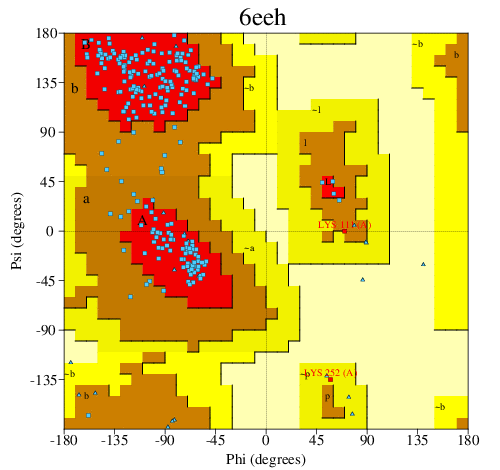
PROCHECK
|
|
|
|
|
|
Headers
|
|
|
|
References
|
|
|
|
|
|

|
|
P00918
(CAH2_HUMAN) -
Carbonic anhydrase 2 from Homo sapiens
|
|
|
|
Seq:
Struc:
|
|
|
|
260 a.a.
257 a.a.*
|
|

|

|
|
|
|
|
|
|
|
|
|
|
|
Key: |
 |
PfamA domain |
|
|
 |
Secondary structure |
|
|
*
PDB and UniProt seqs differ
at 7 residue positions (black
crosses)
|
|
|
|
|
|
|
|
|
|
|
|
|
Enzyme class 2:
|
|
E.C.4.2.1.1
- carbonic anhydrase.
|
|
|
|
|
|
|
Reaction:
|
|
hydrogencarbonate + H+ = CO2 + H2O
|
|
|
|
|
|
 hydrogencarbonate
|
+
|
H(+)
|
=
|
 CO2
CO2
|
+
|
H2O
|
|
|
|
|
|
|
|
|
|
Cofactor:
|
|
Zn(2+)
|
|
|
|
|
|
Enzyme class 3:
|
|
E.C.4.2.1.69
- cyanamide hydratase.
|
|
|
|
|
|
|
Reaction:
|
|
urea = cyanamide + H2O
|
|
|
|
|
|
 urea
urea
|
=
|
 cyanamide
|
+
|
H2O
|
|
|
|
|
|
|
|
|
|
|
|
|
Note, where more than one E.C. class is given (as above), each may
correspond to a different protein domain or, in the case of polyprotein
precursors, to a different mature protein.
|
|
|
|
Molecule diagrams generated from .mol files obtained from the
KEGG ftp site
|
|
|
|
|
|
|
|
|
|
|
|
|
|
 |
|
|
|
|
|
|
| |
|
|
| |
|
DOI no:
|
J Med Chem
61:10860-10874
(2018)
|
|
PubMed id:
|
|
|
|
|
|
| |
|
4-Hydroxy-3-nitro-5-ureido-benzenesulfonamides Selectively Target the Tumor-Associated Carbonic Anhydrase Isoforms IX and XII Showing Hypoxia-Enhanced Antiproliferative Profiles.
|
|
A.Nocentini,
E.Trallori,
S.Singh,
C.L.Lomelino,
G.Bartolucci,
L.Di Cesare Mannelli,
C.Ghelardini,
R.McKenna,
P.Gratteri,
C.T.Supuran.
|
|
|
|
|
| |
ABSTRACT
|
|
|
|
| |
|
|
Human carbonic anhydrases (CA, EC, 4.2.1.1) IX and XII are overexpressed in
cancer cells as adaptive response to hypoxia and acidic conditions
characteristic of many tumors. In addition, hypoxia facilitates the activity of
specific oxido-reductases that may be exploited to selectively activate
bioreductive prodrugs. Here, new selective CA IX/XII inhibitors, as analogues of
the antitumor phase II drug SLC-0111 are described, namely ureido-substituted
benzenesulfonamides appended with a nitro-aromatic moiety to yield an
antiproliferative action increased by hypoxia. These compounds were screened for
the inhibition of the ubiquitous hCA I/II and the target hCA IX/XII. Six X-ray
crystallographies with CA II and IX/mimic allowed for the rationalization of the
compounds inhibitory activity. The effects of some such compounds on the
viability of HT-29, MDA-MB-231, and PC-3 human cancer cell lines in both
normoxic and hypoxic conditions were examined, providing the initiation toward
the development of hypoxia-activated antitumor CAIs.
|
|
|
|
|
|
|
|
|
|
|
|
|
|
|
|
|
|
 |
 |
 |
|


 Links
Links


