 |
PDBsum entry 6e6c

|
|
|
|
|
|

|

|

|

|
|

|
|

|
|

|
|

|
|
|
 |

|

|
|
|
|
|
|
|
|
|
|
|
|
|
|
|
|
|
|
|
|
|
|
|
|
|
|
|
|
|
|
|
|
|
Signaling protein
|
PDB id
|
|
|
|
6e6c
|
|
|
|
|
|
|
|
|
|
|
|
|
|
|

|

|

|
|
|
|
|
|
|
|
|
Enzyme class:
|
|
E.C.3.6.5.2
- small monomeric GTPase.
|
|
|
|
|
|
|
Reaction:
|
|
GTP + H2O = GDP + phosphate + H+
|
|
|
|
|
|
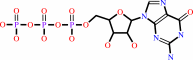 GTP
GTP
|
+
|
H2O
|
=
|
GDP
Bound ligand (Het Group name = )
matches with 81.82% similarity
|
+
|
 phosphate
|
+
|
H(+)
|
|
|
|
|
|
|
|
|
|
|
|
|
Molecule diagrams generated from .mol files obtained from the
KEGG ftp site
|
|
|
|
|
|
|
|
|
|
|
|
|
|
 |
|
|
|
|
|
|
| |
|
|
| |
|
DOI no:
|
Cell Rep
28:1538
(2019)
|
|
PubMed id:
|
|
|
|
|
|
| |
|
Isoform-Specific Destabilization of the Active Site Reveals a Molecular Mechanism of Intrinsic Activation of KRas G13D.
|
|
C.W.Johnson,
Y.J.Lin,
D.Reid,
J.Parker,
S.Pavlopoulos,
P.Dischinger,
C.Graveel,
A.J.Aguirre,
M.Steensma,
K.M.Haigis,
C.Mattos.
|
|
|
|
|
| |
ABSTRACT
|
|
|
|
| |
|
|
Ras GTPases are mutated at codons 12, 13, and 61, with different frequencies in
KRas, HRas, and NRas and in a cancer-specific manner. The G13D mutant appears in
25% of KRas-driven colorectal cancers, while observed only rarely in HRas or
NRas. Structures of Ras G13D in the three isoforms show an open active site,
with adjustments to the D13 backbone torsion angles and with disconnected switch
regions. KRas G13D has unique features that destabilize the nucleotide-binding
pocket. In KRas G13D bound to GDP, A59 is placed in the Mg2+ binding
site, as in the HRas-SOS complex. Structure and biochemistry are consistent with
an intermediate level of KRas G13D bound to GTP, relative to wild-type and KRas
G12D, observed in genetically engineered mouse models. The results explain in
part the elevated frequency of the G13D mutant in KRas over the other isoforms
of Ras.
|
|
|
|
|
|
|
|
|
|
|
|
|
|
|
|
|
|
 |
 |
 |
|


 Links
Links


