 |
PDBsum entry 5tkb

|
|
|
|
|
|

|

|

|

|
|

|
|

|
|

|
|

|
|

|
|

|
|

|
|
|
 |

|

|
|
|
|
|
|
|
|
|
|
|
|
|
|
|
|
|
|
|
|
|
|
|
|
|
|
|
|
|
|
|
|
|
|
|
|
Hydrolase/hydrolase inhibitor
|
PDB id
|
|
|
|
5tkb
|
|
|
|
|
|
|
|
|
|
|
|
|
|
|

|

|

|
|
|
|
|
|
|
PDB id:
|
|
|
|
| Name: |
|
Hydrolase/hydrolase inhibitor
|
|
|
Title:
|
|
Crystal structure of human phosphodiesterase 4d in complex with a tetrafluoranline compound
|
|
Structure:
|
|
Camp-specific 3',5'-cyclic phosphodiesterase 4d. Chain: a, b, c, d. Fragment: unp residues 380-753. Synonym: dpde3,pde43. Engineered: yes. Mutation: yes
|
|
Source:
|
|
Homo sapiens. Human. Organism_taxid: 9606. Gene: pde4d, dpde3. Expressed in: spodoptera frugiperda. Expression_system_taxid: 7108.
|
|
Resolution:
|
|
|
2.16Å
|
R-factor:
|
0.189
|
R-free:
|
0.209
|
|
|
Authors:
|
|
J.S.Sack
|
|
Key ref:
|
|
R.Moslin
et al.
(2017).
Identification of imidazo[1,2-b]pyridazine TYK2 pseudokinase ligands as potent and selective allosteric inhibitors of TYK2 signalling.
Medchemcomm,
8,
700-712.
PubMed id:
|
|
|
Date:
|
|
|
06-Oct-16
|
Release date:
|
28-Dec-16
|
|
|
|
|
|
|
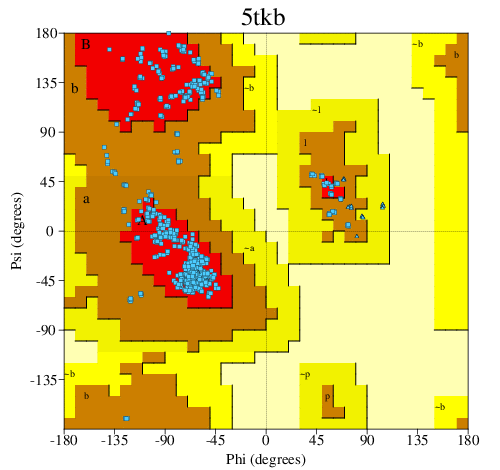
PROCHECK
|
|
|
|
|
|
Headers
|
|
|
|
References
|
|
|
|
|
|

|
|
Q08499
(PDE4D_HUMAN) -
cAMP-specific 3',5'-cyclic phosphodiesterase 4D from Homo sapiens
|
|
|
|
Seq:
Struc:
|
|
|
|
809 a.a.
326 a.a.
|
|

|

|

|
|
|
|
|
|
|
|
|
|
|
Key: |
 |
PfamA domain |
|
|
 |
Secondary structure |
|
|
|
|
|
|
|
|
|
|
|
|
|
Enzyme class:
|
|
E.C.3.1.4.53
- 3',5'-cyclic-AMP phosphodiesterase.
|
|
|
|
|
|
|
Reaction:
|
|
3',5'-cyclic AMP + H2O = AMP + H+
|
|
|
|
|
|
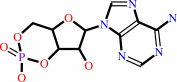 3',5'-cyclic AMP
|
+
|
H2O
|
=
|
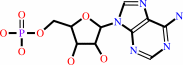 AMP
AMP
|
+
|
H(+)
|
|
|
|
|
|
|
|
|
|
|
|
|
Molecule diagrams generated from .mol files obtained from the
KEGG ftp site
|
|
|
|
|
|
|
|
|
|
|
|
|
|
 |
|
|
|
|
|
|
| |
|
|
| |
|
|
Medchemcomm
8:700-712
(2017)
|
|
PubMed id:
|
|
|
|
|
|
| |
|
Identification of imidazo[1,2-b]pyridazine TYK2 pseudokinase ligands as potent and selective allosteric inhibitors of TYK2 signalling.
|
|
R.Moslin,
D.Gardner,
J.Santella,
Y.Zhang,
J.V.Duncia,
C.Liu,
J.Lin,
J.S.Tokarski,
J.Strnad,
D.Pedicord,
J.Chen,
Y.Blat,
A.Zupa-Fernandez,
L.Cheng,
H.Sun,
C.Chaudhry,
C.Huang,
C.D'Arienzo,
J.S.Sack,
J.K.Muckelbauer,
C.Chang,
J.Tredup,
D.Xie,
N.Aranibar,
J.R.Burke,
P.H.Carter,
D.S.Weinstein.
|
|
|
|
|
| |
ABSTRACT
|
|
|
|
| |
|
|
As a member of the Janus (JAK) family of non-receptor tyrosine kinases, TYK2
mediates the signaling of pro-inflammatory cytokines including IL-12, IL-23 and
type 1 interferon (IFN), and therefore represents an attractive potential target
for treating the various immuno-inflammatory diseases in which these cytokines
have been shown to play a role. Following up on our previous report that ligands
to the pseudokinase domain (JH2) of TYK2 suppress cytokine-mediated receptor
activation of the catalytic (JH1) domain, the imidazo[1,2-b]pyridazine
(IZP) 7 was identified as a promising hit compound. Through iterative
modification of each of the substituents of the IZP scaffold, the cellular
potency was improved while maintaining selectivity over the JH1 domain. These
studies led to the discovery of the JH2-selective TYK2 inhibitor 29,
which provided encouraging systemic exposures after oral dosing in mice.
Phosphodiesterase 4 (PDE4) was identified as an off-target and potential
liability of the IZP ligands, and selectivity for TYK2 JH2 over this enzyme was
obtained by elaborating along selectivity vectors determined from analyses of
X-ray co-crystal structures of representative ligands of the IZP class bound to
both proteins.
|
|
|
|
|
|
|
|
|
|
|
|
|
|
|
|
|
|
 |
 |
 |
|


 Links
Links


