|
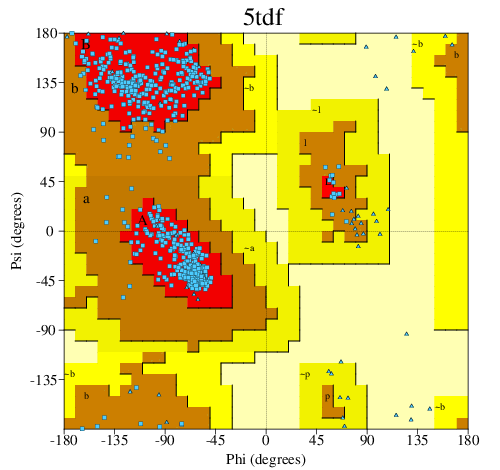
PDBsum entry 5tdf
|
|
|
|
References listed in PDB file
|
 |
|
Key reference
|
|
|
Title
|
|
Binding of hydroxycitrate to human ATP-Citrate lyase.
|
|
|
Authors
|
|
J.Hu,
A.Komakula,
M.E.Fraser.
|
|
|
Ref.
|
|
Acta Crystallogr D Struct Biol, 2017,
73,
660-671.
[DOI no: ]
|
|
|
PubMed id
|
|
|
|
|
|
Abstract
|
|
|
Hydroxycitrate from the fruit of Garcinia cambogia [i.e.
(2S,3S)-2-hydroxycitrate] is the best-known inhibitor of ATP-citrate lyase. Well
diffracting crystals showing how the inhibitor binds to human ATP-citrate lyase
were grown by modifying the protein. The protein was modified by introducing
cleavage sites for Tobacco etch virus protease on either side of a disordered
linker. The protein crystallized consisted of residues 2-425-ENLYFQ and
S-488-810 of human ATP-citrate lyase. (2S,3S)-2-Hydroxycitrate binds in the same
orientation as citrate, but the citrate-binding domain (residues 248-421) adopts
a different orientation with respect to the rest of the protein (residues 4-247,
490-746 and 748-809) from that previously seen. For the first time, electron
density was evident for the loop that contains His760, which is phosphorylated
as part of the catalytic mechanism. The pro-S carboxylate of
(2S,3S)-2-hydroxycitrate is available to accept a phosphoryl group from His760.
However, when co-crystals were grown with ATP and magnesium ions as well as
either the inhibitor or citrate, Mg2+-ADP was bound and His760 was
phosphorylated. The phosphoryl group was not transferred to the organic acid.
This led to the interpretation that the active site is trapped in an open
conformation. The strategy of designing cleavage sites to remove disordered
residues could be useful in determining the crystal structures of other proteins.
|
|
|
|
|
|
|