 |
PDBsum entry 5kd7

|
|
|
|
|
|

|

|

|

|
|

|
|

|
|

|
|

|
|

|
|
|
 |

|

|
|
|
|
|
|
|
|
|
|
|
|
|
|
|
|
|
|
|
|
|
|
|
|
|
|
|
|
|
|
|
|
|
|
Immune system
|
PDB id
|
|
|
|
5kd7
|
|
|
|
|
|
|
|
|
|
|
|
|
|
|

|

|

|
|
|
|
|
|
|
PDB id:
|
|
|
|
| Name: |
|
Immune system
|
|
|
Title:
|
|
Crystal structure of murine mhc-i h-2dd in complex with murine beta2- microglobulin and a variant of peptide (pv9) of HIV gp120 mn isolate (igpgrafyv)
|
|
Structure:
|
|
H-2 class i histocompatibility antigen, d-d alpha chain. Chain: a, c, f, i. Synonym: h-2d(d). Engineered: yes. Beta-2-microglobulin. Chain: b, d, g, j. Engineered: yes. Peptide (pv9) of HIV gp120 mn isolate (igpgrafyv). Chain: p, e, h, k.
|
|
Source:
|
|
Mus musculus. Mouse. Organism_taxid: 10090. Gene: h2-d1. Expressed in: escherichia coli. Expression_system_taxid: 469008. Gene: b2m. Human immunodeficiency virus type 1 group m subtype b (isolate mn).
|
|
Resolution:
|
|
|
2.35Å
|
R-factor:
|
0.199
|
R-free:
|
0.249
|
|
|
Authors:
|
|
J.Jiang,K.Natarajan,D.Margulies
|
|
Key ref:
|
|
B.F.Frey
et al.
(2018).
Effects of Cross-Presentation, Antigen Processing, and Peptide Binding in HIV Evasion of T Cell Immunity.
J Immunol,
200,
1853-1864.
PubMed id:
DOI:
|
|
|
Date:
|
|
|
07-Jun-16
|
Release date:
|
11-Oct-17
|
|
|
|
|
|
|
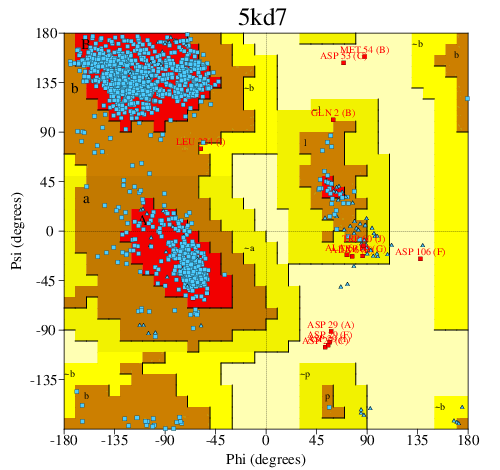
PROCHECK
|
|
|
|
|
|
Headers
|
|
|
|
References
|
|
|
|
|
|
|
|
|
|
|
|
|
|
|
|
 |
|
|
|
|
|
|
| |
|
DOI no:
|
J Immunol
200:1853-1864
(2018)
|
|
PubMed id:
|
|
|
|
|
|
| |
|
Effects of Cross-Presentation, Antigen Processing, and Peptide Binding in HIV Evasion of T Cell Immunity.
|
|
B.F.Frey,
J.Jiang,
Y.Sui,
L.F.Boyd,
B.Yu,
G.Tatsuno,
R.Billeskov,
S.Solaymani-Mohammadi,
P.W.Berman,
D.H.Margulies,
J.A.Berzofsky.
|
|
|
|
|
| |
ABSTRACT
|
|
|
|
| |
|
|
Unlike cytosolic processing and presentation of viral Ags by virus-infected
cells, Ags first expressed in infected nonprofessional APCs, such as
CD4+T cells in the case of HIV, are taken up by dendritic cells and
cross-presented. This generally requires entry through the endocytic pathway,
where endosomal proteases have first access for processing. Thus, understanding
virus escape during cross-presentation requires an understanding of resistance
to endosomal proteases, such as cathepsin S (CatS). We have modified
HIV-1MNgp120 by mutating a key CatS cleavage site
(Thr322Thr323) in the V3 loop of the immunodominant
epitope IGPGRAFYTTto IGPGRAFYVVto prevent digestion. We found this
mutation to facilitate cross-presentation and provide evidence from MHC binding
and X-ray crystallographic structural studies that this results from
preservation of the epitope rather than an increased epitope affinity for the
MHC class I molecule. In contrast, when the protein is expressed by a vaccinia
virus in the cytosol, the wild-type protein is immunogenic without this
mutation. These proof-of-concept results show that a virus like HIV, infecting
predominantly nonprofessional presenting cells, can escape T cell recognition by
incorporating a CatS cleavage site that leads to destruction of an
immunodominant epitope when the Ag undergoes endosomal cross-presentation.
|
|
|
|
|
|
|
|
|
|
|
|
|
|
|
|
|
|
 |
 |
 |
|
|


 Links
Links


