 |
PDBsum entry 4zvc

|
|
|
|
|
|

|

|

|

|
|

|
|

|
|

|
|

|
|

|
|
|
 |

|

|
|
|
|
|
|
|
|
|
|
|
|
|
|
|
|
|
|
|
|
|
|
|
|
|
|
|
|
|
|
|
|
|
|
Signaling protein
|
PDB id
|
|
|
|
4zvc
|
|
|
|
|
|
|
|
|
|
|
|
|
|
|

|

|

|
|
|
|
|
|
|
|
|
Enzyme class:
|
|
E.C.2.7.7.65
- diguanylate cyclase.
|
|
|
|
|
|
|
Reaction:
|
|
2 GTP = 3',3'-c-di-GMP + 2 diphosphate
|
|
|
|
|
|
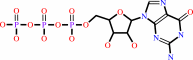 2
×
GTP
2
×
GTP
|
=
|
3',3'-c-di-GMP
|
+
|
 2
×
diphosphate
2
×
diphosphate
|
|
|
|
|
|
|
|
|
|
Cofactor:
|
|
Mg(2+); Mn(2+)
|
|
|
|
|
|
|
|
|
Molecule diagrams generated from .mol files obtained from the
KEGG ftp site
|
|
|
|
|
|
|
|
|
|
|
|
|
|
 |
|
|
|
|
|
|
| |
|
|
| |
|
DOI no:
|
Acta Crystallogr D Biol Crystallogr
71:2158-2177
(2015)
|
|
PubMed id:
|
|
|
|
|
|
| |
|
Structural analysis of an oxygen-regulated diguanylate cyclase.
|
|
M.Tarnawski,
T.R.Barends,
I.Schlichting.
|
|
|
|
|
| |
ABSTRACT
|
|
|
|
| |
|
|
Cyclic di-GMP is a bacterial second messenger that is involved in switching
between motile and sessile lifestyles. Given the medical importance of biofilm
formation, there has been increasing interest in understanding the synthesis and
degradation of cyclic di-GMPs and their regulation in various bacterial
pathogens. Environmental cues are detected by sensing domains coupled to GGDEF
and EAL or HD-GYP domains that have diguanylate cyclase and phosphodiesterase
activities, respectively, producing and degrading cyclic di-GMP. The Escherichia
coli protein DosC (also known as YddV) consists of an oxygen-sensing domain
belonging to the class of globin sensors that is coupled to a C-terminal GGDEF
domain via a previously uncharacterized middle domain. DosC is one of the most
strongly expressed GGDEF proteins in E. coli, but to date structural information
on this and related proteins is scarce. Here, the high-resolution structural
characterization of the oxygen-sensing globin domain, the middle domain and the
catalytic GGDEF domain in apo and substrate-bound forms is described. The
structural changes between the iron(III) and iron(II) forms of the sensor globin
domain suggest a mechanism for oxygen-dependent regulation. The structural
information on the individual domains is combined into a model of the dimeric
DosC holoprotein. These findings have direct implications for the
oxygen-dependent regulation of the activity of the cyclase domain.
|
|
|
|
|
|
|
|
|
|
|
|
|
|
|
|
|
|
 |
 |
 |
|


 Links
Links


