|
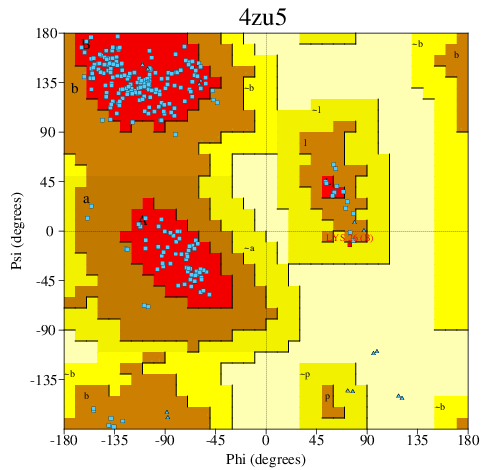
PDBsum entry 4zu5
|
|
|
|
References listed in PDB file
|
 |
|
Key reference
|
|
|
Title
|
|
Bacterial sugar 3,4-Ketoisomerases: structural insight into product stereochemistry.
|
|
|
Authors
|
|
J.B.Thoden,
E.Vinogradov,
M.Gilbert,
A.J.Salinger,
H.M.Holden.
|
|
|
Ref.
|
|
Biochemistry, 2015,
54,
4495-4506.
[DOI no: ]
|
|
|
PubMed id
|
|
|
|
|
|
Abstract
|
|
|
3-Acetamido-3,6-dideoxy-d-galactose (Fuc3NAc) and
3-acetamido-3,6-dideoxy-d-glucose (Qui3NAc) are unusual sugars found on the
lipopolysaccharides of Gram-negative bacteria and on the S-layers of
Gram-positive bacteria. The 3,4-ketoisomerases, referred to as FdtA and QdtA,
catalyze the third steps in the respective biosynthetic pathways for these
sugars. Whereas both enzymes utilize the same substrate, the stereochemistries
of their products are different. Specifically, the hydroxyl groups at the hexose
C-4' positions assume the "galactose" and "glucose"
configurations in the FdtA and QdtA products, respectively. In 2007 we reported
the structure of the apoform of FdtA from Aneurinibacillus thermoaerophilus,
which was followed in 2014 by the X-ray analysis of QdtA from
Thermoanaerobacterium thermosaccharolyticum as a binary complex. Both of these
enzymes belong to the cupin superfamily. Here we report a combined structural
and enzymological study to explore the manner in which these enzymes control the
stereochemistry of their products. Various site-directed mutant proteins of each
enzyme were constructed, and their dTDP-sugar products were analyzed by NMR
spectroscopy. In addition, the kinetic parameters for these protein variants
were measured, and the structure of one, namely, the QdtA Y17R/R97H double
mutant form, was determined to 2.3-Å resolution. Finally, in an attempt to
obtain a model of FdtA with a bound dTDP-linked sugar, the 3,4-ketoisomerase
domain of a bifunctional enzyme from Shewanella denitrificans was cloned,
purified, and crystallized in the presence of a dTDP-linked sugar analogue.
Taken together, the results from this investigation demonstrate that it is
possible to convert a "galacto" enzyme into a "gluco" enzyme
and vice versa.
|
|
|
|
|
|
|