|
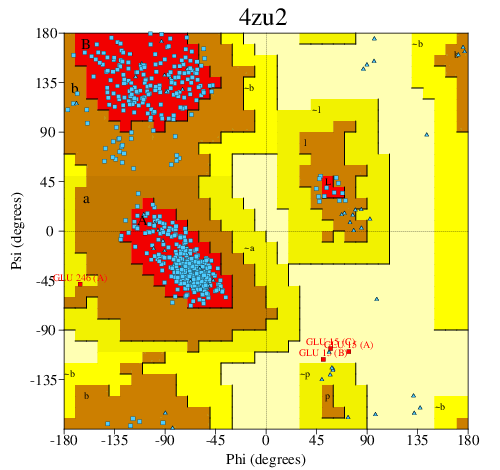
PDBsum entry 4zu2
|
|
|
|
References listed in PDB file
|
 |
|
Key reference
|
|
|
Title
|
|
The pseudomonas aeruginosa isohexenyl glutaconyl coenzyme a hydratase (atue) is upregulated in citronellate-Grown cells and belongs to the crotonase family.
|
|
|
Authors
|
|
N.Poudel,
J.Pfannstiel,
O.Simon,
N.Walter,
A.C.Papageorgiou,
D.Jendrossek.
|
|
|
Ref.
|
|
Appl Environ Microbiol, 2015,
81,
6558-6566.
[DOI no: ]
|
|
|
PubMed id
|
|
|
|
|
|
Abstract
|
|
|
Pseudomonas aeruginosa is one of only a few Pseudomonas species that are able to
use acyclic monoterpenoids, such as citronellol and citronellate, as carbon and
energy sources. This is achieved by the acyclic terpene utilization pathway
(Atu), which includes at least six enzymes (AtuA, AtuB, AtuCF, AtuD, AtuE, AtuG)
and is coupled to a functional leucine-isovalerate utilization (Liu) pathway.
Here, quantitative proteome analysis was performed to elucidate the terpene
metabolism of P. aeruginosa. The proteomics survey identified 187 proteins,
including AtuA to AtuG and LiuA to LiuE, which were increased in abundance in
the presence of citronellate. In particular, two hydratases, AtuE and the PA4330
gene product, out of more than a dozen predicted in the P. aeruginosa proteome
showed an increased abundance in the presence of citronellate. AtuE
(isohexenyl-glutaconyl coenzyme A [CoA] hydratase; EC 4.2.1.57) most likely
catalyzes the hydration of the unsaturated distal double bond in the
isohexenyl-glutaconyl-CoA thioester to yield
3-hydroxy-3-isohexenyl-glutaryl-CoA. Determination of the crystal structure of
AtuE at a 2.13-Å resolution revealed a fold similar to that found in the
hydratase (crotonase) superfamily and provided insights into the nature of the
active site. The AtuE active-site architecture showed a significantly broader
cavity than other crotonase superfamily members, in agreement with the need to
accommodate the branched isoprenoid unit of terpenes. Glu139 was identified to
be a potential catalytic residue, while the backbone NH groups of Gly116 and
Gly68 likely form an oxyanion hole. The present work deepens the understanding
of terpene metabolism in Pseudomonas and may serve as a basis to develop new
strategies for the biotechnological production of terpenoids.
|
|
|
|
|
|
|