|
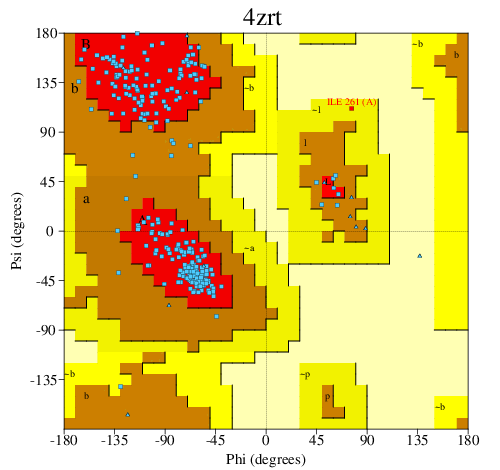
PDBsum entry 4zrt
|
|
|
|
References listed in PDB file
|
 |
|
Key reference
|
|
|
Title
|
|
Diverse levels of sequence selectivity and catalytic efficiency of protein-Tyrosine phosphatases.
|
|
|
Authors
|
|
N.G.Selner,
R.Luechapanichkul,
X.Chen,
B.G.Neel,
Z.Y.Zhang,
S.Knapp,
C.E.Bell,
D.Pei.
|
|
|
Ref.
|
|
Biochemistry, 2014,
53,
397-412.
[DOI no: ]
|
|
|
PubMed id
|
|
|
|
|
|
Abstract
|
|
|
The sequence selectivity of 14 classical protein-tyrosine phosphatases (PTPs)
(PTPRA, PTPRB, PTPRC, PTPRD, PTPRO, PTP1B, SHP-1, SHP-2, HePTP, PTP-PEST, TCPTP,
PTPH1, PTPD1, and PTPD2) was systematically profiled by screening their
catalytic domains against combinatorial peptide libraries. All of the PTPs
exhibit similar preference for pY peptides rich in acidic amino acids and
disfavor positively charged sequences but differ vastly in their degrees of
preference/disfavor. Some PTPs (PTP-PEST, SHP-1, and SHP-2) are highly selective
for acidic over basic (or neutral) peptides (by >10(5)-fold), whereas others
(PTPRA and PTPRD) show no to little sequence selectivity. PTPs also have diverse
intrinsic catalytic efficiencies (kcat/KM values against optimal substrates),
which differ by >10(5)-fold due to different kcat and/or KM values. Moreover,
PTPs show little positional preference for the acidic residues relative to the
pY residue. Mutation of Arg47 of PTP1B, which is located near the pY-1 and pY-2
residues of a bound substrate, decreased the enzymatic activity by 3-18-fold
toward all pY substrates containing acidic residues anywhere within the pY-6 to
pY+5 region. Similarly, mutation of Arg24, which is situated near the C-terminus
of a bound substrate, adversely affected the kinetic activity of all acidic
substrates. A cocrystal structure of PTP1B bound with a nephrin pY(1193) peptide
suggests that Arg24 engages in electrostatic interactions with acidic residues
at the pY+1, pY+2, and likely other positions. These results suggest that
long-range electrostatic interactions between positively charged residues near
the PTP active site and acidic residues on pY substrates allow a PTP to bind
acidic substrates with similar affinities, and the varying levels of preference
for acidic sequences by different PTPs are likely caused by the different
electrostatic potentials near their active sites. The implications of the
varying sequence selectivity and intrinsic catalytic activities with respect to
PTP in vivo substrate specificity and biological functions are discussed.
|
|
|
|
|
|
|