|
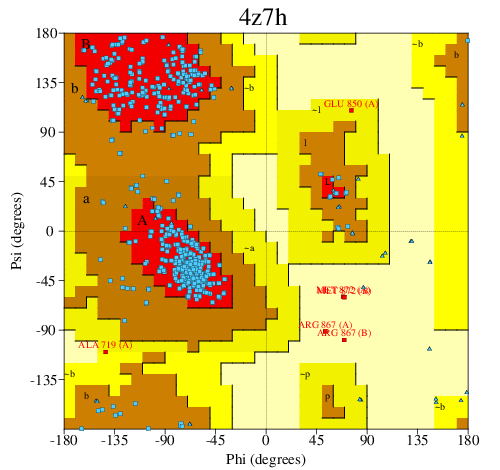
PDBsum entry 4z7h
|
|
|
|
References listed in PDB file
|
 |
|
Key reference
|
|
|
Title
|
|
Molecular mechanisms of human ire1 activation through dimerization and ligand binding.
|
|
|
Authors
|
|
A.Joshi,
Y.Newbatt,
P.C.Mcandrew,
M.Stubbs,
R.Burke,
M.W.Richards,
C.Bhatia,
J.J.Caldwell,
T.Mchardy,
I.Collins,
R.Bayliss.
|
|
|
Ref.
|
|
Oncotarget, 2015,
6,
13019-13035.
[DOI no: ]
|
|
|
PubMed id
|
|
|
|
|
|
Abstract
|
|
|
IRE1 transduces the unfolded protein response by splicing XBP1 through its
C-terminal cytoplasmic kinase-RNase region. IRE1 autophosphorylation is coupled
to RNase activity through formation of a back-to-back dimer, although the
conservation of the underlying molecular mechanism is not clear from existing
structures. We have crystallized human IRE1 in a back-to-back conformation only
previously seen for the yeast homologue. In our structure the kinase domain
appears primed for catalysis but the RNase domains are disengaged.
Structure-function analysis reveals that IRE1 is autoinhibited through a
Tyr-down mechanism related to that found in the unrelated Ser/Thr protein kinase
Nek7. We have developed a compound that potently inhibits human IRE1 kinase
activity while stimulating XBP1 splicing. A crystal structure of the inhibitor
bound to IRE1 shows an increased ordering of the kinase activation loop. The
structures of hIRE in apo and ligand-bound forms are consistent with a
previously proposed model of IRE1 regulation in which formation of a
back-to-back dimer coupled to adoption of a kinase-active conformation drive
RNase activation. The structures provide opportunities for structure-guided
design of IRE1 inhibitors.
|
|
|
|
|
|
|