|
PDBsum entry 4z78

|
|
|
|
|
|

|

|

|

|
|

|
|

|
|

|
|

|
|

|
|
|
 |

|

|
|
|
|
|
|
|
|
|
|
|
|
|
|
|
|
|
|
|
|
|
|
|
|
|
|
|
|
|
|
|
|
|
|
Immune system
|
PDB id
|
|
|
|
4z78
|
|
|
|
|
|
|
|
|
|
|
|
|
|
|

|

|

|
|
|
|
|
|
|
PDB id:
|
|
|
|
| Name: |
|
Immune system
|
|
|
Title:
|
|
Weak tcr binding to an unstable insulin epitope drives type 1 diabetes
|
|
Structure:
|
|
H-2 class i histocompatibility antigen, k-d alpha chain. Chain: a, d, g. Fragment: unp residues 22-296. Synonym: leukocyte antigen heavy chain, h-2k(d). Engineered: yes. Beta-2-microglobulin. Chain: b, e, h. Fragment: unp residues 21-119. Engineered: yes.
|
|
Source:
|
|
Mus musculus. House mouse. Organism_taxid: 10090. Gene: h2-k1, h2-k. Expressed in: escherichia coli bl21(de3). Expression_system_taxid: 469008. Expression_system_variant: rosetta. Homo sapiens. Human.
|
|
Resolution:
|
|
|
2.30Å
|
R-factor:
|
0.190
|
R-free:
|
0.233
|
|
|
Authors:
|
|
P.J.Rizkallah,D.K.Cole
|
|
Key ref:
|
|
C.Motozono
et al.
(2015).
Distortion of the Major Histocompatibility Complex Class I Binding Groove to Accommodate an Insulin-derived 10-Mer Peptide.
J Biol Chem,
290,
18924-18933.
PubMed id:
DOI:
|
|
|
Date:
|
|
|
06-Apr-15
|
Release date:
|
24-Jun-15
|
|
|
|
|
|
|
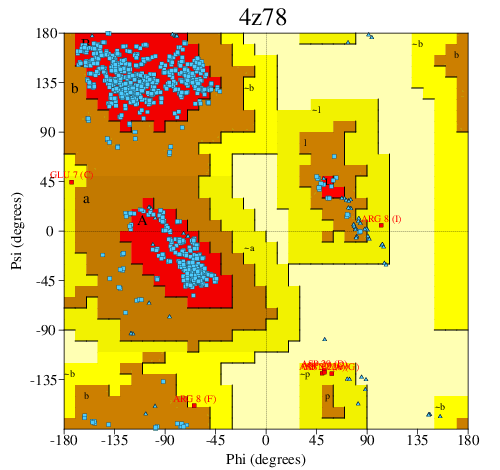
PROCHECK
|
|
|
|
|
|
Headers
|
|
|
|
References
|
|
|
|
|
|
|
|
|
|
|
|
|
|
|
|
 |
|
|
|
|
|
|
| |
|
DOI no:
|
J Biol Chem
290:18924-18933
(2015)
|
|
PubMed id:
|
|
|
|
|
|
| |
|
Distortion of the Major Histocompatibility Complex Class I Binding Groove to Accommodate an Insulin-derived 10-Mer Peptide.
|
|
C.Motozono,
J.A.Pearson,
E.De Leenheer,
P.J.Rizkallah,
K.Beck,
A.Trimby,
A.K.Sewell,
F.S.Wong,
D.K.Cole.
|
|
|
|
|
| |
ABSTRACT
|
|
|
|
| |
|
|
The non-obese diabetic mouse model of type 1 diabetes continues to be an
important tool for delineating the role of T-cell-mediated destruction of
pancreatic β-cells. However, little is known about the molecular mechanisms
that enable this disease pathway. We show that insulin reactivity by a CD8(+)
T-cell clone, known to induce type 1 diabetes, is characterized by weak T-cell
antigen receptor binding to a relatively unstable peptide-MHC. The structure of
the native 9- and 10-mer insulin epitopes demonstrated that peptide residues 7
and 8 form a prominent solvent-exposed bulge that could potentially be the main
focus of T-cell receptor binding. The C terminus of the peptide governed
peptide-MHC stability. Unexpectedly, we further demonstrate a novel mode of
flexible peptide presentation in which the MHC peptide-binding groove is able to
"open the back door" to accommodate extra C-terminal peptide residues.
|
|
|
|
|
|
|
|
|
|
|
|
|
|
|
|
|
|
 |
 |
 |
|
|


 Links
Links