 |
PDBsum entry 4yhq

|
|
|
|
|
|

|

|

|

|
|

|
|

|
|

|
|

|
|

|
|

|
|
|
 |

|

|
|
|
|
|
|
|
|
|
|
|
|
|
|
|
|
|
|
|
|
|
|
|
|
|
|
|
|
|
|
|
|
|
|
|
Hydrolase/hydrolase inhibitor
|
PDB id
|
|
|
|
4yhq
|
|
|
|
|
|
|
|
|
|
|
|
|
|
|

|

|

|
|
|
|
|
|
|
|
|
Enzyme class 1:
|
|
E.C.2.7.7.-
- ?????
|
|
|
|
|
|
|
Enzyme class 2:
|
|
E.C.2.7.7.49
- RNA-directed Dna polymerase.
|
|
|
|
|
|
|
Reaction:
|
|
DNA(n) + a 2'-deoxyribonucleoside 5'-triphosphate = DNA(n+1) + diphosphate
|
|
|
|
|
|
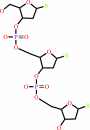 DNA(n)
|
+
|
2'-deoxyribonucleoside 5'-triphosphate
|
=
|
DNA(n+1)
|
+
|
 diphosphate
|
|
|
|
|
|
|
|
|
|
Enzyme class 3:
|
|
E.C.2.7.7.7
- DNA-directed Dna polymerase.
|
|
|
|
|
|
|
Reaction:
|
|
DNA(n) + a 2'-deoxyribonucleoside 5'-triphosphate = DNA(n+1) + diphosphate
|
|
|
|
|
|
DNA(n)
|
+
|
2'-deoxyribonucleoside 5'-triphosphate
|
=
|
DNA(n+1)
|
+
|
diphosphate
|
|
|
|
|
|
|
|
|
|
Enzyme class 4:
|
|
E.C.3.1.-.-
|
|
|
|
|
|
|
Enzyme class 5:
|
|
E.C.3.1.13.2
- exoribonuclease H.
|
|
|
|
|
|
|
Reaction:
|
|
Exonucleolytic cleavage to 5'-phosphomonoester oligonucleotides in both 5'- to 3'- and 3'- to 5'-directions.
|
|
|
|
|
|
Enzyme class 6:
|
|
E.C.3.1.26.13
- retroviral ribonuclease H.
|
|
|
|
|
|
|
Enzyme class 7:
|
|
E.C.3.4.23.16
- HIV-1 retropepsin.
|
|
|
|
|
|
|
Reaction:
|
|
Specific for a P1 residue that is hydrophobic, and P1' variable, but often Pro.
|
|
|
|
|
|
|
|
|
Note, where more than one E.C. class is given (as above), each may
correspond to a different protein domain or, in the case of polyprotein
precursors, to a different mature protein.
|
|
|
|
Molecule diagrams generated from .mol files obtained from the
KEGG ftp site
|
|
|
|
|
|
|
|
|
|
|
|
|
|
 |
|
|
|
|
|
|
| |
|
|
| |
|
DOI no:
|
J Med Chem
58:5088-5095
(2015)
|
|
PubMed id:
|
|
|
|
|
|
| |
|
Substituted Bis-THF Protease Inhibitors with Improved Potency against Highly Resistant Mature HIV-1 Protease PR20.
|
|
J.Agniswamy,
J.M.Louis,
C.H.Shen,
S.Yashchuk,
A.K.Ghosh,
I.T.Weber.
|
|
|
|
|
| |
ABSTRACT
|
|
|
|
| |
|
|
An extremely drug resistant mutant of HIV-1 protease (PR) bearing 20 mutations
(PR20) has been studied with two potent antiviral investigational inhibitors.
GRL-5010A and GRL-4410A were designed to introduce hydrogen bond interactions
with the flexible flaps of the PR by incorporating gem-difluorines and alkoxy,
respectively, at the C4 position of the bis-THF of darunavir. PR20 provides an
excellent model for high level resistance, since clinical inhibitors are
>1000-fold less active on PR20 than on wild-type enzyme. GRL-5010A and
GRL-4410A show inhibition constants of 4.3 ± 7.0 and 1.7 ± 1.8 nM,
respectively, for PR20, compared to the binding affinity of 41 ± 1 nM measured
for darunavir. Crystal structures of PR20 in complexes with the two inhibitors
confirmed the new hydrogen bond interactions with Gly 48 in the flap of the
enzyme. The two new compounds are more effective than darunavir in inhibiting
mature PR20 and show promise for further development of antiviral agents
targeting highly resistant PR mutants.
|
|
|
|
|
|
|
|
|
|
|
|
|
|
|
|
|
|
 |
 |
 |
|


 Links
Links


