|
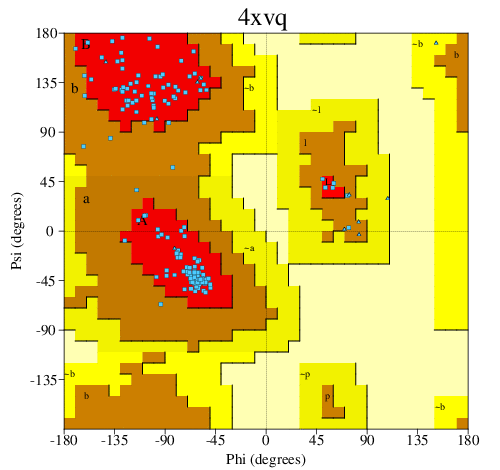
PDBsum entry 4xvq

|
|
|
|
|
|

|
|

|
|

|
|

|
|

|
|

|
|
|
 |

|

|
|
|
|
|
|
|
|
|
|
|
|
|
|
|
|
|
|
|
|
|
|
|
|
|
|
|
|
|
|
|
Signaling protein
|
PDB id
|
|
|
|
4xvq
|
|
|
|
|
|
|
|
|
|
|
|
|
|
|

|

|

|
|
|
|
|
|
References listed in PDB file
|
|
|
Key reference
|
|
|
Title
|
|
Tyrosine phosphorylation of ras by abl allosterically enhances effector binding.
|
|
|
Authors
|
|
P.Y.Ting,
C.W.Johnson,
C.Fang,
X.Cao,
T.G.Graeber,
C.Mattos,
J.Colicelli.
|
|
|
Ref.
|
|
Faseb J, 2015,
29,
3750-3761.
[DOI no: ]
|
|
|
PubMed id
|
|
|
|
|
|
Abstract
|
|
|
RAS proteins are signal transduction gatekeepers that mediate cell growth,
survival, and differentiation through interactions with multiple effector
proteins. The RAS effector RAS- and RAB-interacting protein 1 (RIN1) activates
its own downstream effectors, the small GTPase RAB5 and the tyrosine kinase
Abelson tyrosine-protein kinase (ABL), to modulate endocytosis and cytoskeleton
remodeling. To identify ABL substrates downstream of RAS-to-RIN1 signaling, we
examined human HEK293T cells overexpressing components of this pathway.
Proteomic analysis revealed several novel phosphotyrosine peptides, including
Harvey rat sarcoma oncogene (HRAS)-pTyr(137). Here we report that ABL
phosphorylates tyrosine 137 of H-, K-, and NRAS. Increased RIN1 levels enhanced
HRAS-Tyr(137) phosphorylation by nearly 5-fold, suggesting that RAS-stimulated
RIN1 can drive ABL-mediated RAS modification in a feedback circuit. Tyr(137) is
well conserved among RAS orthologs and is part of a transprotein H-bond network.
Crystal structures of HRAS(Y137F) and HRAS(Y137E) revealed conformation changes
radiating from the mutated residue. Although consistent with Tyr(137)
participation in allosteric control of HRAS function, the mutations did not
alter intrinsic GTP hydrolysis rates in vitro. HRAS-Tyr(137) phosphorylation
enhanced HRAS signaling capacity in cells, however, as reflected by a 4-fold
increase in the association of phosphorylated HRAS(G12V) with its effector
protein RAF proto-oncogene serine/threonine protein kinase 1 (RAF1). These data
suggest that RAS phosphorylation at Tyr(137) allosterically alters protein
conformation and effector binding, providing a mechanism for effector-initiated
modulation of RAS signaling.-Ting, P. Y., Johnson, C. W., Fang, C., Cao, X.,
Graeber, T. G., Mattos, C., Colicelli, J. Tyrosine phosphorylation of RAS by ABL
allosterically enhances effector binding.
|
|
|
|
|
|
|