|
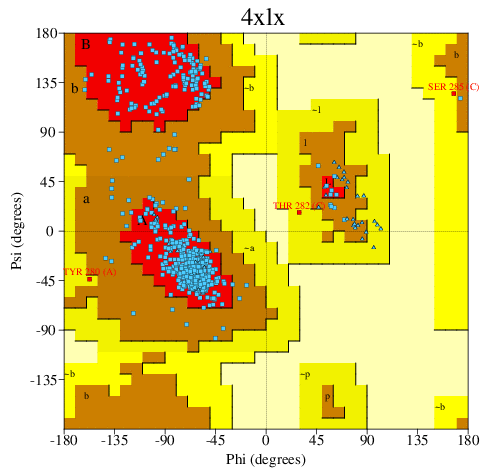
PDBsum entry 4xlx
|
|
|
|
References listed in PDB file
|
 |
|
Key reference
|
|
|
Title
|
|
Structure, Function and inhibition of ent-Kaurene synthase from bradyrhizobium japonicum.
|
|
|
Authors
|
|
W.Liu,
X.Feng,
Y.Zheng,
C.H.Huang,
C.Nakano,
T.Hoshino,
S.Bogue,
T.P.Ko,
C.C.Chen,
Y.Cui,
J.Li,
I.Wang,
S.T.Hsu,
E.Oldfield,
R.T.Guo.
|
|
|
Ref.
|
|
Sci Rep, 2014,
4,
6214.
[DOI no: ]
|
|
|
PubMed id
|
|
|
|
|
|
Abstract
|
|
|
We report the first X-ray crystal structure of ent-kaur-16-ene synthase from
Bradyrhizobium japonicum, together with the results of a site-directed
mutagenesis investigation into catalytic activity. The structure is very similar
to that of the α domains of modern plant terpene cyclases, a result that is of
interest since it has been proposed that many plant terpene cyclases may have
arisen from bacterial diterpene cyclases. The ent-copalyl diphosphate substrate
binds to a hydrophobic pocket near a cluster of Asp and Arg residues that are
essential for catalysis, with the carbocations formed on ionization being
protected by Leu, Tyr and Phe residues. A bisphosphonate inhibitor binds to the
same site. In the kaurene synthase from the moss Physcomitrella patens,
16-α-hydroxy-ent-kaurane as well as kaurene are produced since Leu and Tyr in
the P. patens kaurene synthase active site are replaced by smaller residues
enabling carbocation quenching by water. Overall, the results represent the
first structure determination of a bacterial diterpene cyclase, providing
insights into catalytic activity, as well as structural comparisons with diverse
terpene synthases and cyclases which clearly separate the terpene cyclases from
other terpene synthases having highly α-helical structures.
|
|
|
|
|
|
|