 |
PDBsum entry 4x8o
|
|

|
|
PDB id:
|
|
|
|
| Name: |
|
Transferase
|
|
|
Title:
|
|
Crystal structure of e. Coli adenylate kinase y171w mutant in complex with inhibitor ap5a
|
|
Structure:
|
|
Adenylate kinase. Chain: a, b. Synonym: ak,atp-amp transphosphorylase,atp:amp phosphotransferase, adenylate monophosphate kinase. Engineered: yes. Mutation: yes
|
|
Source:
|
|
Escherichia coli. Organism_taxid: 562. Gene: adk, dnaw, plsa, b0474, jw0463. Expressed in: escherichia coli. Expression_system_taxid: 562
|
|
Resolution:
|
|
|
2.10Å
|
R-factor:
|
0.180
|
R-free:
|
0.240
|
|
|
Authors:
|
|
A.E.Sauer-Eriksson,M.Kovermann,J.Aden,C.Grundstrom,M.Wolf-Watz, U.H.Sauer
|
|
Key ref:
|
|
M.Kovermann
et al.
(2015).
Structural basis for catalytically restrictive dynamics of a high-energy enzyme state.
Nat Commun,
6,
7644.
PubMed id:
DOI:
|
|
|
Date:
|
|
|
10-Dec-14
|
Release date:
|
15-Jul-15
|
|
|
|
|
|
|
PROCHECK
|

|
|
|
|
|
Headers
|
|
|
|
References
|
|
|
|
|
|

|
|
P69441
(KAD_ECOLI) -
Adenylate kinase from Escherichia coli (strain K12)
|
|
|
|
Seq:
Struc:
|
|
|
|
214 a.a.
214 a.a.*
|
|

|

|
|
|
|
|
|
|
|
|
|
|
|
Key: |
|
 |
Secondary structure |
|
 |
CATH domain |
|
|
*
PDB and UniProt seqs differ
at 1 residue position (black
cross)
|
|
|
|
|
|
|
|
|
|
|
|
|
Enzyme class:
|
|
E.C.2.7.4.3
- adenylate kinase.
|
|
|
|
|
|
|
Reaction:
|
|
AMP + ATP = 2 ADP
|
|
|
|
|
|
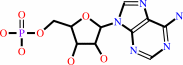 AMP
AMP
|
+
|
ATP
Bound ligand (Het Group name = )
matches with 54.39% similarity
|
=
|
 2
×
ADP
2
×
ADP
|
|
|
|
|
|
|
|
|
|
|
|
|
Molecule diagrams generated from .mol files obtained from the
KEGG ftp site
|
|
|
|
|
|
|
|
|
|
|
|
|
|
 |
|
|
|
|
|
|
| |
|
|
| |
|
DOI no:
|
Nat Commun
6:7644
(2015)
|
|
PubMed id:
|
|
|
|
|
|
| |
|
Structural basis for catalytically restrictive dynamics of a high-energy enzyme state.
|
|
M.Kovermann,
J.Ådén,
C.Grundström,
A.E.Sauer-Eriksson,
U.H.Sauer,
M.Wolf-Watz.
|
|
|
|
|
| |
ABSTRACT
|
|
|
|
| |
|
|
An emerging paradigm in enzymology is that transient high-energy structural
states play crucial roles in enzymatic reaction cycles. Generally, these
high-energy or 'invisible' states cannot be studied directly at atomic
resolution using existing structural and spectroscopic techniques owing to their
low populations or short residence times. Here we report the direct NMR-based
detection of the molecular topology and conformational dynamics of a
catalytically indispensable high-energy state of an adenylate kinase variant. On
the basis of matching energy barriers for conformational dynamics and catalytic
turnover, it was found that the enzyme's catalytic activity is governed by its
dynamic interconversion between the high-energy state and a ground state
structure that was determined by X-ray crystallography. Our results show that it
is possible to rationally tune enzymes' conformational dynamics and hence their
catalytic power-a key aspect in rational design of enzymes catalysing novel
reactions.
|
|
|
|
|
|
|
|
|
|
|
|
|
|
|
|
|
|
 |
 |
 |
|


 Links
Links


