 |
PDBsum entry 4jwc

|
|
|
|
|
|

|

|

|

|
|

|
|

|
|

|
|

|
|

|
|

|
|
|
 |

|

|
|
|
|
|
|
|
|
|
|
|
|
|
|
|
|
|
|
|
|
|
|
|
|
|
|
|
|
|
|
|
|
|
|
|
Chaperone/antibiotic
|
PDB id
|
|
|
|
4jwc
|
|
|
|
|
|
|
|
|
|
|
|
|
|
|

|

|

|
|
|
|
|
|
|
PDB id:
|
|
|
|
| Name: |
|
Chaperone/antibiotic
|
|
|
Title:
|
|
Crystal structure of the substrate binding domain of e.Coli dnak in complex with bovine bac7(1-16)
|
|
Structure:
|
|
Chaperone protein dnak. Chain: a, b. Fragment: uno residues 389-607. Synonym: hsp70, heat shock 70 kda protein, heat shock protein 70. Engineered: yes. Cathelicidin-3. Chain: c, d. Fragment: unp residues 131-146. Synonym: bactenecin-7, bac7, pr-59.
|
|
Source:
|
|
Escherichia coli. Organism_taxid: 83333. Strain: k12. Gene: dnak, grop, grpf, seg. Expressed in: escherichia coli. Expression_system_taxid: 562. Synthetic: yes. Bos taurus. Cow.
|
|
Resolution:
|
|
|
1.80Å
|
R-factor:
|
0.203
|
R-free:
|
0.225
|
|
|
Authors:
|
|
M.Zahn,N.Straeter
|
|
Key ref:
|
|
M.Zahn
et al.
(2014).
Structural identification of DnaK binding sites within bovine and sheep bactenecin Bac7.
Protein Pept Lett,
21,
407-412.
PubMed id:
|
|
|
Date:
|
|
|
27-Mar-13
|
Release date:
|
13-Nov-13
|
|
|
|
|
|
|
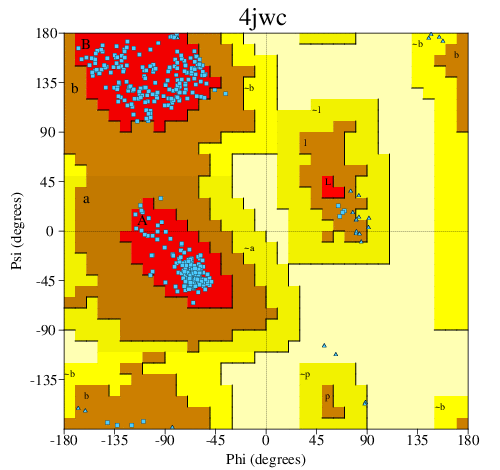
PROCHECK
|
|
|
|
|
|
Headers
|
|
|
|
References
|
|
|
|
|
|

|
|
P0A6Y8
(DNAK_ECOLI) -
Chaperone protein DnaK from Escherichia coli (strain K12)
|
|
|
|
Seq:
Struc:
|
|
|
|
638 a.a.
213 a.a.
|
|

|

|
|
|
|
|
|
|
|
|
|
|
|
Key: |
 |
PfamA domain |
|
|
 |
Secondary structure |
|
 |
CATH domain |
|
|
|
|
|
|
|
|
|
|
|
|
|
|
|
|
|
 |
|
|
|
|
|
|
| |
|
|
Protein Pept Lett
21:407-412
(2014)
|
|
PubMed id:
|
|
|
|
|
|
| |
|
Structural identification of DnaK binding sites within bovine and sheep bactenecin Bac7.
|
|
M.Zahn,
B.Kieslich,
N.Berthold,
D.Knappe,
R.Hoffmann,
N.Strater.
|
|
|
|
|
| |
ABSTRACT
|
|
|
|
| |
|
|
Bacterial resistance against common antibiotics is an increasing health problem.
New pharmaceuticals for the treatment of infections caused by resistant
pathogens are needed. Small proline-rich antimicrobial peptides (PrAMPs) from
insects are known to bind intracellularly to the conventional substrate binding
cleft of the E. coli Hsp70 chaperone DnaK. Furthermore, bactenecins from
mammals, members of the cathelicidin family, also contain potential DnaK binding
sites. Crystal structures of bovine and sheep Bac7 in complex with the DnaK
substrate binding domain show that the peptides bind in the forward binding mode
with a leucine positioned in the central hydrophobic pocket. In most structures,
proline and arginine residues preceding leucine occupy the hydrophobic DnaK
binding sites -1 and -2. Within bovine Bac7, four potential DnaK binding sites
were identified.
|
|
|
|
|
|
|
|
|
|
|
|
|
|
|
|
|
|
 |
 |
 |
|


 Links
Links


