|
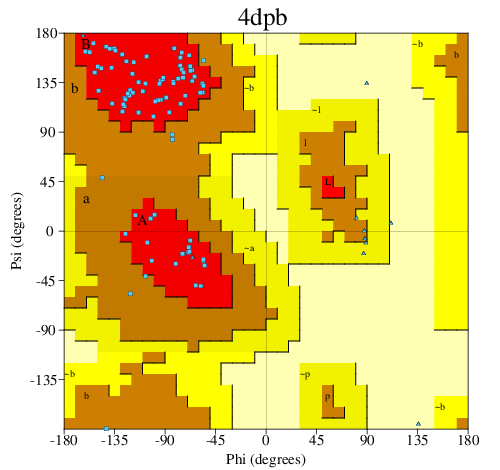
PDBsum entry 4dpb

|
|
|
|
|
|

|
|

|
|

|
|

|
|

|
|
|
 |

|

|
|
|
|
|
|
|
|
|
|
|
|
|
|
|
|
|
|
|
|
|
|
|
|
|
|
|
|
|
|
Electron transport
|
PDB id
|
|
|
|
4dpb
|
|
|
|
|
|
|
|
|
|
|
|
|
|
|

|

|

|
|
|
|
|
|
References listed in PDB file
|
|
|
Key reference
|
|
|
Title
|
|
Structural comparison of the poplar plastocyanin isoforms pca and pcb sheds new light on the role of the copper site geometry in interactions with redox partners in oxygenic photosynthesis.
|
|
|
Authors
|
|
G.S.Kachalova,
A.C.Shosheva,
G.P.Bourenkov,
A.A.Donchev,
M.I.Dimitrov,
H.D.Bartunik.
|
|
|
Ref.
|
|
J Inorg Biochem, 2012,
115,
174-181.
|
|
|
PubMed id
|
|
|
|
|
|
Abstract
|
|
|
Plastocyanin (PC) from poplar leaves is present in two isoforms, PCa and PCb,
which differ in sequence by amino acid replacements at locations remote from the
copper center and simultaneously act in the photosynthetic electron-transport
chain. We describe ultra-high resolution structures of PCa and high-resolution
structures of PCb, both under oxidizing and reducing conditions at pH 4, 6 and
8. The docking on cytochrome f and photosystem I, respectively, has been modeled
for both isoforms. PCa and PCb exhibit closely similar overall and active-site
structures, except for a difference in the relative orientation of the acidic
patches. The isoforms exhibit substantial differences in the dependence of the
reduced (Cu(I)) geometry on pH. In PCa, the decrease in pH causes a gradual
dissociation of His87 from Cu(I) at low pH, probably adopting a neutral
tautomeric state. In PCb, the histidine remains covalently bound to Cu(I) and
may adopt a doubly protonated state at low pH. The fact that both isoforms have
similar although not identical functions in photosynthetic electron flows
suggests that the His87 imidazole does not play a crucial role for the pathway
of electron transport from cytochrome f to oxidized PC.
|
|
|
|
|
|
|