|
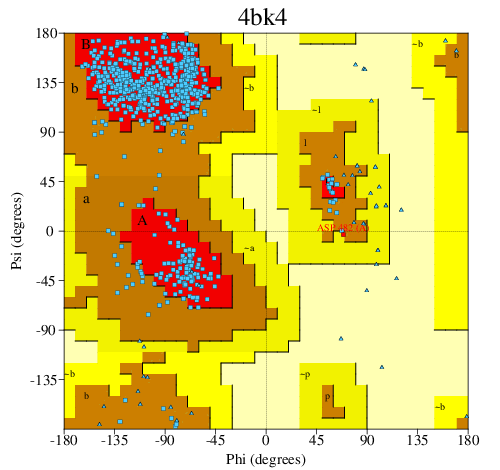
PDBsum entry 4bk4

|
|
|
|
|
|

|
|

|
|

|
|

|
|

|
|

|
|

|
|
|
 |

|

|
|
|
|
|
|
|
|
|
|
|
|
|
|
|
|
|
|
|
|
|
|
|
|
|
|
|
|
|
|
|
|
Signaling protein
|
PDB id
|
|
|
|
4bk4
|
|
|
|
|
|
|
|
|
|
|
|
|
|
|

|

|

|
|
|
|
|
|
References listed in PDB file
|
|
|
Key reference
|
|
|
Title
|
|
Structurally encoded intraclass differences in epha clusters drive distinct cell responses.
|
|
|
Authors
|
|
E.Seiradake,
A.Schaupp,
D.Del toro ruiz,
R.Kaufmann,
N.Mitakidis,
K.Harlos,
A.R.Aricescu,
R.Klein,
E.Y.Jones.
|
|
|
Ref.
|
|
Nat Struct Biol, 2013,
20,
958-964.
[DOI no: ]
|
|
|
PubMed id
|
|
|
|
|
|
Abstract
|
|
|
Functional outcomes of ephrin binding to Eph receptors (Ephs) range from cell
repulsion to adhesion. Here we used cell collapse and stripe assays, showing
contrasting effects of human ephrinA5 binding to EphA2 and EphA4. Despite
equivalent ligand binding affinities, EphA4 triggered greater cell collapse,
whereas EphA2-expressing cells adhered better to ephrinA5-coated surfaces.
Chimeric receptors showed that the ectodomain is a major determinant of cell
response. We report crystal structures of EphA4 ectodomain alone and in
complexes with ephrinB3 and ephrinA5. These revealed closed clusters with a
dimeric or circular arrangement in the crystal lattice, contrasting with
extended arrays previously observed for EphA2 ectodomain. Localization
microscopy showed that ligand-stimulated EphA4 induces smaller clusters than
does EphA2. Mutant Ephs link these characteristics to interactions observed in
the crystal lattices, suggesting a mechanism by which distinctive ectodomain
surfaces determine clustering, and thereby signaling, properties.
|
|
|
|
|
|
|