 |
PDBsum entry 3uyt

|
|
|
|
|
|

|

|

|

|
|

|
|

|
|

|
|

|
|

|
|

|
|
|
 |

|

|
|
|
|
|
|
|
|
|
|
|
|
|
|
|
|
|
|
|
|
|
|
|
|
|
|
|
|
|
|
|
|
|
|
|
Transferase/transferase inhibitor
|
PDB id
|
|
|
|
3uyt
|
|
|
|
|
|
|
|
|
|
|
|
|
|
|

|

|

|
|
|
|
|
|
|
|
|
|
|
Enzyme class 1:
|
|
Chains A, B, C, D:
E.C.2.7.11.1
- non-specific serine/threonine protein kinase.
|
|
|
|
|
|
|
Reaction:
|
|
|
1.
|
L-seryl-[protein] + ATP = O-phospho-L-seryl-[protein] + ADP + H+
|
|
2.
|
L-threonyl-[protein] + ATP = O-phospho-L-threonyl-[protein] + ADP + H+
|
|
|
|
|
|
|
L-seryl-[protein]
|
+
|
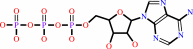 ATP
ATP
|
=
|
O-phospho-L-seryl-[protein]
|
+
|
 ADP
ADP
|
+
|
H(+)
|
|
|
|
|
|
|
L-threonyl-[protein]
|
+
|
ATP
|
=
|
O-phospho-L-threonyl-[protein]
|
+
|
ADP
|
+
|
H(+)
|
|
|
|
|
|
|
|
|
|
Enzyme class 2:
|
|
Chains A, B, C, D:
E.C.2.7.11.26
- [tau protein] kinase.
|
|
|
|
|
|
|
Reaction:
|
|
|
1.
|
L-seryl-[tau protein] + ATP = O-phospho-L-seryl-[tau protein] + ADP + H+
|
|
2.
|
L-threonyl-[tau protein] + ATP = O-phospho-L-threonyl-[tau protein] + ADP + H+
|
|
|
|
|
|
|
L-seryl-[tau protein]
|
+
|
ATP
|
=
|
O-phospho-L-seryl-[tau protein]
|
+
|
ADP
|
+
|
H(+)
|
|
|
|
|
|
|
L-threonyl-[tau protein]
|
+
|
ATP
|
=
|
O-phospho-L-threonyl-[tau protein]
|
+
|
ADP
|
+
|
H(+)
|
|
|
|
|
|
|
|
|
|
|
|
|
Note, where more than one E.C. class is given (as above), each may
correspond to a different protein domain or, in the case of polyprotein
precursors, to a different mature protein.
|
|
|
|
Molecule diagrams generated from .mol files obtained from the
KEGG ftp site
|
|
|
|
|
|
|
|
|
|
|
|
|
|
 |
|
|
|
|
|
|
| |
|
|
| |
|
|
J Med Chem
55:956-960
(2012)
|
|
PubMed id:
|
|
|
|
|
|
| |
|
Structural basis for the interaction between casein kinase 1 delta and a potent and selective inhibitor.
|
|
A.Long,
H.Zhao,
X.Huang.
|
|
|
|
|
| |
ABSTRACT
|
|
|
|
| |
|
|
Casein kinase 1 delta (CK1δ) and its closest homologue CK1ε are key regulators
of diverse cellular growth and survival processes such as Wnt signaling, DNA
repair, and circadian rhythms. We report three crystal structures of the kinase
domain of human CK1δ, one apo and two complexed with a potent and selective
CK1δ/ε inhibitor PF670462 in two different crystal forms. These structures
provide a molecular basis for the strong and specific inhibitor interactions and
suggest clues for further development of CK1δ/ε inhibitors.
|
|
|
|
|
|
|
|
|
|
|
|
|
|
|
|
|
|
 |
 |
 |
|
|


 Links
Links


