 |
PDBsum entry 3tk3

|
|
|
|
|
|

|

|

|

|
|

|
|

|
|

|
|

|
|

|
|

|
|
|
 |

|

|
|
|
|
|
|
|
|
|
|
|
|
|
|
|
|
|
|
|
|
|
|
|
|
|
|
|
|
|
|
|
|
|
|
|
Oxidoreductase
|
PDB id
|
|
|
|
3tk3
|
|
|
|
|
|
|
|
|
|
|
|
|
|
|

|

|

|
|
|
|
|
|
|
PDB id:
|
|
|
|
| Name: |
|
Oxidoreductase
|
|
|
Title:
|
|
Cytochrome p450 2b4 mutant l437a in complex with 4-(4-chlorophenyl) imidazole
|
|
Structure:
|
|
Cytochrome p450 2b4. Chain: a, b, c, d. Synonym: cypiib4, cytochrome p450 isozyme 2, cytochrome p450 lm2, cytochrome p450 type b0, cytochrome p450 type b1. Engineered: yes. Mutation: yes
|
|
Source:
|
|
Oryctolagus cuniculus. European rabbit,japanese white rabbit,domestic rabbit,rabbits. Organism_taxid: 9986. Gene: cyp2b4. Expressed in: escherichia coli. Expression_system_taxid: 562.
|
|
Resolution:
|
|
|
2.80Å
|
R-factor:
|
0.195
|
R-free:
|
0.241
|
|
|
Authors:
|
|
S.C.Gay,H.H.Jang,P.R.Wilderman,Q.Zhang,C.D.Stout,J.R.Halpert
|
|
Key ref:
|
|
P.R.Wilderman
et al.
(2012).
Investigation by site-directed mutagenesis of the role of cytochrome P450 2B4 non-active-site residues in protein-ligand interactions based on crystal structures of the ligand-bound enzyme.
Febs J,
279,
1607-1620.
PubMed id:
|
|
|
Date:
|
|
|
25-Aug-11
|
Release date:
|
16-Nov-11
|
|
|
|
|
|
|
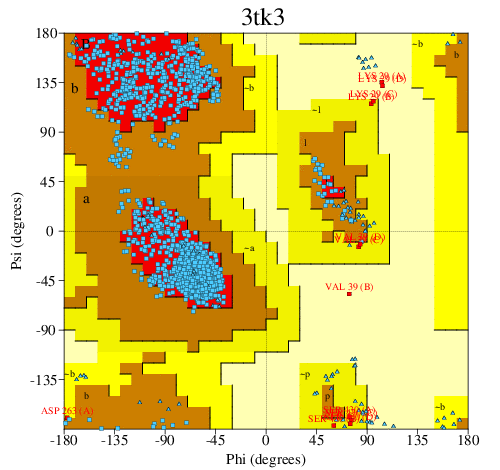
PROCHECK
|
|
|
|
|
|
Headers
|
|
|
|
References
|
|
|
|
|
|

|
|
P00178
(CP2B4_RABIT) -
Cytochrome P450 2B4 from Oryctolagus cuniculus
|
|
|
|
Seq:
Struc:
|
|
|
|
491 a.a.
465 a.a.*
|
|

|

|

|
|
|
|
|
|
|
|
|
|
|
Key: |
 |
PfamA domain |
|
|
 |
Secondary structure |
|
 |
CATH domain |
|
|
*
PDB and UniProt seqs differ
at 4 residue positions (black
crosses)
|
|
|
|
|
|
|
|
|
|
|
|
|
Enzyme class:
|
|
E.C.1.14.14.1
- unspecific monooxygenase.
|
|
|
|
|
|
|
Reaction:
|
|
an organic molecule + reduced [NADPH--hemoprotein reductase] + O2 = an alcohol + oxidized [NADPH--hemoprotein reductase] + H2O + H+
|
|
|
|
|
|
organic molecule
|
+
|
reduced [NADPH--hemoprotein reductase]
|
+
|
 O2
O2
|
=
|
 alcohol
|
+
|
oxidized [NADPH--hemoprotein reductase]
|
+
|
H2O
|
+
|
H(+)
|
|
|
|
|
|
|
|
|
|
Cofactor:
|
|
Heme-thiolate
|
|
|
|
|
|
|
|
|
Molecule diagrams generated from .mol files obtained from the
KEGG ftp site
|
|
|
|
|
|
|
|
|
|
|
|
|
|
 |
|
|
|
|
|
|
| |
|
|
| |
|
|
Febs J
279:1607-1620
(2012)
|
|
PubMed id:
|
|
|
|
|
|
| |
|
Investigation by site-directed mutagenesis of the role of cytochrome P450 2B4 non-active-site residues in protein-ligand interactions based on crystal structures of the ligand-bound enzyme.
|
|
P.R.Wilderman,
S.C.Gay,
H.H.Jang,
Q.Zhang,
C.D.Stout,
J.R.Halpert.
|
|
|
|
|
| |
ABSTRACT
|
|
|
|
| |
|
|
Residues located outside the active site of cytochromes P450 2B have exhibited
importance in ligand binding, structural stability and drug metabolism. However,
contributions of non-active-site residues to the plasticity of these enzymes are
not known. Thus, a systematic investigation was undertaken of unique
residue-residue interactions found in crystal structures of P450 2B4 in complex
with 4-(4-chlorophenyl)imidazole (4-CPI), a closed conformation, or in complex
with bifonazole, an expanded conformation. Nineteen mutants distributed over 11
sites were constructed, expressed in Escherichia coli and purified. Most mutants
showed significantly decreased expression, especially in the case of
interactions found in the 4-CPI structure. Six mutants (H172A, H172F, H172Q,
L437A, E474D and E474Q) were chosen for detailed functional analysis. Among
these, the K(s) of H172F for bifonazole was ∼ 20 times higher than for
wild-type 2B4, and the K(s) of L437A for 4-CPI was ∼ 50 times higher than for
wild-type, leading to significantly altered inhibitor selectivity. Enzyme
function was tested with the substrates 7-ethoxy-4-(trifluoromethyl)coumarin,
7-methoxy-4-(trifluoromethyl)coumarin and 7-benzyloxyresorufin (7-BR). H172F was
inactive with all three substrates, and L437A did not turn over 7-BR.
Furthermore, H172A, H172Q, E474D and E474Q showed large changes in k(cat)/K(M)
for each of the three substrates, in some cases up to 50-fold. Concurrent
molecular dynamics simulations yielded distances between some of the residues in
these putative interaction pairs that are not consistent with contact. The
results indicate that small changes in the protein scaffold lead to large
differences in solution behavior and enzyme function.
|
|
|
|
|
|
|
|
|
|
|
|
|
|
|
|
|
|
 |
 |
 |
|


 Links
Links


