|
PDBsum entry 3khb

|
|
|
|
|
|

|

|

|

|
|

|
|

|
|

|
|

|
|
|
 |

|

|
|
|
|
|
|
|
|
|
|
|
|
|
|
|
|
|
|
|
|
|
|
|
|
|
|
|
|
|
|
|
|
|
Oxidoreductase
|
PDB id
|
|
|
|
3khb
|
|
|
|
|
|
|
|
|
|
|
|
|
|
|

|

|

|
|
|
|
|
|
|
|
 |
Contents |
 |
|
|
|
|
|
|
|
|
|
|
|
|
|
|
* Residue conservation analysis
|
|
|
|
|
|
|
|
|
|
|
Enzyme class:
|
|
E.C.1.14.11.33
- Dna oxidative demethylase.
|
|
|
|
|
|
|
Reaction:
|
|
a methylated nucleobase within DNA + 2-oxoglutarate + O2 = a nucleobase within DNA + formaldehyde + succinate + CO2
|
|
|
|
|
|
methylated nucleobase within DNA
Bound ligand (Het Group name = )
corresponds exactly
|
+
|
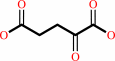 2-oxoglutarate
|
+
|
 O2
O2
|
=
|
nucleobase within DNA
|
+
|
 formaldehyde
|
+
|
 succinate
|
+
|
 CO2
CO2
|
|
|
|
|
|
|
|
|
|
Cofactor:
|
|
Fe cation
|
|
|
|
|
|
|
|
|
Molecule diagrams generated from .mol files obtained from the
KEGG ftp site
|
|
|
|
|
|
|
|
|
|
|
|
|
|
 |
|
|
|
|
|
|
| |
|
|
| |
|
|
Plos One
5:e8680
(2010)
|
|
PubMed id:
|
|
|
|
|
|
| |
|
Structural and mutational analysis of Escherichia coli AlkB provides insight into substrate specificity and DNA damage searching.
|
|
P.J.Holland,
T.Hollis.
|
|
|
|
|
| |
ABSTRACT
|
|
|
|
| |
|
|
BACKGROUND: In Escherichia coli, cytotoxic DNA methyl lesions on the N1 position
of purines and N3 position of pyrimidines are primarily repaired by the
2-oxoglutarate (2-OG) iron(II) dependent dioxygenase, AlkB. AlkB repairs
1-methyladenine (1-meA) and 3-methylcytosine (3-meC) lesions, but it also
repairs 1-methylguanine (1-meG) and 3-methylthymine (3-meT) at a much less
efficient rate. How the AlkB enzyme is able to locate and identify methylated
bases in ssDNA has remained an open question. METHODOLOGY/PRINCIPAL FINDINGS: We
determined the crystal structures of the E. coli AlkB protein holoenzyme and the
AlkB-ssDNA complex containing a 1-meG lesion. We coupled this to site-directed
mutagenesis of amino acids in and around the active site, and tested the effects
of these mutations on the ability of the protein to bind both damaged and
undamaged DNA, as well as catalyze repair of a methylated substrate.
CONCLUSIONS/SIGNIFICANCE: A comparison of our substrate-bound AlkB-ssDNA complex
with our unliganded holoenzyme reveals conformational changes of residues within
the active site that are important for binding damaged bases. Site-directed
mutagenesis of these residues reveals novel insight into their roles in DNA
damage recognition and repair. Our data support a model that the AlkB protein
utilizes at least two distinct conformations in searching and binding methylated
bases within DNA: a "searching" mode and "repair" mode. Moreover, we are able to
functionally separate these modes through mutagenesis of residues that affect
one or the other binding state. Finally, our mutagenesis experiments show that
amino acid D135 of AlkB participates in both substrate specificity and catalysis.
|
|
|
|
|
|
|
|
|
|
|
|
|
|
|
|
|
|
 |
 |
 |
|
Literature references that cite this PDB file's key reference
|
|
|
| |
PubMed id
|
|
Reference
|
|
|
|
|
|
B.Chen,
H.Liu,
X.Sun,
and
C.G.Yang
(2010).
Mechanistic insight into the recognition of single-stranded and double-stranded DNA substrates by ABH2 and ABH3.
|
| |
Mol Biosyst,
6,
2143-2149.
|
|
|
|
|
|
|
C.Yi,
G.Jia,
G.Hou,
Q.Dai,
W.Zhang,
G.Zheng,
X.Jian,
C.G.Yang,
Q.Cui,
and
C.He
(2010).
Iron-catalysed oxidation intermediates captured in a DNA repair dioxygenase.
|
| |
Nature,
468,
330-333.
|
|
|
PDB codes:
|
|
|
|
|
|
|
|
E.A.Waligora,
D.M.Ramsey,
E.E.Pryor,
H.Lu,
T.Hollis,
G.P.Sloan,
R.Deora,
and
D.J.Wozniak
(2010).
AmrZ beta-sheet residues are essential for DNA binding and transcriptional control of Pseudomonas aeruginosa virulence genes.
|
| |
J Bacteriol,
192,
5390-5401.
|
|
|
|
|
|
|
V.T.Monsen,
O.Sundheim,
P.A.Aas,
M.P.Westbye,
M.M.Sousa,
G.Slupphaug,
and
H.E.Krokan
(2010).
Divergent ß-hairpins determine double-strand versus single-strand substrate recognition of human AlkB-homologues 2 and 3.
|
| |
Nucleic Acids Res,
38,
6447-6455.
|
|
|
|
|
|
The most recent references are shown first.
Citation data come partly from CiteXplore and partly
from an automated harvesting procedure. Note that this is likely to be
only a partial list as not all journals are covered by
either method. However, we are continually building up the citation data
so more and more references will be included with time.
Where a reference describes a PDB structure, the PDB
codes are
shown on the right.
|
|


 Links
Links