 |
PDBsum entry 3hg2

|
|
|
|
|
 |
Contents |
 |
|
|
|
|
|
|
|
|
|
|
|
|
* Residue conservation analysis
|
|
|
|
|
|
|
|
|
|
|
Enzyme class:
|
|
E.C.3.2.1.22
- alpha-galactosidase.
|
|
|
|
|
|
|
Reaction:
|
|
Melibiose + H2O = galactose + glucose
|
|
|
|
|
|
|
|
|
|
|
|
|
|
|
Cofactor:
|
|
Mg(2+); NAD(+)
|
|
|
|
|
|
Mg(2+)
|
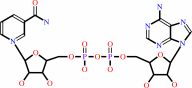 NAD(+)
|
|
|
|
|
|
|
Molecule diagrams generated from .mol files obtained from the
KEGG ftp site
|
|
|
|
|
|
|
|
|
|
|
|
|
|
 |
|
|
|
|
|
|
| |
|
|
| |
|
|
J Biol Chem
285:3625-3632
(2010)
|
|
PubMed id:
|
|
|
|
|
|
| |
|
Catalytic mechanism of human alpha-galactosidase.
|
|
A.I.Guce,
N.E.Clark,
E.N.Salgado,
D.R.Ivanen,
A.A.Kulminskaya,
H.Brumer,
S.C.Garman.
|
|
|
|
|
| |
ABSTRACT
|
|
|
|
| |
|
|
The enzyme alpha-galactosidase (alpha-GAL, also known as alpha-GAL A; E.C.
3.2.1.22) is responsible for the breakdown of alpha-galactosides in the
lysosome. Defects in human alpha-GAL lead to the development of Fabry disease, a
lysosomal storage disorder characterized by the buildup of alpha-galactosylated
substrates in the tissues. alpha-GAL is an active target of clinical research:
there are currently two treatment options for Fabry disease, recombinant enzyme
replacement therapy (approved in the United States in 2003) and pharmacological
chaperone therapy (currently in clinical trials). Previously, we have reported
the structure of human alpha-GAL, which revealed the overall structure of the
enzyme and established the locations of hundreds of mutations that lead to the
development of Fabry disease. Here, we describe the catalytic mechanism of the
enzyme derived from x-ray crystal structures of each of the four stages of the
double displacement reaction mechanism. Use of a
difluoro-alpha-galactopyranoside allowed trapping of a covalent intermediate.
The ensemble of structures reveals distortion of the ligand into a (1)S(3) skew
(or twist) boat conformation in the middle of the reaction cycle. The high
resolution structures of each step in the catalytic cycle will allow for
improved drug design efforts on alpha-GAL and other glycoside hydrolase family
27 enzymes by developing ligands that specifically target different states of
the catalytic cycle. Additionally, the structures revealed a second
ligand-binding site suitable for targeting by novel pharmacological chaperones.
|
|
|
|
|
|
|
|
|
|
|
|
|
|
|
|
|
|
 |
 |
 |
|
Literature references that cite this PDB file's key reference
|
|
|
| |
PubMed id
|
|
Reference
|
|
|
|
|
|
D.P.Germain
(2010).
Fabry disease.
|
| |
Orphanet J Rare Dis,
5,
30.
|
|
|
|
|
|
|
G.Andreotti,
M.R.Guarracino,
M.Cammisa,
A.Correra,
and
M.V.Cubellis
(2010).
Prediction of the responsiveness to pharmacological chaperones: lysosomal human alpha-galactosidase, a case of study.
|
| |
Orphanet J Rare Dis,
5,
36.
|
|
|
|
|
|
|
H.Nakai,
M.J.Baumann,
B.O.Petersen,
Y.Westphal,
M.A.Hachem,
A.Dilokpimol,
J.Ã.˜.Duus,
H.A.Schols,
and
B.Svensson
(2010).
Aspergillus nidulans alpha-galactosidase of glycoside hydrolase family 36 catalyses the formation of alpha-galacto-oligosaccharides by transglycosylation.
|
| |
FEBS J,
277,
3538-3551.
|
|
|
|
|
|
|
T.V.Vuong,
and
D.B.Wilson
(2010).
Glycoside hydrolases: catalytic base/nucleophile diversity.
|
| |
Biotechnol Bioeng,
107,
195-205.
|
|
|
|
|
|
The most recent references are shown first.
Citation data come partly from CiteXplore and partly
from an automated harvesting procedure. Note that this is likely to be
only a partial list as not all journals are covered by
either method. However, we are continually building up the citation data
so more and more references will be included with time.
|
|


 Links
Links


