|
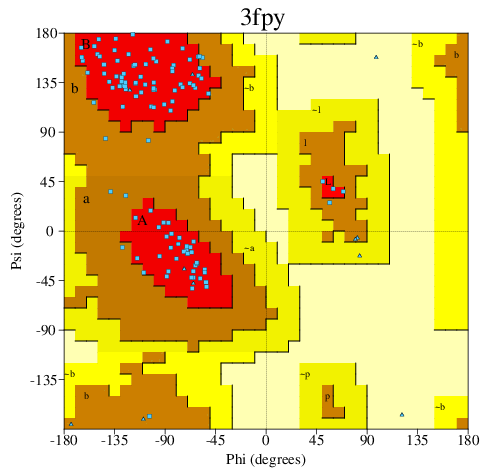
PDBsum entry 3fpy

|
|
|
|
|
|

|
|

|
|

|
|

|
|

|
|

|
|
|
 |

|

|
|
|
|
|
|
|
|
|
|
|
|
|
|
|
|
|
|
|
|
|
|
|
|
|
|
|
|
|
|
|
Electron transport
|
PDB id
|
|
|
|
3fpy
|
|
|
|
|
|
|
|
|
|
|
|
|
|
|

|

|

|
|
|
|
|
|
References listed in PDB file
|
|
|
Key reference
|
|
|
Title
|
|
Type-Zero copper proteins.
|
|
|
Authors
|
|
K.M.Lancaster,
S.Debeer george,
K.Yokoyama,
J.H.Richards,
H.B.Gray.
|
|
|
Ref.
|
|
Nat Chem, 2009,
1,
711-715.
|
|
|
PubMed id
|
|
|
|
|
|
Abstract
|
|
|
Copper proteins play key roles in biological processes such as electron transfer
and dioxygen activation; the active site of each of these proteins is classified
as either type 1, 2, or 3, depending on its optical and electron paramagnetic
resonance properties. We have built a new type of site that we call "type zero
copper" by incorporating leucine, isoleucine, or phenylalanine in place of
methionine at position 121 in C112D Pseudomonas aeruginosa azurin. X-ray
crystallographic analysis shows that these sites adopt distorted tetrahedral
geometries, with an unusually short Cu-O(G45 carbonyl) bond (2.35-2.55 A).
Relatively weak absorption near 800 nm and narrow parallel hyperfine splittings
in EPR spectra are the spectroscopic signatures of type zero copper. Copper
K-edge x-ray absorption spectra suggest elevated Cu(II) 4p character in the
d-electron ground state. Cyclic voltammetric experiments demonstrate that the
electron transfer reactivities of type zero azurins are enhanced relative to
that of the corresponding type 2 (C112D) protein.
|
|
|
|
|
|
|