|
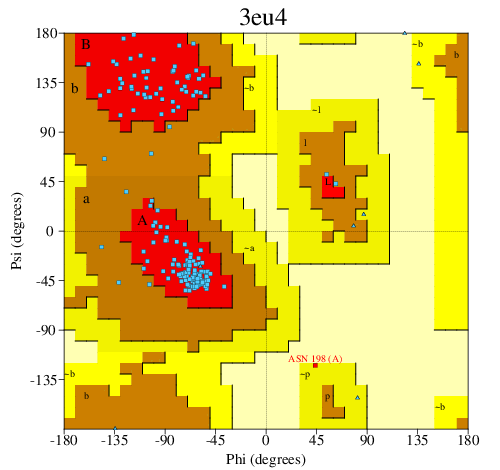
PDBsum entry 3eu4

|
|
|
|
|
|

|
|

|
|

|
|

|
|

|
|
|
 |

|

|
|
|
|
|
|
|
|
|
|
|
|
|
|
|
|
|
|
|
|
|
|
|
|
|
|
|
|
|
|
Oxidoreductase
|
PDB id
|
|
|
|
3eu4
|
|
|
|
|
|
|
|
|
|
|
|
|
|
|

|

|

|
|
|
|
|
|
References listed in PDB file
|
|
|
Key reference
|
|
|
Title
|
|
Crystal structure and biophysical properties of bacillus subtilis bdbd. An oxidizing thiol:disulfide oxidoreductase containing a novel metal site.
|
|
|
Authors
|
|
A.Crow,
A.Lewin,
O.Hecht,
M.Carlsson möller,
G.R.Moore,
L.Hederstedt,
N.E.Le brun.
|
|
|
Ref.
|
|
J Biol Chem, 2009,
284,
23719-23733.
[DOI no: ]
|
|
|
PubMed id
|
|
|
|
|
|
Abstract
|
|
|
BdbD is a thiol:disulfide oxidoreductase (TDOR) from Bacillus subtilis that
functions to introduce disulfide bonds in substrate proteins/peptides on the
outside of the cytoplasmic membrane and, as such, plays a key role in disulfide
bond management. Here we demonstrate that the protein is membrane-associated in
B. subtilis and present the crystal structure of the soluble part of the protein
lacking its membrane anchor. This reveals that BdbD is similar in structure to
Escherichia coli DsbA, with a thioredoxin-like domain with an inserted helical
domain. A major difference, however, is the presence in BdbD of a metal site,
fully occupied by Ca(2+), at an inter-domain position some 14 A away from the
CXXC active site. The midpoint reduction potential of soluble BdbD was
determined as -75 mV versus normal hydrogen electrode, and the active site
N-terminal cysteine thiol was shown to have a low pK(a), consistent with BdbD
being an oxidizing TDOR. Equilibrium unfolding studies revealed that the
oxidizing power of the protein is based on the instability introduced by the
disulfide bond in the oxidized form. The crystal structure of Ca(2+)-depleted
BdbD showed that the protein remained folded, with only minor conformational
changes. However, the reduced form of Ca(2+)-depleted BdbD was significantly
less stable than reduced Ca(2+)-containing protein, and the midpoint reduction
potential was shifted by approximately -20 mV, suggesting that Ca(2+) functions
to boost the oxidizing power of the protein. Finally, we demonstrate that
electron exchange does not occur between BdbD and B. subtilis ResA, a low
potential extra-cytoplasmic TDOR.
|
|
|
|

|
|

|
|
Figure 3.
Active site region of BdbD.A, detailed view of the N terminus
of helix α1 of sBdbD showing the Cys-Pro-Ser-Cys active site of
sBdbD and the closely lying cis-proline (Pro^193), which is
invariant in all thioredoxin-like proteins. B and C, electron
density (contoured at 1.0σ) of the active site region of sBdbD
in oxidized and reduced states, respectively.
|
|
Figure 4.
Ca^2+-binding site of BdbD.A, detailed view (contoured at 1.2
σ) of the Ca^2+-binding site of sBdbD, showing monodentate
ligands Gln^49 and Glu^115, bidentate Asp^180, and three
crystallographically ordered water molecules. B, an ideal capped
octahedral site for comparison with that observed in BdbD.
Positions of the idealized capped octahedron correspond to the
following: I, Gln^49O-ϵ; II, Glu^115O-ϵ; III–V, waters; VI
and VII, Asp^180O-δ1 and Asp^180O-δ2. Ca^2+-ligand distances
are indicated.
|
|
|
|
|
|
The above figures are
reprinted
from an Open Access publication published by the ASBMB:
J Biol Chem
(2009,
284,
23719-23733)
copyright 2009.
|
|
|
|
|
|
|