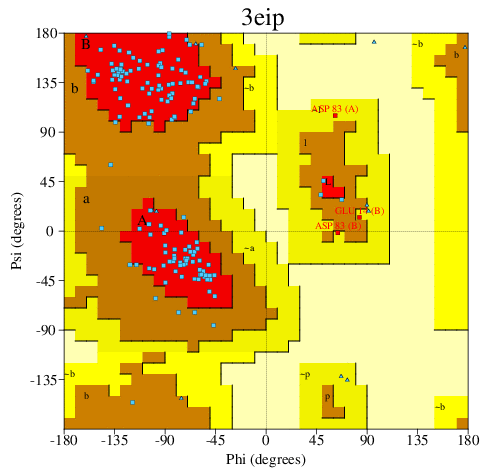
|
PDBsum entry 3eip

|
|
|
|
|
|

|

|

|

|
|

|
|

|
|

|
|

|
|

|
|

|
|
|
 |

|

|
|
|
|
|
|
|
|
|
|
|
|
|
|
|
|
|
|
|
|
|
|
|
|
|
|
|
|
|
|
|
|
|
|
|
Immune system
|
PDB id
|
|
|
|
3eip
|
|
|
|
|
|
|
|
|
|
|
|
|
|
|

|

|

|
|
|
|
|
|
|
|
 |
Contents |
 |
|
|
|
|
|
|
|
|
|
|
|
|
* Residue conservation analysis
|
|
|
|
|
|
|
|
|
|
|
|
|
|
|
 |
|
|
|
|
|
|
| |
|
DOI no:
|
Structure
7:1365-1372
(1999)
|
|
PubMed id:
|
|
|
|
|
|
| |
|
Crystal structure of colicin E3 immunity protein: an inhibitor of a ribosome-inactivating RNase.
|
|
C.Li,
D.Zhao,
A.Djebli,
M.Shoham.
|
|
|
|
|
| |
ABSTRACT
|
|
|
|
| |
|
|
BACKGROUND: Colicins are antibiotic-like proteins of Escherichia coli that kill
related strains. Colicin E3 acts as an RNase that specifically cleaves 16S rRNA,
thereby inactivating the ribosomes in the infected cell. The producing organism
is protected against colicin E3 by a specific inhibitor, the immunity protein
Im3, which forms a tight 1:1 complex with colicin E3 and renders it inactive.
Crystallographic studies on colicin E3 and Im3 have been undertaken to unravel
the structural basis for the ribonucleolytic activity and its inhibition.
RESULTS: The crystal structure of Im3 has been determined to a resolution of 1.8
A. The structure consists of a four-standard antiparallel beta sheet flanked by
three alpha helices on one side of the sheet. Thr7, Phe9, Phe16 and Phe74 form a
hydrophobic cluster on the surface of the protein in the vicinity of Cys47. This
cluster is part of a putative binding pocket which also includes nine polar
residues. CONCLUSIONS: The putative binding pocket of Im3 is the probable site
of interaction with colicin E3. The six acidic residues in the pocket may
interact with some of the numerous basic residues of colicin E3. The involvement
of hydrophobic moieties in the binding is consistent with the observation that
the tight complex can only be dissociated by denaturation. The structure of Im3
resembles those of certain nucleic acid binding proteins, in particular domain
II of topoisomerase I and RNA-binding proteins that contain the
ribonucleoprotein (RNP) sequence motif. This observation suggests that Im3 has a
nucleic acid binding function in addition to binding colicin E3.
|
|
|
|
|
|
| |
Selected figure(s)
|
|
|
|
| |
|
|

|
|
Figure 3.
Figure 3. The molecular interface of the Im3 dimer.
Monomers A and B are depicted as Ca traces. Residues at the
interface are shown in ball-and-stick representation in green
(monomer A) and blue (monomer B). A major intermolecular
interaction is the covalent cross-link of the thiols via a zinc
ion, shown in yellow. Additional interactions include two
intermolecular hydrogen bonds as well as hydrophobic
interactions involving the nonpolar atoms of nine residues from
monomer A, and seven residues from monomer B (see text).
Furthermore, there are two water molecules, shown in red, that
mediate the interaction between the monomers. (This figure was
made with the program MOLSCRIPT [43].)
|
|
|
|
|
|
| |
The above figure is
reprinted
by permission from Cell Press:
Structure
(1999,
7,
1365-1372)
copyright 1999.
|
|
| |
Figure was
selected
by an automated process.
|
|
|
|
|
|
|
|
|
|
|
|
|
|
|
|
 |
 |
 |
|
Literature references that cite this PDB file's key reference
|
|
|
| |
PubMed id
|
|
Reference
|
|
|
|
|
|
C.Kleanthous,
and
D.Walker
(2001).
Immunity proteins: enzyme inhibitors that avoid the active site.
|
| |
Trends Biochem Sci,
26,
624-631.
|
|
|
|
|
|
|
S.Soelaiman,
K.Jakes,
N.Wu,
C.Li,
and
M.Shoham
(2001).
Crystal structure of colicin E3: implications for cell entry and ribosome inactivation.
|
| |
Mol Cell,
8,
1053-1062.
|
|
|
PDB code:
|
|
|
|
|
|
|
|
S.Carr,
D.Walker,
R.James,
C.Kleanthous,
and
A.M.Hemmings
(2000).
Inhibition of a ribosome-inactivating ribonuclease: the crystal structure of the cytotoxic domain of colicin E3 in complex with its immunity protein.
|
| |
Structure,
8,
949-960.
|
|
|
PDB code:
|
|
|
|
|
|
|
The most recent references are shown first.
Citation data come partly from CiteXplore and partly
from an automated harvesting procedure. Note that this is likely to be
only a partial list as not all journals are covered by
either method. However, we are continually building up the citation data
so more and more references will be included with time.
Where a reference describes a PDB structure, the PDB
code is
shown on the right.
|
|


 Links
Links