|
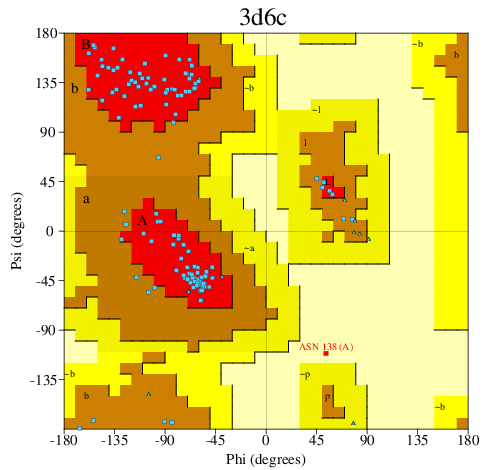
PDBsum entry 3d6c
|
|
|
|
References listed in PDB file
|
 |
|
Key reference
|
|
|
Title
|
|
The pk(a) values of acidic and basic residues buried at the same internal location in a protein are governed by different factors.
|
|
|
Authors
|
|
M.J.Harms,
C.A.Castañeda,
J.L.Schlessman,
G.R.Sue,
D.G.Isom,
B.R.Cannon,
B.García-Moreno e.
|
|
|
Ref.
|
|
J Mol Biol, 2009,
389,
34-47.
[DOI no: ]
|
|
|
PubMed id
|
|
|
|
|
|
|
|
|
Abstract
|
|
|
The pK(a) values of internal ionizable groups are usually very different from
the normal pK(a) values of ionizable groups in water. To examine the molecular
determinants of pK(a) values of internal groups, we compared the properties of
Lys, Asp, and Glu at internal position 38 in staphylococcal nuclease. Lys38
titrates with a normal or elevated pK(a), whereas Asp38 and Glu38 titrate with
elevated pK(a) values of 7.0 and 7.2, respectively. In the structure of the L38K
variant, the buried amino group of the Lys38 side chain makes an ion pair with
Glu122, whereas in the structure of the L38E variant, the buried carboxyl group
of Glu38 interacts with two backbone amides and has several nearby carboxyl
oxygen atoms. Previously, we showed that the pK(a) of Lys38 is normal owing to
structural reorganization and water penetration concomitant with ionization of
the Lys side chain. In contrast, the pK(a) values of Asp38 and Glu38 are
perturbed significantly owing to an imbalance between favorable polar
interactions and unfavorable contributions from dehydration and from Coulomb
interactions with surface carboxylic groups. Their ionization is also coupled to
subtle structural reorganization. These results illustrate the complex interplay
between local polarity, Coulomb interactions, and structural reorganization as
determinants of pK(a) values of internal groups in proteins. This study suggests
that improvements to computational methods for pK(a) calculations will require
explicit treatment of the conformational reorganization that can occur when
internal groups ionize.
|
|
|
|

|
|

|
|
Figure 1.
Fig. 1. Crystal structure of PHS/L38E (pink, PDB accession
code 3D6C) overlaid on the structures of PHS/L38K (blue, PDB
accession code 2RKS) and PHS nuclease (white, PDB accession code
1EY8). (a) The global fold of the protein is not perturbed. The
C^α atoms of Asp and Glu residues are shown as red spheres.
Glu38, Lys38, and Glu122 are shown as sticks. (b)
Microenvironment of Glu38 and Lys38. Ionizable residues within
8.4 Å of Glu38 are shown in stick, and hydrogen bonds are
shown as broken lines.
|
|
Figure 6.
Fig. 6. Distance dependence of apparent Coulomb interactions
for the current study (●) and for data published previously by
Lee et al. ( Image )^29 and Baran et al. ( Image ).^30 The
broken line is a fit to the data from the current study only,
whereas the continuous line is a fit to all available data.
|
|
|
|
|
|
The above figures are
reprinted
by permission from Elsevier:
J Mol Biol
(2009,
389,
34-47)
copyright 2009.
|
|
|
|
|
|
|