|
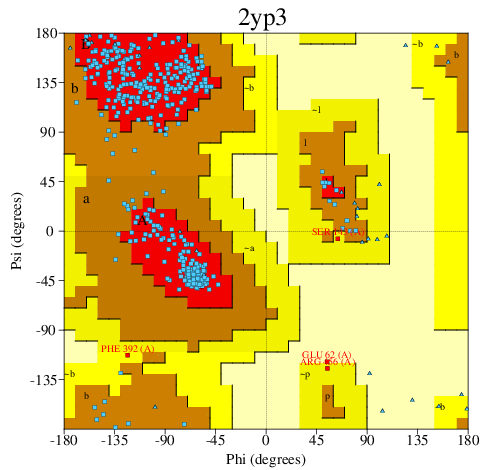
PDBsum entry 2yp3

|
|
|
|
|
|

|
|

|
|

|
|

|
|

|
|

|
|

|
|
|
 |

|

|
|
|
|
|
|
|
|
|
|
|
|
|
|
|
|
|
|
|
|
|
|
|
|
|
|
|
|
|
|
|
|
Viral protein
|
PDB id
|
|
|
|
2yp3
|
|
|
|
|
|
|
|
|
|
|
|
|
|
|

|

|

|
|
|
|
|
|
References listed in PDB file
|
|
|
Key reference
|
|
|
Title
|
|
Evolution of the receptor binding properties of the influenza a(h3n2) hemagglutinin.
|
|
|
Authors
|
|
Y.P.Lin,
X.Xiong,
S.A.Wharton,
S.R.Martin,
P.J.Coombs,
S.G.Vachieri,
E.Christodoulou,
P.A.Walker,
J.Liu,
J.J.Skehel,
S.J.Gamblin,
A.J.Hay,
R.S.Daniels,
J.W.Mccauley.
|
|
|
Ref.
|
|
Proc Natl Acad Sci U S A, 2012,
109,
21474-21479.
|
|
|
PubMed id
|
|
|
|
|
|
|
|
|
Abstract
|
|
|
The hemagglutinin (HA) of influenza A(H3N2) virus responsible for the 1968
influenza pandemic derived from an avian virus. On introduction into humans, its
receptor binding properties had changed from a preference for avian receptors
(α2,3-linked sialic acid) to a preference for human receptors (α2,6-linked
sialic acid). By 2001, the avidity of human H3 viruses for avian receptors had
declined, and since then the affinity for human receptors has also decreased
significantly. These changes in receptor binding, which correlate with increased
difficulties in virus propagation in vitro and in antigenic analysis, have been
assessed by virus hemagglutination of erythrocytes from different species and
quantified by measuring virus binding to receptor analogs using surface biolayer
interferometry. Crystal structures of HA-receptor analog complexes formed with
HAs from viruses isolated in 2004 and 2005 reveal significant differences in the
conformation of the 220-loop of HA1, relative to the 1968 structure, resulting
in altered interactions between the HA and the receptor analog that explain the
changes in receptor affinity. Site-specific mutagenesis shows the HA1
Asp-225→Asn substitution to be the key determinant of the decreased receptor
binding in viruses circulating since 2005. Our results indicate that the
evolution of human influenza A(H3N2) viruses since 1968 has produced a virus
with a low propensity to bind human receptor analogs, and this loss of avidity
correlates with the marked reduction in A(H3N2) virus disease impact in the last
10 y.
|
|
|
|
|
|
|