|
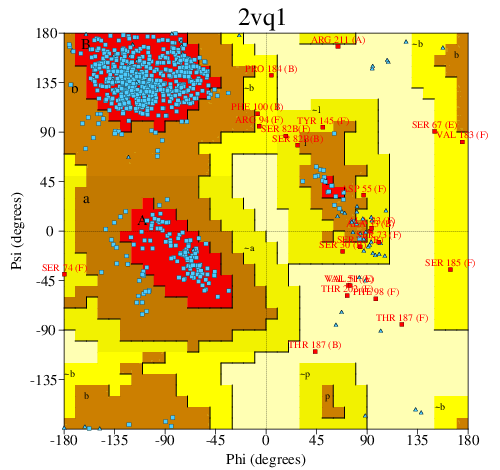
PDBsum entry 2vq1

|
|
|
|
|
|

|
|

|
|

|
|

|
|

|
|

|
|

|
|

|
|
|
 |

|

|
|
|
|
|
|
|
|
|
|
|
|
|
|
|
|
|
|
|
|
|
|
|
|
|
|
|
|
|
|
|
|
|
Immune system
|
PDB id
|
|
|
|
2vq1
|
|
|
|
|
|
|
|
|
|
|
|
|
|
|

|

|

|
|
|
|
|
|
References listed in PDB file
|
|
|
Key reference
|
|
|
Title
|
|
Characterization of a diagnostic FAB fragment binding trimeric lewis X.
|
|
|
Authors
|
|
D.C.De geus,
A.M.Van roon,
E.A.Thomassen,
C.H.Hokke,
A.M.Deelder,
J.P.Abrahams.
|
|
|
Ref.
|
|
Proteins, 2009,
76,
439-447.
|
|
|
PubMed id
|
|
|
|
|
|
Abstract
|
|
|
Lewis X trisaccharides normally function as essential cell-cell interaction
mediators. However, oligomers of Lewis X trisaccharides expressed by the
parasite Schistosoma mansoni seem to be related to its evasion of the immune
response of its human host. Here we show that monoclonal antibody 54-5C10-A,
which is used to diagnose schistosomiasis in humans, interacts with oligomers of
at least three Lewis X trisaccharides, but not with monomeric Lewis X. We
describe the sequence and the 2.5 A crystal structure of its Fab fragment and
infer a possible mode of binding of the polymeric Lewis X from docking studies.
Our studies indicate a radically different mode of binding compared to Fab
291-2G3-A, which is specific for monomeric Lewis X, thus providing a structural
explanation of the diagnostic success of 54-5C10-A.
|
|
|
|
|
|
|