|
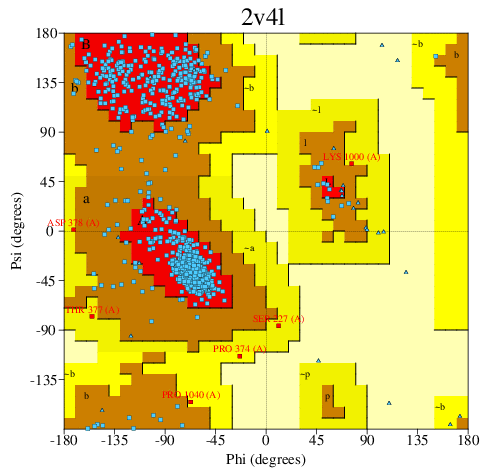
PDBsum entry 2v4l
|
|
|
|
References listed in PDB file
|
 |
|
Key reference
|
|
|
Title
|
|
Targeted polypharmacology: discovery of dual inhibitors of tyrosine and phosphoinositide kinases.
|
|
|
Authors
|
|
B.Apsel,
J.A.Blair,
B.Gonzalez,
T.M.Nazif,
M.E.Feldman,
B.Aizenstein,
R.Hoffman,
R.L.Williams,
K.M.Shokat,
Z.A.Knight.
|
|
|
Ref.
|
|
Nat Chem Biol, 2008,
4,
691-699.
[DOI no: ]
|
|
|
PubMed id
|
|
|
|
|
Note In the PDB file this reference is
annotated as "TO BE PUBLISHED".
The citation details given above were identified by an automated
search of PubMed on title and author
names, giving a
perfect match.
|
|
|
|
Abstract
|
|
|
The clinical success of multitargeted kinase inhibitors has stimulated efforts
to identify promiscuous drugs with optimal selectivity profiles. It remains
unclear to what extent such drugs can be rationally designed, particularly for
combinations of targets that are structurally divergent. Here we report the
systematic discovery of molecules that potently inhibit both tyrosine kinases
and phosphatidylinositol-3-OH kinases, two protein families that are among the
most intensely pursued cancer drug targets. Through iterative chemical
synthesis, X-ray crystallography and kinome-level biochemical profiling, we
identified compounds that inhibit a spectrum of new target combinations in these
two families. Crystal structures revealed that the dual selectivity of these
molecules is controlled by a hydrophobic pocket conserved in both enzyme classes
and accessible through a rotatable bond in the drug skeleton. We show that one
compound, PP121, blocks the proliferation of tumor cells by direct inhibition of
oncogenic tyrosine kinases and phosphatidylinositol-3-OH kinases. These
molecules demonstrate the feasibility of accessing a chemical space that
intersects two families of oncogenes.
|
|
|
|

|
|

|
|
Figure 2.
(a) Experimental strategy for the discovery of dual
inhibitors, and IC[50] values (  M)
for 8 molecules tested against 14 tyrosine kinases and PI(3)Ks
(10 M
ATP). IC[50] values less than 0.1 M
are shaded red. Pyrazolopyrimidine N4 and N5, which make
hydrogen bonds to the kinase, are labeled. (b) Percentage
inhibition of 84 tyrosine kinases (right) and 135
serine-threonine kinases (left) by 7 inhibitors from this study
(right columns) and 5 reference compounds (left columns). PP
inhibitors were tested at 1 M
drug and, typically, 10 M
ATP. Data from the Invitrogen SelectScreen assay. (c) Principal
component analysis of the target selectivity of 172
pyrazolopyrimidine inhibitors and 8 reference compounds. Key
compounds are labeled. M)
for 8 molecules tested against 14 tyrosine kinases and PI(3)Ks
(10 M
ATP). IC[50] values less than 0.1 M
are shaded red. Pyrazolopyrimidine N4 and N5, which make
hydrogen bonds to the kinase, are labeled. (b) Percentage
inhibition of 84 tyrosine kinases (right) and 135
serine-threonine kinases (left) by 7 inhibitors from this study
(right columns) and 5 reference compounds (left columns). PP
inhibitors were tested at 1 M
drug and, typically, 10 M
ATP. Data from the Invitrogen SelectScreen assay. (c) Principal
component analysis of the target selectivity of 172
pyrazolopyrimidine inhibitors and 8 reference compounds. Key
compounds are labeled.
|
|
Figure 4.
(a) Correlation between IC[50] values for inhibitors against
Src (x axis) and either Hck or the gatekeeper mutant Src T338I
(y axis). (b) Binding orientation of S1 relative to ATP in c-Src
(top) and p110  (bottom).
(c) Overlay of cocrystal structures of inhibitors bound to c-Src
(protein colored red, drugs orange: S1, PP102, PP121 and PP494)
and p110 (protein
blue, compounds gray: S1 and S2). The gatekeeper residues Thr338
(c-Src) and Ile879 (p110 )
are highlighted. (d) Top, the catalytic lysine (Lys295) makes a
hydrogen bond to Glu310 in active c-Src. Center, helix C and
Glu310 are disordered in c-Src structures containing PP102.
Bottom, PP121 makes a hydrogen bond to Glu310 and orders helix C
when bound to c-Src. (bottom).
(c) Overlay of cocrystal structures of inhibitors bound to c-Src
(protein colored red, drugs orange: S1, PP102, PP121 and PP494)
and p110 (protein
blue, compounds gray: S1 and S2). The gatekeeper residues Thr338
(c-Src) and Ile879 (p110 )
are highlighted. (d) Top, the catalytic lysine (Lys295) makes a
hydrogen bond to Glu310 in active c-Src. Center, helix C and
Glu310 are disordered in c-Src structures containing PP102.
Bottom, PP121 makes a hydrogen bond to Glu310 and orders helix C
when bound to c-Src.
|
|
|
|
|
|
The above figures are
reprinted
by permission from Macmillan Publishers Ltd:
Nat Chem Biol
(2008,
4,
691-699)
copyright 2008.
|
|
|
|
|
|
|