|
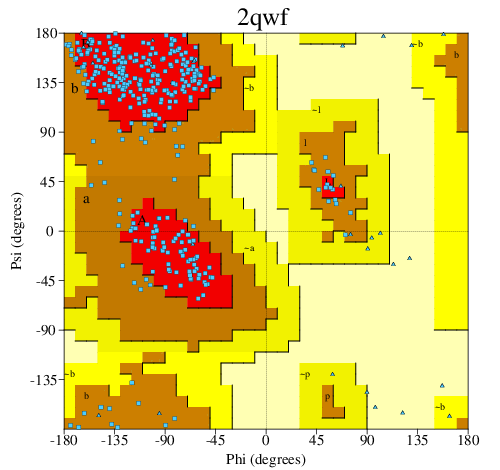
PDBsum entry 2qwf
|
|
|
|
References listed in PDB file
|
 |
|
Key reference
|
|
|
Title
|
|
Drug design against a shifting target: a structural basis for resistance to inhibitors in a variant of influenza virus neuraminidase.
|
|
|
Authors
|
|
J.N.Varghese,
P.W.Smith,
S.L.Sollis,
T.J.Blick,
A.Sahasrabudhe,
J.L.Mckimm-Breschkin,
P.M.Colman.
|
|
|
Ref.
|
|
Structure, 1998,
6,
735-746.
[DOI no: ]
|
|
|
PubMed id
|
|
|
|
|
|
Abstract
|
|
|
BACKGROUND: Inhibitors of the influenza virus neuraminidase have been shown to
be effective antiviral agents in humans. Several studies have reported the
selection of novel influenza strains when the virus is cultured with
neuraminidase inhibitors in vitro. These resistant viruses have mutations either
in the neuraminidase or in the viral haemagglutinin. Inhibitors in which the
glycerol sidechain at position 6 of 2-deoxy-2,3-dehydro-N-acetylneuraminic acid
(Neu5Ac2en) has been replaced by carboxamide-linked hydrophobic substituents
have recently been reported and shown to select neuraminidase variants. This
study seeks to clarify the structural and functional consequences of replacing
the glycerol sidechain of the inhibitor with other chemical constituents.
RESULTS: The neuraminidase variant Arg292-->Lys is modified in one of three
arginine residues that encircle the carboxylate group of the substrate. The
structure of this variant in complex with the carboxamide inhibitor used for its
selection, and with other Neu5Ac2en analogues, is reported here at high
resolution. The structural consequences of the mutation correlate with altered
inhibitory activity of the compounds compared with wild-type neuraminidase.
CONCLUSIONS: The Arg292-->Lys variant of influenza neuraminidase affects the
binding of substrate by modification of the interaction with the substrate
carboxylate. This may be one of the structural correlates of the reduced enzyme
activity of the variant. Inhibitors that have replacements for the glycerol at
position 6 are further affected in the Arg292-->Lys variant because of
structural changes in the binding site that apparently raise the energy barrier
for the conformational change in the enzyme required to accommodate such
inhibitors. These results provide evidence that a general strategy for drug
design when the target has a high mutation frequency is to design the inhibitor
to be as closely related as possible to the natural ligands of the target.
|
|
|
|

|
|
Figure 1.
Figure 1. The chemical structures of influenza
neuraminidase inhibitors: 1, sialic acid (N-acetylneuraminic
acid (Neu5Ac)); 2, 2-deoxy-2,3-dehydro-N-acetylneuraminic acid
(Neu5Ac2en); 3, 4-amino-Neu5Ac2en; 4, Zanamivir,
4-guanidino-Neu5Ac2en; 5,
5-N-acetyl-4-guanidino-6-methyl(propyl)
carboxamide-4,5-dihydro-2H-pyran-2-carboxylic acid; 6,
5-N-acetyl-4-amino-6-diethyl
carboxamide-4,5-dihydro-2H-pyran-2-carboxylic acid; and 7,
GS4071,
4-N-acetyl-5-amino-3-(1-ethylpropoxy)-1-cyclohexene-1-carboxylic
acid.
|
|
|
|
|
|
The above figure is
reprinted
by permission from Cell Press:
Structure
(1998,
6,
735-746)
copyright 1998.
|
|
|
Secondary reference #1
|
|
|
Title
|
|
Mutations in a conserved residue in the influenza virus neuraminidase active site decreases sensitivity to neu5ac2en-Derived inhibitors.
|
|
|
Authors
|
|
J.L.Mckimm-Breschkin,
A.Sahasrabudhe,
T.J.Blick,
M.Mcdonald,
P.M.Colman,
G.J.Hart,
R.C.Bethell,
J.N.Varghese.
|
|
|
Ref.
|
|
J Virol, 1998,
72,
2456-2462.
|
|
|
PubMed id
|
|
|
|
|
|
|
|
|
|
|
|
|