|
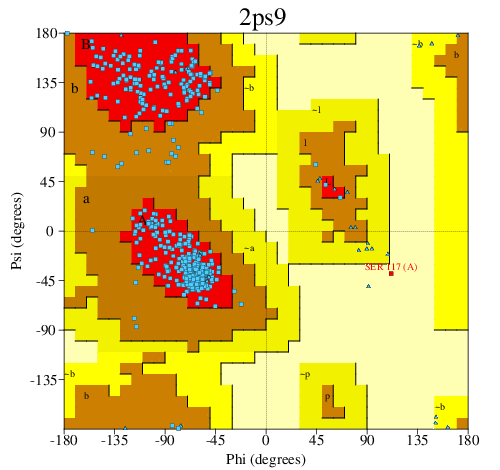
PDBsum entry 2ps9

|
|
|
|
|
|

|
|

|
|

|
|

|
|

|
|

|
|

|
|

|
|
|
 |

|

|
|
|
|
|
|
|
|
|
|
|
|
|
|
|
|
|
|
|
|
|
|
|
|
|
|
|
|
|
|
|
|
|
Metal transport
|
PDB id
|
|
|
|
2ps9
|
|
|
|
|
|
|
|
|
|
|
|
|
|
|

|

|

|
|
|
|
|
|
References listed in PDB file
|
|
|
Key reference
|
|
|
Title
|
|
Structure and metal binding properties of znua, A periplasmic zinc transporter from escherichia coli.
|
|
|
Authors
|
|
L.A.Yatsunyk,
J.A.Easton,
L.R.Kim,
S.A.Sugarbaker,
B.Bennett,
R.M.Breece,
I.I.Vorontsov,
D.L.Tierney,
M.W.Crowder,
A.C.Rosenzweig.
|
|
|
Ref.
|
|
J Biol Inorg Chem, 2008,
13,
271-288.
|
|
|
PubMed id
|
|
|
|
|
|
|
|
|
Abstract
|
|
|
ZnuA is the periplasmic Zn(2+)-binding protein associated with the high-affinity
ATP-binding cassette ZnuABC transporter from Escherichia coli. Although several
structures of ZnuA and its homologs have been determined, details regarding
metal ion stoichiometry, affinity, and specificity as well as the mechanism of
metal uptake and transfer remain unclear. The crystal structures of E. coli ZnuA
(Eco-ZnuA) in the apo, Zn(2+)-bound, and Co(2+)-bound forms have been
determined. ZnZnuA binds at least two metal ions. The first, observed previously
in other structures, is coordinated tetrahedrally by Glu59, His60, His143, and
His207. Replacement of Zn(2+) with Co(2+) results in almost identical
coordination geometry at this site. The second metal binding site involves
His224 and several yet to be identified residues from the His-rich loop that is
unique to Zn(2+) periplasmic metal binding receptors. Electron paramagnetic
resonance and X-ray absorption spectroscopic data on CoZnuA provide additional
insight into possible residues involved in this second site. The second site is
also detected by metal analysis and circular dichroism (CD) titrations. Eco-ZnuA
binds Zn(2+) (estimated K (d) < 20 nM), Co(2+), Ni(2+), Cu(2+), Cu(+), and
Cd(2+), but not Mn(2+). Finally, conformational changes upon metal binding
observed in the crystal structures together with fluorescence and CD data
indicate that only Zn(2+) substantially stabilizes ZnuA and might facilitate
recognition of ZnuB and subsequent metal transfer.
|
|
|
|
|
|
|