
|
|
|
|
|
 |
Contents |
 |
|
|
|
|
|
|
|
|
|
|
|

 128 a.a.
|
|
|
|
|
|
|
|
|
|
|

 93 a.a.
|
|
|
|
|
|
|
|
|
|
|

 324 a.a.
|
|
|
|
|
|
|
|
|
|
|
* Residue conservation analysis
|
|
|
|
|
|
PDB id:
|
|
|
|
| Name: |
|
Transferase
|
|
|
Title:
|
|
Crystal structure of the adenylate sensor from amp-activated protein kinase complexed with amp
|
|
Structure:
|
|
Snf1-like protein kinase ssp2. Chain: a, c. Fragment: c-terminal domain: residues 440-576. Engineered: yes. Spcc1919.03c protein. Chain: b, d. Fragment: c-terminal domain: residues 203-298. Engineered: yes. Hypothetical protein c1556.08c in chromosome i.
|
|
Source:
|
|
Schizosaccharomyces pombe. Fission yeast. Organism_taxid: 4896. Strain: 972. Atcc: 38366. Gene: ssp2, spcc74.03c. Expressed in: escherichia coli bl21(de3). Expression_system_taxid: 469008. Gene: spcc1919.03c.
|
|
Resolution:
|
|
|
2.60Å
|
R-factor:
|
0.210
|
R-free:
|
0.273
|
|
|
Authors:
|
|
R.Townley,L.Shapiro
|
Key ref:

|
|
R.Townley
and
L.Shapiro
(2007).
Crystal structures of the adenylate sensor from fission yeast AMP-activated protein kinase.
Science,
315,
1726-1729.
PubMed id:
DOI:

|
|
|
Date:
|
|
|
26-Jan-07
|
Release date:
|
06-Feb-07
|
|
|
|
|
|
|
PROCHECK
|

|
|
|
|
|
Headers
|
|
|
|
References
|
|
|
|
|
|

|
|
O74536
(SNF1_SCHPO) -
SNF1-like protein kinase ssp2 from Schizosaccharomyces pombe (strain 972 / ATCC 24843)
|
|
|
|
Seq:
Struc:
|
|
|
|
576 a.a.
128 a.a.
|
|

|

|
|
|
|
|
|
|
|
|
|
|
|
|
|
|
|
|
|
Enzyme class:
|
|
Chains A, C:
E.C.2.7.11.1
- non-specific serine/threonine protein kinase.
|
|
|
|
|
|
|
Reaction:
|
|
|
1.
|
L-seryl-[protein] + ATP = O-phospho-L-seryl-[protein] + ADP + H+
|
|
2.
|
L-threonyl-[protein] + ATP = O-phospho-L-threonyl-[protein] + ADP + H+
|
|
|
|
|
|
|
L-seryl-[protein]
|
+
|
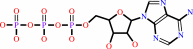 ATP
ATP
|
=
|
O-phospho-L-seryl-[protein]
Bound ligand (Het Group name = )
matches with 85.19% similarity
|
+
|
 ADP
ADP
|
+
|
H(+)
|
|
|
|
|
|
|
L-threonyl-[protein]
|
+
|
ATP
|
=
|
O-phospho-L-threonyl-[protein]
Bound ligand (Het Group name = )
matches with 85.19% similarity
|
+
|
ADP
|
+
|
H(+)
|
|
|
|
|
|
|
|
|
|
|
|
|
Molecule diagrams generated from .mol files obtained from the
KEGG ftp site
|
|
|
|
|
|
|
|
|
|
|
|
|
|
 |
|
|
|
|
|
|
| |
|
|
| |
|
DOI no:
|
Science
315:1726-1729
(2007)
|
|
PubMed id:
|
|
|
|
|
|
| |
|
Crystal structures of the adenylate sensor from fission yeast AMP-activated protein kinase.
|
|
R.Townley,
L.Shapiro.
|
|
|
|
|
| |
ABSTRACT
|
|
|
|
| |
|
|
The 5'-AMP (adenosine monophosphate)-activated protein kinase (AMPK) coordinates
metabolic function with energy availability by responding to changes in
intracellular ATP (adenosine triphosphate) and AMP concentrations. Here, we
report crystal structures at 2.9 and 2.6 A resolution for ATP- and AMP-bound
forms of a core alphabetagamma adenylate-binding domain from the fission yeast
AMPK homolog. ATP and AMP bind competitively to a single site in the gamma
subunit, with their respective phosphate groups positioned near
function-impairing mutants. Unexpectedly, ATP binds without counterions,
amplifying its electrostatic effects on a critical regulatory region where all
three subunits converge.
|
|
|
|
|
|
| |
Selected figure(s)
|
|
|
|
| |
|
|

|
|

|
|
Figure 1.
Fig. 1. Overall structure of the adenylate binding region from
S. pombe AMPK with bound AMP. The ATP-bound form is nearly
identical (fig. S6) and reveals no global structural changes
attributable to nucleotide identity. (A) Ribbon diagram of a
single heterotrimer, with  , ß, and , ß, and
 subunits colored
yellow, blue, and green, respectively. The single molecule of
bound AMP is shown in CPK representation, and connections to the
GBD and KD at the N-termini of the ß and subunits,
respectively, are indicated. (B) View rotated 90°,
highlighting the adenylate binding entrance (AXP) and phosphate
binding tunnel, which is capped on the putative KD-interaction
surface by a polar flap from the ß subunit. The structure
corresponds to a heterotrimer defined by limited proteolysis, as
indicated in (C): hatched regions were excluded. Each of the two
crystal forms reported here includes a dimer of trimers in the
asymmetric unit (D). Analytical ultracentrifugation analysis
also demonstrates a dimer of trimers configuration. subunits colored
yellow, blue, and green, respectively. The single molecule of
bound AMP is shown in CPK representation, and connections to the
GBD and KD at the N-termini of the ß and subunits,
respectively, are indicated. (B) View rotated 90°,
highlighting the adenylate binding entrance (AXP) and phosphate
binding tunnel, which is capped on the putative KD-interaction
surface by a polar flap from the ß subunit. The structure
corresponds to a heterotrimer defined by limited proteolysis, as
indicated in (C): hatched regions were excluded. Each of the two
crystal forms reported here includes a dimer of trimers in the
asymmetric unit (D). Analytical ultracentrifugation analysis
also demonstrates a dimer of trimers configuration.
|
|
Figure 3.
Fig. 3. [(A) and (B)] Functional mutations map within the
phosphate binding tunnel, a large internal cavity that traverses
the subunit, shown in
red. The majority of known function-impairing mutants map to the
surface of this tunnel, positioned between the terminal
phosphate of the bound nucleotide and the putative
kinase-binding face. Two orthogonal views are shown.
|
|
|
|
|
|
| |
The above figures are
reprinted
by permission from the AAAs:
Science
(2007,
315,
1726-1729)
copyright 2007.
|
|
| |
Figures were
selected
by the author.
|
|
|
|
|
|
|
|
|
|
|
|
|
|
|
|
 |
 |
 |
|
Literature references that cite this PDB file's key reference
|
|
|
| |
PubMed id
|
|
Reference
|
|
|
|
|
|
D.G.Hardie,
F.A.Ross,
and
S.A.Hawley
(2012).
AMPK: a nutrient and energy sensor that maintains energy homeostasis.
|
| |
Nat Rev Mol Cell Biol,
13,
251-262.
|
|
|
|
|
|
|
L.Chen,
J.Wang,
Y.Y.Zhang,
S.F.Yan,
D.Neumann,
U.Schlattner,
Z.X.Wang,
and
J.W.Wu
(2012).
AMP-activated protein kinase undergoes nucleotide-dependent conformational changes.
|
| |
Nat Struct Mol Biol,
19,
716-718.
|
|
|
PDB codes:
|
|
|
|
|
|
|
|
J.Jämsen,
H.Tuominen,
A.A.Baykov,
and
R.Lahti
(2011).
Mutational analysis of residues in the regulatory CBS domains of Moorella thermoacetica pyrophosphatase corresponding to disease-related residues of human proteins.
|
| |
Biochem J,
433,
497-504.
|
|
|
|
|
|
|
L.A.Martínez-Cruz,
J.A.Encinar,
P.Sevilla,
I.Oyenarte,
I.Gómez-García,
D.Aguado-Llera,
F.García-Blanco,
J.Gómez,
and
J.L.Neira
(2011).
Nucleotide-induced conformational transitions in the CBS domain protein MJ0729 of Methanocaldococcus jannaschii.
|
| |
Protein Eng Des Sel,
24,
161-169.
|
|
|
|
|
|
|
L.Zhu,
L.Chen,
X.M.Zhou,
Y.Y.Zhang,
Y.J.Zhang,
J.Zhao,
S.R.Ji,
J.W.Wu,
and
Y.Wu
(2011).
Structural insights into the architecture and allostery of full-length AMP-activated protein kinase.
|
| |
Structure,
19,
515-522.
|
|
|
|
|
|
|
N.Handa,
T.Takagi,
S.Saijo,
S.Kishishita,
D.Takaya,
M.Toyama,
T.Terada,
M.Shirouzu,
A.Suzuki,
S.Lee,
T.Yamauchi,
M.Okada-Iwabu,
M.Iwabu,
T.Kadowaki,
Y.Minokoshi,
and
S.Yokoyama
(2011).
Structural basis for compound C inhibition of the human AMP-activated protein kinase α2 subunit kinase domain.
|
| |
Acta Crystallogr D Biol Crystallogr,
67,
480-487.
|
|
|
PDB codes:
|
|
|
|
|
|
|
|
B.Viollet,
S.Horman,
J.Leclerc,
L.Lantier,
M.Foretz,
M.Billaud,
S.Giri,
and
F.Andreelli
(2010).
AMPK inhibition in health and disease.
|
| |
Crit Rev Biochem Mol Biol,
45,
276-295.
|
|
|
|
|
|
|
C.Moffat,
and
M.Ellen Harper
(2010).
Metabolic functions of AMPK: aspects of structure and of natural mutations in the regulatory gamma subunits.
|
| |
IUBMB Life,
62,
739-745.
|
|
|
|
|
|
|
J.A.Zorn,
and
J.A.Wells
(2010).
Turning enzymes ON with small molecules.
|
| |
Nat Chem Biol,
6,
179-188.
|
|
|
|
|
|
|
J.S.Oakhill,
Z.P.Chen,
J.W.Scott,
R.Steel,
L.A.Castelli,
N.Ling,
S.L.Macaulay,
and
B.E.Kemp
(2010).
β-Subunit myristoylation is the gatekeeper for initiating metabolic stress sensing by AMP-activated protein kinase (AMPK).
|
| |
Proc Natl Acad Sci U S A,
107,
19237-19241.
|
|
|
|
|
|
|
J.Zhang,
G.Vemuri,
and
J.Nielsen
(2010).
Systems biology of energy homeostasis in yeast.
|
| |
Curr Opin Microbiol,
13,
382-388.
|
|
|
|
|
|
|
J.Zheng,
and
Z.Jia
(2010).
Structure of the bifunctional isocitrate dehydrogenase kinase/phosphatase.
|
| |
Nature,
465,
961-965.
|
|
|
PDB codes:
|
|
|
|
|
|
|
|
K.Moravcevic,
J.M.Mendrola,
K.R.Schmitz,
Y.H.Wang,
D.Slochower,
P.A.Janmey,
and
M.A.Lemmon
(2010).
Kinase associated-1 domains drive MARK/PAR1 kinases to membrane targets by binding acidic phospholipids.
|
| |
Cell,
143,
966-977.
|
|
|
PDB codes:
|
|
|
|
|
|
|
|
N.Dzamko,
B.J.van Denderen,
A.L.Hevener,
S.B.Jørgensen,
J.Honeyman,
S.Galic,
Z.P.Chen,
M.J.Watt,
D.J.Campbell,
G.R.Steinberg,
and
B.E.Kemp
(2010).
AMPK beta1 deletion reduces appetite, preventing obesity and hepatic insulin resistance.
|
| |
J Biol Chem,
285,
115-122.
|
|
|
|
|
|
|
Z.Wang,
X.Wang,
K.Qu,
P.Zhu,
N.Guo,
R.Zhang,
Z.Abliz,
H.Yu,
and
H.Zhu
(2010).
Binding of cordycepin monophosphate to AMP-activated protein kinase and its effect on AMP-activated protein kinase activation.
|
| |
Chem Biol Drug Des,
76,
340-344.
|
|
|
|
|
|
|
A.De Angeli,
O.Moran,
S.Wege,
S.Filleur,
G.Ephritikhine,
S.Thomine,
H.Barbier-Brygoo,
and
F.Gambale
(2009).
ATP binding to the C terminus of the Arabidopsis thaliana nitrate/proton antiporter, AtCLCa, regulates nitrate transport into plant vacuoles.
|
| |
J Biol Chem,
284,
26526-26532.
|
|
|
|
|
|
|
A.E.Roux,
A.Leroux,
M.A.Alaamery,
C.S.Hoffman,
P.Chartrand,
G.Ferbeyre,
and
L.A.Rokeach
(2009).
Pro-aging effects of glucose signaling through a G protein-coupled glucose receptor in fission yeast.
|
| |
PLoS Genet,
5,
e1000408.
|
|
|
|
|
|
|
A.McBride,
S.Ghilagaber,
A.Nikolaev,
and
D.G.Hardie
(2009).
The glycogen-binding domain on the AMPK beta subunit allows the kinase to act as a glycogen sensor.
|
| |
Cell Metab,
9,
23-34.
|
|
|
|
|
|
|
B.B.Zhang,
G.Zhou,
and
C.Li
(2009).
AMPK: an emerging drug target for diabetes and the metabolic syndrome.
|
| |
Cell Metab,
9,
407-416.
|
|
|
|
|
|
|
J.S.Oakhill,
J.W.Scott,
and
B.E.Kemp
(2009).
Structure and function of AMP-activated protein kinase.
|
| |
Acta Physiol (Oxf),
196,
3.
|
|
|
|
|
|
|
L.Chen,
Z.H.Jiao,
L.S.Zheng,
Y.Y.Zhang,
S.T.Xie,
Z.X.Wang,
and
J.W.Wu
(2009).
Structural insight into the autoinhibition mechanism of AMP-activated protein kinase.
|
| |
Nature,
459,
1146-1149.
|
|
|
PDB codes:
|
|
|
|
|
|
|
|
M.Pimkin,
J.Pimkina,
and
G.D.Markham
(2009).
A regulatory role of the Bateman domain of IMP dehydrogenase in adenylate nucleotide biosynthesis.
|
| |
J Biol Chem,
284,
7960-7969.
|
|
|
|
|
|
|
R.Scholz,
M.Suter,
T.Weimann,
C.Polge,
P.V.Konarev,
R.F.Thali,
R.D.Tuerk,
B.Viollet,
T.Wallimann,
U.Schlattner,
and
D.Neumann
(2009).
Homo-oligomerization and activation of AMP-activated protein kinase are mediated by the kinase domain alphaG-helix.
|
| |
J Biol Chem,
284,
27425-27437.
|
|
|
|
|
|
|
B.C.Jeong,
K.S.Yoo,
K.W.Jung,
J.S.Shin,
and
H.K.Song
(2008).
Purification, crystallization and preliminary X-ray diffraction analysis of a cystathionine beta-synthase domain-containing protein, CDCP2, from Arabidopsis thaliana.
|
| |
Acta Crystallogr Sect F Struct Biol Cryst Commun,
64,
825-827.
|
|
|
|
|
|
|
J.Qi,
J.Gong,
T.Zhao,
J.Zhao,
P.Lam,
J.Ye,
J.Z.Li,
J.Wu,
H.M.Zhou,
and
P.Li
(2008).
Downregulation of AMP-activated protein kinase by Cidea-mediated ubiquitination and degradation in brown adipose tissue.
|
| |
EMBO J,
27,
1537-1548.
|
|
|
|
|
|
|
J.S.Burg,
D.W.Powell,
R.Chai,
A.L.Hughes,
A.J.Link,
and
P.J.Espenshade
(2008).
Insig regulates HMG-CoA reductase by controlling enzyme phosphorylation in fission yeast.
|
| |
Cell Metab,
8,
522-531.
|
|
|
|
|
|
|
J.W.Scott,
B.J.van Denderen,
S.B.Jorgensen,
J.E.Honeyman,
G.R.Steinberg,
J.S.Oakhill,
T.J.Iseli,
A.Koay,
P.R.Gooley,
D.Stapleton,
and
B.E.Kemp
(2008).
Thienopyridone drugs are selective activators of AMP-activated protein kinase beta1-containing complexes.
|
| |
Chem Biol,
15,
1220-1230.
|
|
|
|
|
|
|
L.J.Reichling,
S.M.Riddle,
B.Mei,
R.Bruinsma,
T.A.Goossens,
K.G.Huwiler,
M.Maffitt,
A.M.Newport,
X.D.Qian,
C.Ruttimann-Johnson,
and
K.W.Vogel
(2008).
Homogenous fluorescent assays for characterizing small-molecule activators of AMP-activated protein kinase (AMPK).
|
| |
Curr Chem Genomics,
1,
34-42.
|
|
|
|
|
|
|
M.Lucas,
D.Kortazar,
E.Astigarraga,
J.A.Fernández,
J.M.Mato,
M.L.Martínez-Chantar,
and
L.A.Martínez-Cruz
(2008).
Purification, crystallization and preliminary X-ray diffraction analysis of the CBS-domain pair from the Methanococcus jannaschii protein MJ0100.
|
| |
Acta Crystallogr Sect F Struct Biol Cryst Commun,
64,
936-941.
|
|
|
|
|
|
|
M.Momcilovic,
S.H.Iram,
Y.Liu,
and
M.Carlson
(2008).
Roles of the glycogen-binding domain and Snf4 in glucose inhibition of SNF1 protein kinase.
|
| |
J Biol Chem,
283,
19521-19529.
|
|
|
|
|
|
|
M.Pimkin,
and
G.D.Markham
(2008).
The CBS subdomain of inosine 5'-monophosphate dehydrogenase regulates purine nucleotide turnover.
|
| |
Mol Microbiol,
68,
342-359.
|
|
|
|
|
|
|
M.Proudfoot,
S.A.Sanders,
A.Singer,
R.Zhang,
G.Brown,
A.Binkowski,
L.Xu,
J.A.Lukin,
A.G.Murzin,
A.Joachimiak,
C.H.Arrowsmith,
A.M.Edwards,
A.V.Savchenko,
and
A.F.Yakunin
(2008).
Biochemical and structural characterization of a novel family of cystathionine beta-synthase domain proteins fused to a Zn ribbon-like domain.
|
| |
J Mol Biol,
375,
301-315.
|
|
|
PDB codes:
|
|
|
|
|
|
|
|
N.P.King,
T.M.Lee,
M.R.Sawaya,
D.Cascio,
and
T.O.Yeates
(2008).
Structures and functional implications of an AMP-binding cystathionine beta-synthase domain protein from a hyperthermophilic archaeon.
|
| |
J Mol Biol,
380,
181-192.
|
|
|
PDB codes:
|
|
|
|
|
|
|
|
P.Fernández-Millán,
D.Kortazar,
M.Lucas,
M.L.Martínez-Chantar,
E.Astigarraga,
J.A.Fernández,
O.Sabas,
A.Albert,
J.M.Mato,
and
L.A.Martínez-Cruz
(2008).
Crystallization and preliminary crystallographic analysis of merohedrally twinned crystals of MJ0729, a CBS-domain protein from Methanococcus jannaschii.
|
| |
Acta Crystallogr Sect F Struct Biol Cryst Commun,
64,
605-609.
|
|
|
|
|
|
|
S.Zaman,
S.I.Lippman,
X.Zhao,
and
J.R.Broach
(2008).
How Saccharomyces responds to nutrients.
|
| |
Annu Rev Genet,
42,
27-81.
|
|
|
|
|
|
|
T.Williams,
and
J.E.Brenman
(2008).
LKB1 and AMPK in cell polarity and division.
|
| |
Trends Cell Biol,
18,
193-198.
|
|
|
|
|
|
|
B.E.Kemp,
J.S.Oakhill,
and
J.W.Scott
(2007).
AMPK structure and regulation from three angles.
|
| |
Structure,
15,
1161-1163.
|
|
|
|
|
|
|
B.Xiao,
R.Heath,
P.Saiu,
F.C.Leiper,
P.Leone,
C.Jing,
P.A.Walker,
L.Haire,
J.F.Eccleston,
C.T.Davis,
S.R.Martin,
D.Carling,
and
S.J.Gamblin
(2007).
Structural basis for AMP binding to mammalian AMP-activated protein kinase.
|
| |
Nature,
449,
496-500.
|
|
|
PDB codes:
|
|
|
|
|
|
|
|
D.G.Hardie
(2007).
AMPK and SNF1: Snuffing Out Stress.
|
| |
Cell Metab,
6,
339-340.
|
|
|
|
|
|
|
D.G.Hardie
(2007).
AMP-activated/SNF1 protein kinases: conserved guardians of cellular energy.
|
| |
Nat Rev Mol Cell Biol,
8,
774-785.
|
|
|
|
|
|
|
G.A.Amodeo,
M.J.Rudolph,
and
L.Tong
(2007).
Crystal structure of the heterotrimer core of Saccharomyces cerevisiae AMPK homologue SNF1.
|
| |
Nature,
449,
492-495.
|
|
|
PDB code:
|
|
|
|
|
|
|
|
K.Lindgren,
M.Ormestad,
M.Persson,
S.Martinsson,
L.T.Svensson,
and
M.Mahlapuu
(2007).
Regulation of the muscle-specific AMP-activated protein kinase alpha2beta2gamma3 complexes by AMP and implications of the mutations in the gamma3-subunit for the AMP dependence of the enzyme.
|
| |
FEBS J,
274,
2887-2896.
|
|
|
|
|
|
|
S.Markovic,
and
R.Dutzler
(2007).
The structure of the cytoplasmic domain of the chloride channel ClC-Ka reveals a conserved interaction interface.
|
| |
Structure,
15,
715-725.
|
|
|
PDB code:
|
|
|
|
|
|
|
|
X.Jin,
R.Townley,
and
L.Shapiro
(2007).
Structural insight into AMPK regulation: ADP comes into play.
|
| |
Structure,
15,
1285-1295.
|
|
|
PDB codes:
|
|
|
|
|
|
|
The most recent references are shown first.
Citation data come partly from CiteXplore and partly
from an automated harvesting procedure. Note that this is likely to be
only a partial list as not all journals are covered by
either method. However, we are continually building up the citation data
so more and more references will be included with time.
Where a reference describes a PDB structure, the PDB
codes are
shown on the right.
|
 |
|


 Links
Links


