 |
PDBsum entry 2o4c

|
|
|
|
|
|

|

|

|

|
|

|
|

|
|

|
|

|
|

|
|
|
 |

|

|
|
|
|
|
|
|
|
|
|
|
|
|
|
|
|
|
|
|
|
|
|
|
|
|
|
|
|
|
|
|
|
|
|
Oxidoreductase
|
PDB id
|
|
|
|
2o4c
|
|
|
|
|
|
|
|
|
|
|
|
|
|
|

|

|

|
|
|
|
|
|
|
|
 |
Contents |
 |
|
|
|
|
|
|
|
|
|
|
|
|
* Residue conservation analysis
|
|
|
|
|
|
PDB id:
|
|
|
|
| Name: |
|
Oxidoreductase
|
|
|
Title:
|
|
Crystal structure of d-erythronate-4-phosphate dehydrogenase complexed with NAD
|
|
Structure:
|
|
Erythronate-4-phosphate dehydrogenase. Chain: a, b. Engineered: yes
|
|
Source:
|
|
Pseudomonas aeruginosa. Organism_taxid: 287. Strain: pao1. Gene: pa1375, pdxb. Expressed in: escherichia coli. Expression_system_taxid: 562.
|
|
Resolution:
|
|
|
2.30Å
|
R-factor:
|
0.229
|
R-free:
|
0.259
|
|
|
Authors:
|
|
J.Y.Ha,J.H.Lee,K.H.Kim,D.J.Kim,H.H.Lee,H.K.Kim,H.J.Yoon,S.W.Suh
|
Key ref:

|
|
J.Y.Ha
et al.
(2007).
Crystal Structure of d-Erythronate-4-phosphate Dehydrogenase Complexed with NAD.
J Mol Biol,
366,
1294-1304.
PubMed id:
DOI:

|
|
|
Date:
|
|
|
04-Dec-06
|
Release date:
|
20-Feb-07
|
|
|
|
|
|
|
PROCHECK
|

|
|
|
|
|
Headers
|
|
|
|
References
|
|
|
|
|
|

|
|
Q9I3W9
(PDXB_PSEAE) -
Erythronate-4-phosphate dehydrogenase from Pseudomonas aeruginosa (strain ATCC 15692 / DSM 22644 / CIP 104116 / JCM 14847 / LMG 12228 / 1C / PRS 101 / PAO1)
|
|
|
|
Seq:
Struc:
|
|
|
|
380 a.a.
380 a.a.
|
|

|

|

|
|
|
|
|
|
|
|
|
|
|
Key: |
 |
PfamA domain |
|
|
 |
Secondary structure |
|
 |
CATH domain |
|
|
|
|
|
|
|
|
|
|
|
|
|
Enzyme class:
|
|
E.C.1.1.1.290
- 4-phosphoerythronate dehydrogenase.
|
|
|
|
|
|
|
Reaction:
|
|
4-phospho-D-erythronate + NAD+ = (R)-3-hydroxy-2-oxo-4- phosphooxybutanoate + NADH + H+
|
|
|
|
|
|
4-phospho-D-erythronate
Bound ligand (Het Group name = )
matches with 64.29% similarity
|
+
|
NAD(+)
Bound ligand (Het Group name = )
corresponds exactly
|
=
|
(R)-3-hydroxy-2-oxo-4- phosphooxybutanoate
|
+
|
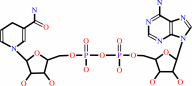 NADH
NADH
|
+
|
H(+)
|
|
|
|
|
|
|
|
|
|
Cofactor:
|
|
NAD(+)
|
|
|
|
|
|
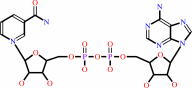 NAD(+)
|
|
|
|
|
|
|
Molecule diagrams generated from .mol files obtained from the
KEGG ftp site
|
|
|
|
|
|
|
|
|
|
|
|
|
|
 |
|
|
|
|
|
|
| |
|
|
| |
|
DOI no:
|
J Mol Biol
366:1294-1304
(2007)
|
|
PubMed id:
|
|
|
|
|
|
| |
|
Crystal Structure of d-Erythronate-4-phosphate Dehydrogenase Complexed with NAD.
|
|
J.Y.Ha,
J.H.Lee,
K.H.Kim,
d.o. .J.Kim,
H.H.Lee,
H.K.Kim,
H.J.Yoon,
S.W.Suh.
|
|
|
|
|
| |
ABSTRACT
|
|
|
|
| |
|
|
Pyridoxal-5'-phosphate (the active form of vitamin B6) is an essential cofactor
in many enzymatic reactions. While animals lack any of the pathways for de novo
synthesis and salvage of vitamin B6, it is synthesized by two distinct
biosynthetic routes in bacteria, fungi, parasites, and plants. One of them is
the PdxA/PdxJ pathway found in the gamma subdivision of proteobacteria. It
depends on the pdxB gene, which encodes erythronate-4-phosphate dehydrogenase
(PdxB), a member of the d-isomer specific 2-hydroxyacid dehydrogenase
superfamily. Although three-dimensional structures of other functionally related
dehydrogenases are available, no structure of PdxB has been reported. To provide
the missing structural information and to gain insights into the catalytic
mechanism, we have determined the first crystal structure of
erythronate-4-phosphate dehydrogenase from Pseudomonas aeruginosa in the
ligand-bound state. It is a homodimeric enzyme consisting of 380-residue
subunits. Each subunit consists of three structural domains: the lid domain, the
nucleotide-binding domain, and the C-terminal dimerization domain. The latter
domain has a unique fold and is largely responsible for dimerization.
Interestingly, two subunits of the dimeric enzyme are bound with different
combinations of ligands in the crystal and they display significantly different
conformations. Subunit A is bound with NAD and a phosphate ion, while subunit B,
with a more open active site cleft, is bound with NAD and l(+)-tartrate. Our
structural data allow a detailed understanding of cofactor and substrate
recognition, thus providing substantial insights into PdxB catalysis.
|
|
|
|
|
|
| |
Selected figure(s)
|
|
|
|
| |
|
|

|
|

|
|
Figure 4.
Figure 4. Conformational difference between subunits A and B of
P. aeruginosa PdxB. Stereo surface view of (a) subunit A and
(b) subunit B. Stereo view of (c) subunit A, Ile67 and Arg208
are shown in spheres and NAD is shown in sticks, and (d) subunit
B, Ile67 and Arg208 are shown in spheres and NAD is shown in
sticks. (e) Displacement of Ile67 and Arg208 upon binding
l(+)-tartrate. Pink and violet indicate subunits A and B,
respectively. Figure 4. Conformational difference between
subunits A and B of P. aeruginosa PdxB. Stereo surface view of
(a) subunit A and (b) subunit B. Stereo view of (c) subunit A,
Ile67 and Arg208 are shown in spheres and NAD is shown in
sticks, and (d) subunit B, Ile67 and Arg208 are shown in spheres
and NAD is shown in sticks. (e) Displacement of Ile67 and Arg208
upon binding l(+)-tartrate. Pink and violet indicate subunits A
and B, respectively.
|
|
Figure 5.
Figure 5. A proposed model for the substrate binding to P.
aeruginosa PdxB. (a) Chemical structures of l(+)-tartrate and
d-erythronate-4-phosphate. (b) Modeled binding of
d-erythronate-4-phosphate to P. aeruginosa PdxB. Arg208, Glu237,
and His254 in this Figure constitute the catalytic triad in P.
aeruginosa PdxB. Figure 5. A proposed model for the substrate
binding to P. aeruginosa PdxB. (a) Chemical structures of
l(+)-tartrate and d-erythronate-4-phosphate. (b) Modeled binding
of d-erythronate-4-phosphate to P. aeruginosa PdxB. Arg208,
Glu237, and His254 in this Figure constitute the catalytic triad
in P. aeruginosa PdxB.
|
|
|
|
|
|
| |
The above figures are
reprinted
by permission from Elsevier:
J Mol Biol
(2007,
366,
1294-1304)
copyright 2007.
|
|
| |
Figures were
selected
by an automated process.
|
|
|
|
|
|
|
|
|
|
|
|
|
|
|
|
 |
 |
 |
|
Literature references that cite this PDB file's key reference
|
|
|
| |
PubMed id
|
|
Reference
|
|
|
|
|
|
V.Janiak,
M.Petersen,
M.Zentgraf,
G.Klebe,
and
A.Heine
(2010).
Structure and substrate docking of a hydroxy(phenyl)pyruvate reductase from the higher plant Coleus blumei Benth.
|
| |
Acta Crystallogr D Biol Crystallogr,
66,
593-603.
|
|
|
PDB code:
|
|
|
|
|
|
|
|
E.J.Drake,
and
A.M.Gulick
(2008).
Three-dimensional structures of Pseudomonas aeruginosa PvcA and PvcB, two proteins involved in the synthesis of 2-isocyano-6,7-dihydroxycoumarin.
|
| |
J Mol Biol,
384,
193-205.
|
|
|
PDB codes:
|
|
|
|
|
|
|
|
G.N.Parkinson,
D.Vines,
P.C.Driscoll,
and
S.Djordjevic
(2008).
Crystal structures of PI3K-C2alpha PX domain indicate conformational change associated with ligand binding.
|
| |
BMC Struct Biol,
8,
13.
|
|
|
PDB codes:
|
|
|
|
|
|
|
|
Y.Wada,
S.Iwai,
Y.Tamura,
T.Ando,
T.Shinoda,
K.Arai,
and
H.Taguchi
(2008).
A new family of D-2-hydroxyacid dehydrogenases that comprises D-mandelate dehydrogenases and 2-ketopantoate reductases.
|
| |
Biosci Biotechnol Biochem,
72,
1087-1094.
|
|
|
|
|
|
|
D.E.Scott,
A.Ciulli,
and
C.Abell
(2007).
Coenzyme biosynthesis: enzyme mechanism, structure and inhibition.
|
| |
Nat Prod Rep,
24,
1009-1026.
|
|
|
|
|
|
The most recent references are shown first.
Citation data come partly from CiteXplore and partly
from an automated harvesting procedure. Note that this is likely to be
only a partial list as not all journals are covered by
either method. However, we are continually building up the citation data
so more and more references will be included with time.
Where a reference describes a PDB structure, the PDB
code is
shown on the right.
|
|


 Links
Links


