|
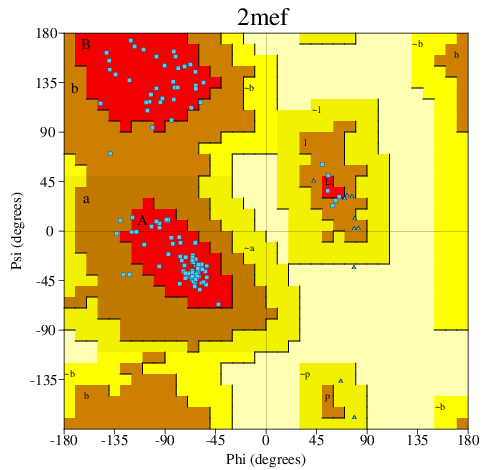
PDBsum entry 2mef
|
|
|
|
References listed in PDB file
|
 |
|
Key reference
|
|
|
Title
|
|
Contribution of amino acid substitutions at two different interior positions to the conformational stability of human lysozyme.
|
|
|
Authors
|
|
J.Funahashi,
K.Takano,
Y.Yamagata,
K.Yutani.
|
|
|
Ref.
|
|
Protein Eng, 1999,
12,
841-850.
|
|
|
PubMed id
|
|
|
|
|
Note: In the PDB file this reference is
annotated as "TO BE PUBLISHED". The citation details given above have
been manually determined.
|
|
|
|
Abstract
|
|
|
To elucidate correlative relationships between structural change and
thermodynamic stability in proteins, a series of mutant human lysozymes modified
at two buried positions (Ile56 and Ile59) were examined. Their thermodynamic
parameters of denaturation and crystal structures were studied by calorimetry
and X-ray crystallography. The mutants at positions 56 and 59 exhibited
different responses to a series of amino acid substitutions. The changes in
stability due to substitutions showed a linear correlation with changes in
hydrophobicity of substituted residues, having different slopes at each mutation
site. However, the stability of each mutant was found to be represented by a
unique equation involving physical properties calculated from mutant structures.
By fitting present and previous stability data for mutant human lysozymes
substituted at various positions to the equation, the magnitudes of the
hydrophobicity of a carbon atom and the hydrophobicity of nitrogen and neutral
oxygen atoms were found to be 0.178 and -0.013 kJ/mol.A(2), respectively. It was
also found that the contribution of a hydrogen bond with a length of 3.0 A to
protein stability was 5.1 kJ/mol and the entropy loss of newly introduction of a
water molecules was 7.8 kJ/mol.
|
|
|
Secondary reference #1
|
|
|
Title
|
|
Contribution of hydrogen bonds to the conformational stability of human lysozyme: calorimetry and X-Ray analysis of six tyrosine --≫ phenylalanine mutants.
|
|
|
Authors
|
|
Y.Yamagata,
M.Kubota,
Y.Sumikawa,
J.Funahashi,
K.Takano,
S.Fujii,
K.Yutani.
|
|
|
Ref.
|
|
Biochemistry, 1998,
37,
9355-9362.
[DOI no: ]
|
|
|
PubMed id
|
|
|
|
|
Note In the PDB file this reference is
annotated as "TO BE PUBLISHED".
The citation details given above were identified by an automated
search of PubMed on title and author
names, giving a
percentage match of
90%.
|
|
|
|
|
|
|
Secondary reference #2
|
|
|
Title
|
|
Contribution of the hydrophobic effect to the stability of human lysozyme: calorimetric studies and X-Ray structural analyses of the nine valine to alanine mutants.
|
|
|
Authors
|
|
K.Takano,
Y.Yamagata,
S.Fujii,
K.Yutani.
|
|
|
Ref.
|
|
Biochemistry, 1997,
36,
688-698.
[DOI no: ]
|
|
|
PubMed id
|
|
|
|
|
|
|
|
|
Secondary reference #3
|
|
|
Title
|
|
Contribution of water molecules in the interior of a protein to the conformational stability.
|
|
|
Authors
|
|
K.Takano,
J.Funahashi,
Y.Yamagata,
S.Fujii,
K.Yutani.
|
|
|
Ref.
|
|
J Mol Biol, 1997,
274,
132-142.
[DOI no: ]
|
|
|
PubMed id
|
|
|
|
|
|
|
|
|
|

|
|

|
|
Figure 2.
Figure 2. Structures in the vicinity of the residue 56 in
the wild-type (a) and I56A (b) to (d), and those of the residue
59 in the wild-type (e) and I59A (f). In (c) and (d), dummy
water molecules, which were estimated to be energetically
favorable using the program, X-PLOR [Brunger 1992], are drawn.
The dummy water molecules in (c) and (d) made hydrogen bonds
with O^γ of Ser36 and an internal water molecule, respectively.
The side-chain atoms of the residues 56 and 59, carbon atoms,
oxygen and nitrogen atoms, interior water molecules, introduced
water molecules and the dummy water molecules are represented by
green, yellow, orange, blue, dark blue and purple, respectively.
|
|
Figure 3.
Figure 3. Correlation of ΔΔASA[HP] (changes in
hydrophobic surface area exposed upon denaturation) with ΔΔG
for the mutant proteins with empty cavities (a) and with
solvated cavities (b). The mutants with solvated cavities are
shown as open symbols and labeled. The mutants of the type I are
represented by black filled up-triangles (with empty cavity).
The black continuous line shows the linear regression of the
type I mutants with empty cavity (black filled up-triangles).
The mutants of the type II are represented by blue filled (with
empty cavity) and open (with solvated cavity) circles. The blue
broken line shows the linear regression of the type II mutants
with solvated cavity (blue open circles). The mutants of the
type III are represented by red filled (with empty cavity) and
open (with solvated cavity) squares. The red continuous line
shows the linear regression of the type III mutants with empty
cavity (red filled squares). The red broken line is drawn with
reference to the red continuous line. The ASA values were
calculated using the procedure of [Connolly 1993].
|
|
|
|
|
|
The above figures are
reproduced from the cited reference
with permission from Elsevier
|
|
|
Secondary reference #4
|
|
|
Title
|
|
The structure, Stability, And folding process of amyloidogenic mutant human lysozyme.
|
|
|
Authors
|
|
J.Funahashi,
K.Takano,
K.Ogasahara,
Y.Yamagata,
K.Yutani.
|
|
|
Ref.
|
|
J Biochem (tokyo), 1996,
120,
1216-1223.
|
|
|
PubMed id
|
|
|
|
|
|
|
|
|
Secondary reference #5
|
|
|
Title
|
|
Contribution of hydrophobic residues to the stability of human lysozyme: calorimetric studies and X-Ray structural analysis of the five isoleucine to valine mutants.
|
|
|
Authors
|
|
K.Takano,
K.Ogasahara,
H.Kaneda,
Y.Yamagata,
S.Fujii,
E.Kanaya,
M.Kikuchi,
M.Oobatake,
K.Yutani.
|
|
|
Ref.
|
|
J Mol Biol, 1995,
254,
62-76.
[DOI no: ]
|
|
|
PubMed id
|
|
|
|
|
|
|
|
|
|

|
|

|
|
Figure 2.
Figure 2. Typical excess heat capacity curves of the
mutant human lysozyme (I106V) at pH 2.70 (a), 2.92 (b),
3.04 (c), 3.10 (d), and 3.14 (e). The increments of excess
heat capacity were 10 kJ/mol K.
|
|
Figure 5.
Figure 5. Stereo drawings (Johnson, 1976) showing the mutant structure in the vicinity of the mutation sites. The
wild-type (open bonds) and mutant structures (filled bonds) are superimposed. (a) I23V; (b) I56V; (c) I59V; (d) I89V;
and (e) I106V. Solvent water molecules are drawn as cross-circles. Broken lines indicate hydrogen bonds.
|
|
|
|
|
|
The above figures are
reproduced from the cited reference
with permission from Elsevier
|
|
|
|
|
|
|