|
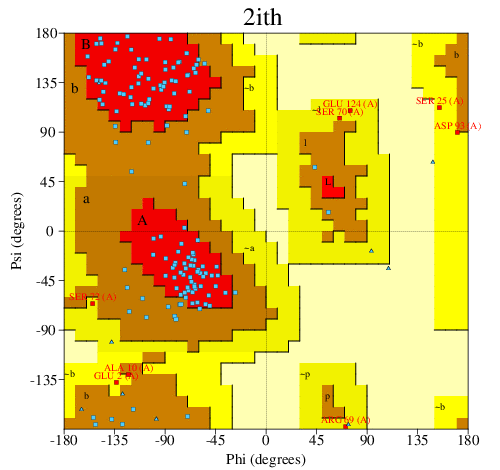
PDBsum entry 2ith

|
|
|
|
|
|

|
|

|
|

|
|

|
|

|
|
|
 |

|

|
|
|
|
|
|
|
|
|
|
|
|
|
|
|
|
|
|
|
|
|
|
|
|
|
|
|
|
|
|
Oxidoreductase
|
PDB id
|
|
|
|
2ith
|
|
|
|
|
|
|
|
|
|
|
|
|
|
|

|

|

|
|
|
|
|
|
References listed in PDB file
|
|
|
Key reference
|
|
|
Title
|
|
Structure in an extreme environment: nmr at high salt.
|
|
|
Authors
|
|
B.Binbuga,
A.F.Boroujerdi,
J.K.Young.
|
|
|
Ref.
|
|
Protein Sci, 2007,
16,
1783-1787.
[DOI no: ]
|
|
|
PubMed id
|
|
|
|
|
|
Abstract
|
|
|
Proteins from halophiles have adapted to challenging environmental conditions
and require salt for their structure and function. How halophilic proteins
adapted to a hypersaline environment is still an intriguing question. It is
important to mimic the physiological conditions of the archae extreme halophiles
when characterizing their enzymes, including structural characterization. The
NMR derived structure of Haloferax volcanii dihydrofolate reductase in 3.5 M
NaCl is presented, and represents the first high salt structure calculated using
NMR data. Structure calculations show that this protein has a solution structure
which is similar to the previously determined crystal structure with a
difference at the N terminus of beta3 and the type of beta-turn connection beta7
and beta8.
|
|
|
|

|
|
Figure 1.
Figure 1. (A) Backbone superimposition of the 20 lowest energy structures of hvDHFR1, and (B) a representative structure generated
|
|
|
|
|
|
The above figure is
reprinted
by permission from the Protein Society:
Protein Sci
(2007,
16,
1783-1787)
copyright 2007.
|
|
|
Secondary reference #1
|
|
|
Title
|
|
1h, 13c and 15n backbone and side chain resonance assignments of haloferax volcanii dhfr1.
|
|
|
Authors
|
|
B.Binbuga,
J.K.Young.
|
|
|
Ref.
|
|
J Biomol Nmr, 2005,
33,
281.
|
|
|
PubMed id
|
|
|
|
|
|
|
|
|
|
|
|
|