|
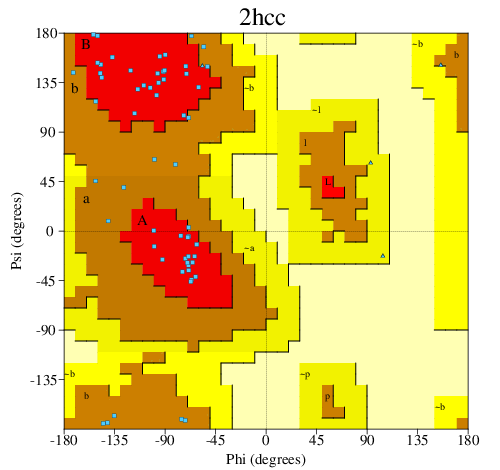
PDBsum entry 2hcc
|
|
|
|
References listed in PDB file
|
 |
|
Key reference
|
|
|
Title
|
|
Solution structure of the human cc chemokine 2: a monomeric representative of the cc chemokine subtype.
|
|
|
Authors
|
|
H.Sticht,
S.E.Escher,
K.Schweimer,
W.G.Forssmann,
P.Rösch,
K.Adermann.
|
|
|
Ref.
|
|
Biochemistry, 1999,
38,
5995-6002.
[DOI no: ]
|
|
|
PubMed id
|
|
|
|
|
|
Abstract
|
|
|
HCC-2, a 66-amino acid residue human CC chemokine, was reported to induce
chemotaxis on monocytes, T-lymphocytes, and eosinophils. The three-dimensional
structure of HCC-2 has been determined by 1H nuclear magnetic resonance (NMR)
spectroscopy and restrained molecular dynamics calculations on the basis of 871
experimental restraints. The structure is well-defined, exhibiting average
root-mean-square deviations of 0.58 and 0.96 A for the backbone heavy atoms and
all heavy atoms of residues 5-63, respectively. In contrast to most other
chemokines, subtle structural differences impede dimer formation of HCC-2 in a
concentration range of 0.1 microM to 2 mM. HCC-2, however, exhibits the same
structural elements as the other chemokines, i.e., a triple-stranded
antiparallel beta-sheet covered by an alpha-helix, showing that the chemokine
fold is not influenced by quaternary interactions. Structural investigations
with a HCC-2 mutant prove that a third additional disulfide bond present in
wild-type HCC-2 is not necessary for maintaining the relative orientation of the
helix and the beta-sheet.
|
|
|
Secondary reference #1
|
|
|
Title
|
|
Hcc-2, A human chemokine: gene structure, Expression pattern, And biological activity.
|
|
|
Authors
|
|
A.Pardigol,
U.Forssmann,
H.D.Zucht,
P.Loetscher,
P.Schulz-Knappe,
M.Baggiolini,
W.G.Forssmann,
H.J.Mägert.
|
|
|
Ref.
|
|
Proc Natl Acad Sci U S A, 1998,
95,
6308-6313.
[DOI no: ]
|
|
|
PubMed id
|
|
|
|
|
|
|
|
|
|

|
|

|
|
Figure 3.
Fig. 3. HCC-2 and HCC-1 expression in tissues. The blots
were sequentially hybridized with 32P-labeled cDNA probes
specific for HCC-2 (Upper) and HCC-1 (Lower). The position of
the RNA markers are indicated. Arrows mark the positions of the
monocistronic (m) and bicistronic (b) HCC-2 and HCC-1
transcripts and an additional, third (t) HCC-1 transcript.
|
|
Figure 5.
Fig. 5. Amino acid sequence of HCC-2 aligned with CK  8, MIP-1 8, MIP-1
 , HCC-1,
and I-309. The cysteines are highlighted by boxes, and identical
amino acids are marked by asterisks. , HCC-1,
and I-309. The cysteines are highlighted by boxes, and identical
amino acids are marked by asterisks.
|
|
|
|
|
|
|
|
|
|